The post outlines using the Evaluation Framework in watsonx Orchestrate ADK to verify AI Agent behavior through a practical example: Galaxium Travels, a fictional booking system. It details setting up the environment, defining user Stories, generating synthetic Test Cases, and running evaluations, crucial for ensuring AI reliability and transparency.
Build, Export & Import a watsonx Orchestrate Agent with the Agent Development Kit (ADK)
This post guides users through building an AI agent locally using the watsonx Orchestrate Agent Development Kit (ADK), exporting it from their local setup, and importing it into a remote instance on IBM Cloud. The process enhances local development while ensuring efficient production deployment.
Create a Full-Screen Web-Chat with watsonx Assistant, IBM Cloud Code Engine and watsonx.ai
The blog post shows integrating watsonx Assistant and watsonx.ai to create a full-screen user interface for interacting with a large language model (LLM) using minimal coding. It outlines the motivation, architecture, setup process, and specific actions necessary to deploy the integration on IBM Cloud Code Engine.
Implementing LangChain AI Agent with WatsonxLLM for a Weather Queries application
This blog post describes the customization of the LangChain AI Agent example from IBM Developer using Watsonx in Python. It demonstrates the implementation of a weather query application with detailed steps. The post offers insight into model parameters, creating prompts, agent chains, tool definitions, and execution. Additionally, it provides links to additional resources for further exploration.
Integrating langchain_ibm with watsonx and LangChain for function calls: Example and Tutorial
The blog post demonstrates using the ChatWatsonx class of langchain_ibm for "function calls" with LangChain and IBM watsonx™ AI. It provides an example of a chat function call for weather information for various cities. The post also includes instructions to set up and run the example. Additional resources and examples are also provided.
How to define a custom Open API specification for a Watson Machine Learning deployment to integrate it into watsonx Assistant
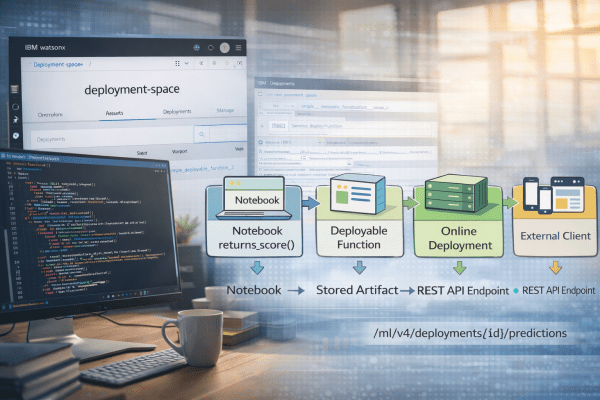
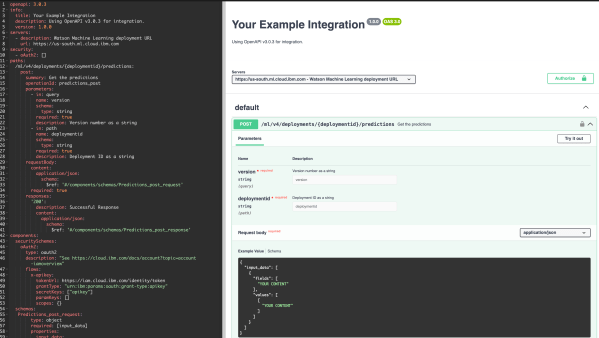
This blog post is about how to define a custom Open API specification` for Watson Machine Learning - IBM Cloud deployment to integrate it into watsonx Assistant. The Watson Machine Learning deployments make it easy for data scientists to write AI Prototypes to be integrated into applications because they can use Jupyter Notebooks and Python they are used to without knowing how to write containers and set up runtimes; they can deploy, and the developers can consume the AI functionalities they have implemented via a REST API.
CheatSheet: How to loop an endpoint of an application running on “IBM Cloud Code Engine” with a bash automation
This blog post is a CheatSheet about how to loop an endpoint of an application running on IBM Cloud Code Engine with a bash automation.
Observe a running pod on IBM Cloud Code Engine with kubectl commands
In IBM Cloud Code Engine you also can use kubectl commands to get information about your running application in addition to the IBM Cloud Code Engine CLI.
Build and push a container image to IBM Cloud Container Registry using bash automation
This extract is from a bash automation script in the question-answering GitHub project. The bash script automates the deployment to IBM Cloud Code Engine. The extraction is about the building and pushing a container to the IBM Cloud Container Registry.
Show the collection IDs of IBM Cloud Watson Discovery projects using cURL
This blog post is a simple example (cheat sheet) of listing the collections for a project in Watson Discovery using cURL and the IBM Cloud Watson Discovery API V2. You can get more details in the IBM Cloud Watson Discovery API documentation. 1. Log on to IBM Cloud ibmcloud login (-sso) REGION=us-south GROUP=default ibmcloud target -r... Continue Reading →