This blog post is related to the blog post DEVELOP A SIMPLE OPERATOR TO DEPLOY A WEB APPLICATION USING THE GO OPERATOR SDK. In that last blog post we addressed the topic get a web frontend application running on Kubernetes using a GO Operator. An important part in that scenario is also, how to manage the clean-up for an application instance and it’s related Kubernetes resources and objects created by the operator based on the Custom Resource Object, or: How to delete services, secrets, and deployments related to a Custom Resource Object in a GO Operator?
Debug a Kubernetes Operator written in GO
In this blog post I want to share how to debug a GO Operator on your local machine on macOS. Adam de Leeuw and I verified it in different GO operator projects. Sometimes you find on Google information which uses the older Operator SDK. The following instructions worked for us in March 2022. 😉
Additional notes related to operator development
This blog post is just a list or let me say this is an addition to my last blog post Let’s get started with the development of operators using the GO SDK "one additional road" to get started with operator development from a more technical perspective.
Connect to a PostgreSQL database, create tables, insert data, and use a file from a GitHub project with GO
This blog post covers the topic connect to a PostgreSQL database, create tables, insert data and use a file from a GitHub project and do the implementation with GO. That blog post is also related to my last blog post called Connect to a PostgreSQL database using GO. You find the related code to my new blog post in that GitHub project.
Connect to a PostgreSQL database using GO
This blog post is related to this good pgx - PostgreSQL Driver and Toolkit that is used to access a PostgresSQL database with GO. My blog post contains minor modifications of an example in that toolkit. You can find the source code related to my blog post in that GitHub project.
Develop a simple operator to deploy a web application using the GO Operator SDK
This blog post is a bigger cheat sheet about how to start with an operator implementation with the GO Operator SDK and also contains some details how to define Kubernetes deployments, secrets, and services.
Let’s get started with the development of operators using the GO SDK
That new blog post is related to start with development of operators using the GO API. I want to point to some resources which are from my personal perspective are an incredible combination to start and I want to highlight some major points which are relevant in that context.
FATA[0009] failed to create API: unable to run post-scaffold tasks of “base.go.kubebuilder.io/v3”: exit status 2
This blog post is about how you could save time, when you are starting to setup your development environment for a GO operator with the Operator SDK on a macOS, in combination with Visual Studio Code.
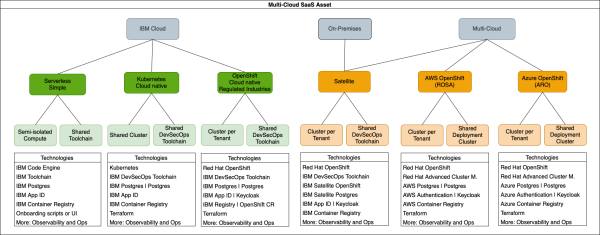
New Open-Source Multi-Cloud Asset to build SaaS
When software is provided as a managed service (SaaS), using a multi-tenant approach helps minimise costs for the deployments and operations of each tenant. In order to leverage these advantages, applications need to be designed so that they can be deployed to support multiple tenants, while maintaining isolation for security reasons. At the same time, common deployment and operation models are required so that new SaaS versions can be deployed to existing tenants, or to onboard new tenants, in a reliable and efficient way.
Instantiation of a Red Hat OpenShift cluster in a Multizone VPC IBM Cloud environment using the free IBM Cloud Schematics (“Terraform as a Service”)
In this blog post we will look at the steps we need to do, when we use IBM Cloud Schematics service with Terraform to instantiate a Red Hat OpenShift cluster in a "Multizone VPC IBM Cloud environment".