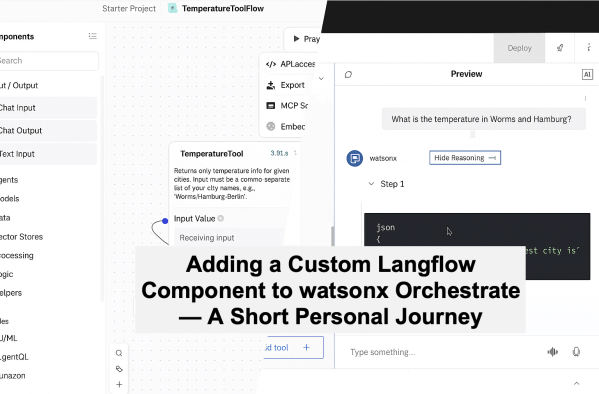
This blog post outlines a practical example of setting up a custom component in Langflow to connect with an external weather API and import it into the watsonx Orchestrate Development Edition. The process emphasizes learning through experimentation rather than achieving a flawless solution, highlighting the potential of Langflow and watsonx Orchestrate for AI development.
It’s All About Risk-Taking: Why “Trustworthy” Beats “Deterministic” in the Era of Agentic AI
This post explores how Generative AI and Agentic AI emphasize trustworthiness over absolute determinism. As AI's role in enterprises evolves, organizations must focus on building reliable systems that operate under risk, balancing innovation with accountability. A personal perspective.
How to Build a Knowledge Graph RAG Agent Locally with Neo4j, LangGraph, and watsonx.ai
The post discusses integrating Knowledge Graphs with Retrieval-Augmented Generation (RAG), specifically using Neo4j and LangGraph. It outlines an example setup where extracted document data forms a structured graph for querying. The system enables natural question-and-answer interactions through AI, enhancing information retrieval with graph relationships and embeddings.
Getting Started with Local AI Agents in the watsonx Orchestrate Development Edition
The blog post outlines the process of setting up the Agent Developer Kit (ADK) to build and run AI agents locally using WatsonX Orchestrate Developer Edition. It involves setting up prerequisites, installing the necessary software, and loading an example agent—optional integration with Langfuse for observability.
Exploring the “AI Operational Complexity Cube idea” for Testing Applications integrating LLMs
The post explores the integration of Large Language Models (LLMs) in applications, stressing the need for effective production testing. It introduces the AI Operational Complexity Cube concept, emphasizing new testing dimensions for LLMs, including prompt testing and user engagement. A structured testing approach is proposed to ensure reliability and robustness.
(outdated) Develop and Deploy Custom AI Agents to watsonx.ai on IBM Cloud
This blog post details the development and deployment of a customizable AI Agent using watsonx.ai. It covers motivations, architecture, and code for a weather query tool, explaining local execution, testing with pytest, and deployment via scripts. The integration with Streamlit UI is emphasized, showcasing seamless deployment processes and enhanced functionality for developers.
Deploying an InstructLab Fine-Tuned Model on IBM watsonx Inference: A SaaS Guide
This blog post explains how to deploy a fine-tuned model to IBM watsonx on IBM Cloud. It highlights the advantages of using this platform, such as avoiding infrastructure management and ensuring enterprise security, as well as detailed steps for configuration, deployment, and accessing the model from IBM watsonx.
How to Install and Configure InstructLab in January 2025 – are there any changes?
This blog post provides updates on the InstructLab project by IBM and Red Hat, detailing installation and configuration changes. It discusses new default locations for files and troubleshooting steps for model serving, emphasizing an overall installation process that remains largely consistent with prior guidance while noting minor user-friendly adjustments.
InstructLab Fine-Tuning Guide: Updates and Insights for the Musician Example
The blog post outlines updates on fine-tuning a model with the InstructLab , detailing tasks like data preparation, validation, synthetic data generation, model training, and testing. It emphasizes the need for extensive and accurate input for effective training, while only minimal changes in the overall process since previous versions, particularly in handling data quality. This blog post contains updates related to my blog post InstructLab and Taxonomy tree: LLM Foundation Model Fine-tuning Guide | Musician Example.
Implementing Independent Bee Agents with TypeScript
This blog post discusses the creation of a custom Bee Agent that operates independently from the Bee Stack and interacts in German. It explores requirements, agent examples, coding in TypeScript, and GitHub references. The author implements an agent using a specific system prompt while addressing the challenges of ensuring consistent output in German.