This post explores how Generative AI and Agentic AI emphasize trustworthiness over absolute determinism. As AI's role in enterprises evolves, organizations must focus on building reliable systems that operate under risk, balancing innovation with accountability. A personal perspective.
How to Build a Knowledge Graph RAG Agent Locally with Neo4j, LangGraph, and watsonx.ai
The post discusses integrating Knowledge Graphs with Retrieval-Augmented Generation (RAG), specifically using Neo4j and LangGraph. It outlines an example setup where extracted document data forms a structured graph for querying. The system enables natural question-and-answer interactions through AI, enhancing information retrieval with graph relationships and embeddings.
Build, Export & Import a watsonx Orchestrate Agent with the Agent Development Kit (ADK)
This post guides users through building an AI agent locally using the watsonx Orchestrate Agent Development Kit (ADK), exporting it from their local setup, and importing it into a remote instance on IBM Cloud. The process enhances local development while ensuring efficient production deployment.
Create Your First AI Agent with Langflow and watsonx
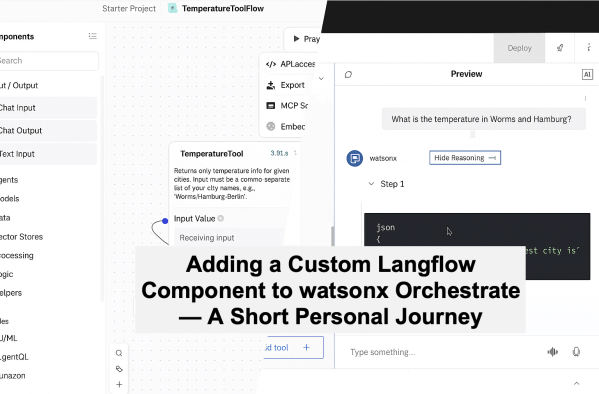
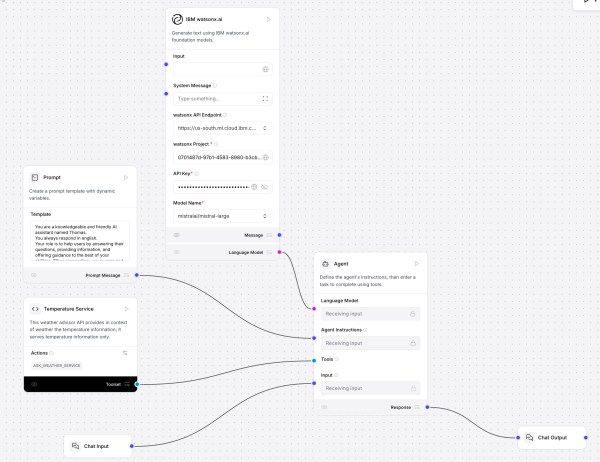
This post shows how to use Langflow with watsonx.ai and a custom component for a “Temperature Service” that fetches and ranks live city temperatures. It covers installation, flow setup, agent prompting, tool integration, and interactive testing. Langflow’s visual design, MCP support, and extensibility offer rapid prototyping; future focus includes DevOps and version control.
Getting Started with Local AI Agents in the watsonx Orchestrate Development Edition
The blog post outlines the process of setting up the Agent Developer Kit (ADK) to build and run AI agents locally using WatsonX Orchestrate Developer Edition. It involves setting up prerequisites, installing the necessary software, and loading an example agent—optional integration with Langfuse for observability.
Exploring the “AI Operational Complexity Cube idea” for Testing Applications integrating LLMs
The post explores the integration of Large Language Models (LLMs) in applications, stressing the need for effective production testing. It introduces the AI Operational Complexity Cube concept, emphasizing new testing dimensions for LLMs, including prompt testing and user engagement. A structured testing approach is proposed to ensure reliability and robustness.
Deploying an InstructLab Fine-Tuned Model on IBM watsonx Inference: A SaaS Guide
This blog post explains how to deploy a fine-tuned model to IBM watsonx on IBM Cloud. It highlights the advantages of using this platform, such as avoiding infrastructure management and ensuring enterprise security, as well as detailed steps for configuration, deployment, and accessing the model from IBM watsonx.
Implementing Independent Bee Agents with TypeScript
This blog post discusses the creation of a custom Bee Agent that operates independently from the Bee Stack and interacts in German. It explores requirements, agent examples, coding in TypeScript, and GitHub references. The author implements an agent using a specific system prompt while addressing the challenges of ensuring consistent output in German.
Simplified Example to build a Web Chat App with watsonx and Streamlit
This blog post describes a web chat application using a large language model on watsonx, with the interface built in Streamlit.io. It focuses on motivation, architecture, code sections, and local setup, featuring basic authentication and options for user interaction. The author highlights Streamlit’s rapid prototyping capabilities and ease of use with Python.
Reflecting on 2024: My Journey Through Innovation, AI, and Development
In 2024, I published 35 blog posts focusing on innovation in AI and development, emphasizing the Bee Agent Framework and IBM's watsonx.ai. The highlights including creating cheat sheets, exploring large language models, and providing practical guides. That boost my excitement for future challenges in 2025.