This blog post explains how to deploy a fine-tuned model to IBM watsonx on IBM Cloud. It highlights the advantages of using this platform, such as avoiding infrastructure management and ensuring enterprise security, as well as detailed steps for configuration, deployment, and accessing the model from IBM watsonx.
InstructLab Fine-Tuning Guide: Updates and Insights for the Musician Example
The blog post outlines updates on fine-tuning a model with the InstructLab , detailing tasks like data preparation, validation, synthetic data generation, model training, and testing. It emphasizes the need for extensive and accurate input for effective training, while only minimal changes in the overall process since previous versions, particularly in handling data quality. This blog post contains updates related to my blog post InstructLab and Taxonomy tree: LLM Foundation Model Fine-tuning Guide | Musician Example.
InstructLab and Taxonomy tree: LLM Foundation Model Fine-tuning Guide | Musician Example
The blog post introduces InstructLab, a project by IBM and Red Hat, outlining the fine-tuning process of the model "MODELS/MERLINITE-7B-LAB-Q4_K_M.GGUF." This involves data preparation, model training, testing, and conversion, finally serving the model to verify its accuracy, by using a personal musician example.
Use IasCable to create a Virtual Private Cloud and a Red Hat OpenShift cluster on IBM Cloud
In that blog post we use the IasCable framework to create a Virtual Private Cloud and a Red Hat OpenShift cluster on IBM Cloud. I covered the starting point for the IasCable framework in my last blog post “Get started with an installable component infrastructure by selecting components from a catalog of available modules with IasCable“
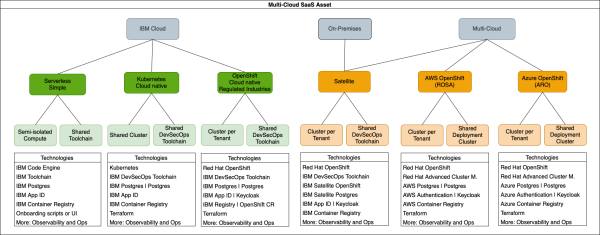
New Open-Source Multi-Cloud Asset to build SaaS
When software is provided as a managed service (SaaS), using a multi-tenant approach helps minimise costs for the deployments and operations of each tenant. In order to leverage these advantages, applications need to be designed so that they can be deployed to support multiple tenants, while maintaining isolation for security reasons. At the same time, common deployment and operation models are required so that new SaaS versions can be deployed to existing tenants, or to onboard new tenants, in a reliable and efficient way.
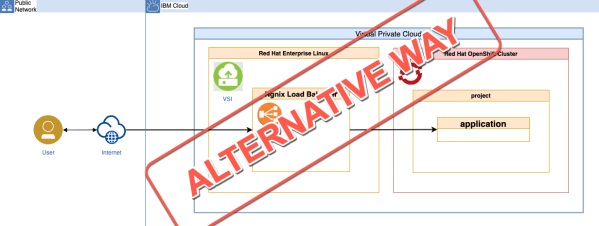
An alternative way for access the example application on OpenShift in VPC
alancer on the Virtual Service Instance (VSI) from the last blog post titled Use a Ngnix load balancer on a VSI to access an application on OpenShift in VPC.
Open the door for root users in Red Hat OpenShift (example Deployment)
This "blog post"/"cheat sheet" is about "Open the door for root users in OpenShift". The topic is in context of an older blog post I wrote called Run a PostgreSQL container as a non-root user in OpenShift. Let's look for the opposite perspective this blog post.