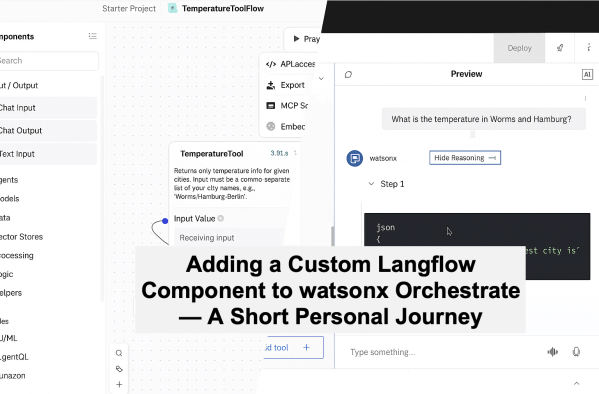
This blog post outlines a practical example of setting up a custom component in Langflow to connect with an external weather API and import it into the watsonx Orchestrate Development Edition. The process emphasizes learning through experimentation rather than achieving a flawless solution, highlighting the potential of Langflow and watsonx Orchestrate for AI development.
Cheat Sheet & Mini-Tutorial: watsonx Orchestrate CLI (for local dev & remote config)
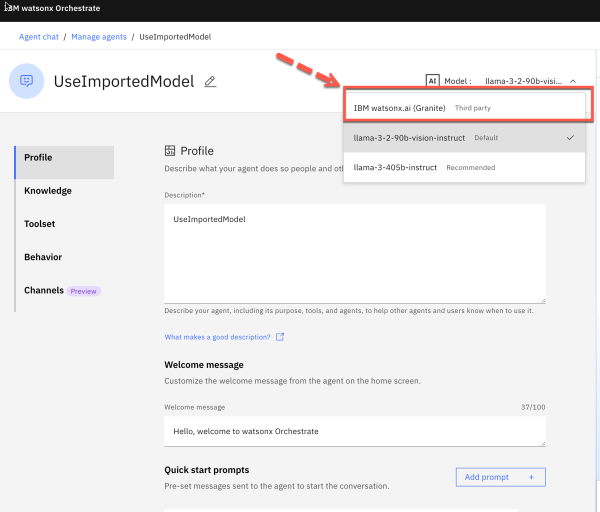
This guide explains the essentials of using the watsonx Orchestrate CLI, covering setup, agents, connections, and loading an IBM watsonx.ai model. It provides a reliable reference for activating environments, managing agents, configuring connections, and importing models, ensuring clarity for users in day-to-day operations.
Testing AI Agents with the watsonx Orchestrate Agent Developer Kit (ADK)- Evaluation Framework – A Hands-on Example
The post outlines using the Evaluation Framework in watsonx Orchestrate ADK to verify AI Agent behavior through a practical example: Galaxium Travels, a fictional booking system. It details setting up the environment, defining user Stories, generating synthetic Test Cases, and running evaluations, crucial for ensuring AI reliability and transparency.
Integrating watsonx Orchestrate Agent Chat in Web Apps
This blog post demonstrates the usage of the web channel functionality in watsonx Orchestrate, enabling the embedding of conversational AI agents into custom web applications. It guides users through setting up a remote environment, generating source code, and running a web server to invoke chat features, emphasizing ease of use and customization options.
REST API Usage with the watsonx Orchestrate Developer Edition locally: An Example
This post outlines the process of setting up a local watsonx Orchestrate server and invoking a simple agent via REST API using Python. It covers environment setup, Bearer token retrieval, agent ID listing, and code execution.
Build, Export & Import a watsonx Orchestrate Agent with the Agent Development Kit (ADK)
This post guides users through building an AI agent locally using the watsonx Orchestrate Agent Development Kit (ADK), exporting it from their local setup, and importing it into a remote instance on IBM Cloud. The process enhances local development while ensuring efficient production deployment.
Getting Started with Local AI Agents in the watsonx Orchestrate Development Edition
The blog post outlines the process of setting up the Agent Developer Kit (ADK) to build and run AI agents locally using WatsonX Orchestrate Developer Edition. It involves setting up prerequisites, installing the necessary software, and loading an example agent—optional integration with Langfuse for observability.
Supercharge Your Support: Example Build & Orchestrate AI Agents with watsonx.ai and watsonx Orchestrate
This post explains how to create, test, and integrate AI support agents using IBM's watsonx.ai and watsonx Orchestrate. It describes an example to integrate a Specialist Support Agent for DB2, into multi-agent orchestration, and highlights best practices for creating efficient agent workflows and accurate responses while anticipating potential complexities.