This post outlines the process of setting up a local watsonx Orchestrate server and invoking a simple agent via REST API using Python. It covers environment setup, Bearer token retrieval, agent ID listing, and code execution.
Build, Export & Import a watsonx Orchestrate Agent with the Agent Development Kit (ADK)
This post guides users through building an AI agent locally using the watsonx Orchestrate Agent Development Kit (ADK), exporting it from their local setup, and importing it into a remote instance on IBM Cloud. The process enhances local development while ensuring efficient production deployment.
Create Your First AI Agent with Langflow and watsonx
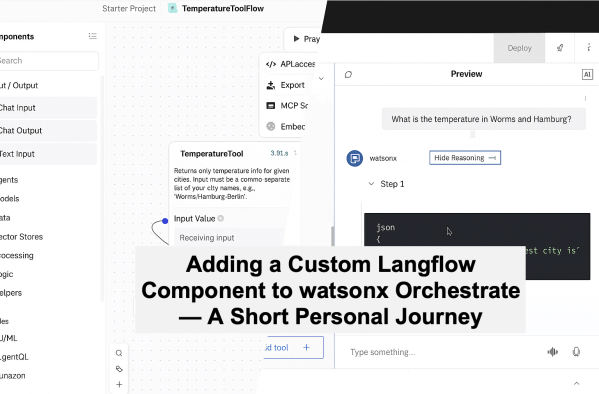
This post shows how to use Langflow with watsonx.ai and a custom component for a “Temperature Service” that fetches and ranks live city temperatures. It covers installation, flow setup, agent prompting, tool integration, and interactive testing. Langflow’s visual design, MCP support, and extensibility offer rapid prototyping; future focus includes DevOps and version control.
Avoid the DCO error for your pull requests in a GitHub repository fork
The content provides a solution for resolving the 'DCO is missing' error encountered when forking a GitHub project. It outlines steps to amend commits with sign-off, including adding a commit-msg hook script. Successfully following these instructions helps ensure that your pull request functions correctly.
Getting Started with Local AI Agents in the watsonx Orchestrate Development Edition
The blog post outlines the process of setting up the Agent Developer Kit (ADK) to build and run AI agents locally using WatsonX Orchestrate Developer Edition. It involves setting up prerequisites, installing the necessary software, and loading an example agent—optional integration with Langfuse for observability.
The Rise of Agentic AI and Managing Expectations
This blog discusses the emergence of agentic AI, capable of planning and executing complex tasks autonomously, contrasting with traditional generative AI. The post emphasizes the importance of managing expectations, oversight, and ensuring transparency due to the unpredictability, including potential hallucinations associated with these systems. LangGraph is highlighted as a powerful tool for developing agentic workflows.
Supercharge Your Support: Example Build & Orchestrate AI Agents with watsonx.ai and watsonx Orchestrate
This post explains how to create, test, and integrate AI support agents using IBM's watsonx.ai and watsonx Orchestrate. It describes an example to integrate a Specialist Support Agent for DB2, into multi-agent orchestration, and highlights best practices for creating efficient agent workflows and accurate responses while anticipating potential complexities.
Exploring the “AI Operational Complexity Cube idea” for Testing Applications integrating LLMs
The post explores the integration of Large Language Models (LLMs) in applications, stressing the need for effective production testing. It introduces the AI Operational Complexity Cube concept, emphasizing new testing dimensions for LLMs, including prompt testing and user engagement. A structured testing approach is proposed to ensure reliability and robustness.
(outdated) Develop and Deploy Custom AI Agents to watsonx.ai on IBM Cloud
This blog post details the development and deployment of a customizable AI Agent using watsonx.ai. It covers motivations, architecture, and code for a weather query tool, explaining local execution, testing with pytest, and deployment via scripts. The integration with Streamlit UI is emphasized, showcasing seamless deployment processes and enhanced functionality for developers.
Deploying an InstructLab Fine-Tuned Model on IBM watsonx Inference: A SaaS Guide
This blog post explains how to deploy a fine-tuned model to IBM watsonx on IBM Cloud. It highlights the advantages of using this platform, such as avoiding infrastructure management and ensuring enterprise security, as well as detailed steps for configuration, deployment, and accessing the model from IBM watsonx.