In this blog post we use an existing template file, that we created for a custom resource to insert the needed value for an URL to point to a container image in a container registry, to create custom resource yaml file we use to deploy that custom resource . The template file contains a string which we will replace with the content of URL to the container image. We haven't used helm, kustomize to do that in this situation.
Simple Helm chart for an UBI container on OpenShift
That blog post is a short cheat sheet to deploy a pure UBI image as a container with Helm. With the values.yaml in the Helm chart we can configure replica count of the pods. The deployed containers are only a basic UBI operating system (Red Hat Universal Base Image).
Deploy a container with a Helm chart
This blog post is a small cheat sheet to deploy and delete the vend application example with a Helm chart in an OpenShift cluster. The related GitHub repository is vend-helm.
Using Multipass to run a tools virtual machine
This blog post is a short cheat sheet related to the setup of a supported environment when you use a tools virtual machine in context for the usage with iascable and the Terraform output.
Create a new GitHub repository based on a template
This blog post is a cheat sheet how to create a new git repository from a GitHub repository template. In that case we use the template-terraform-gitops repository. That repository is a template to build own modules for terraform automations.
One option to setup an app-of-apps example in Argo CD
This blog post is one example “how to setup an app-of-apps pattern in ArgoCD” and is in the context of the blog post How to use a declarative setup for Argo CD to deploy an application using a Helm repository?
How to use a declarative setup for Argo CD to deploy an application using a Helm repository?
In this blog post I will cover the topic, how to use Argo CD - Declarative Setup to deploy an application using Helm repository.
How to deploy an application with Argo CD using a Helm repository
In this blog post I will cover the topic, how to use an existing Helm Chart project and an existing Argo CD instance on OpenShift to deploy an example application. The example application is a Node.js server application I used in several blog posts related to OpenShift. This blog post is in the context of my last blog posts using IasCable and Software Everywhere to setup GitOps. In this last blog post I showed how to setup Red Hat OpenShift and Argo CD and an initial GitOps repository on IBM Cloud and in this blog post we reuse the created environment with IasCable GitOps to create a new application inside Argo CD manually.
Use Software Everywhere and IasCable to setup GitOps on a Red Hat OpenShift Cluster in a Virtual Private Cloud on IBM Cloud
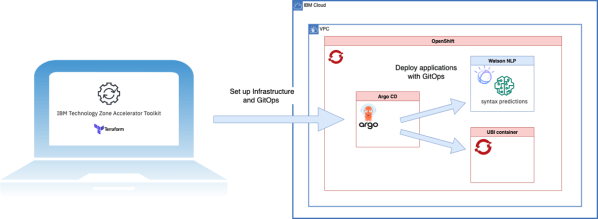
This is a long blog post and the third one related to the Software Everywhere project and IasCable. Our objective in this blog post is to create a customized initial GitOps setup in an IBM Cloud environment. The Software Everywhere project and IasCable CLI do provide an awesome way to eliminate writing Terraform modules for various clouds such as IBM Cloud, AWS or Azure to create and configure resources. We are going to reuse Terraform modules which the Software Everywhere catalog does provide.
Use IasCable to create a Virtual Private Cloud and a Red Hat OpenShift cluster on IBM Cloud
In that blog post we use the IasCable framework to create a Virtual Private Cloud and a Red Hat OpenShift cluster on IBM Cloud. I covered the starting point for the IasCable framework in my last blog post “Get started with an installable component infrastructure by selecting components from a catalog of available modules with IasCable“