This article explores why governance becomes more important as software engineering becomes increasingly automated. It describes the evolution from human-centric development to AI-assisted and agentic engineering, where AI systems no longer only generate code but increasingly participate in engineering decisions. The main argument is that faster software creation does not automatically lead to better software. As AI accelerates implementation, accountability, traceability, reviewability, and human approval become more important. Effective governance allows organizations to use AI capabilities without losing human responsibility. It helps make AI-assisted software engineering more transparent, more reviewable, and more trustworthy.
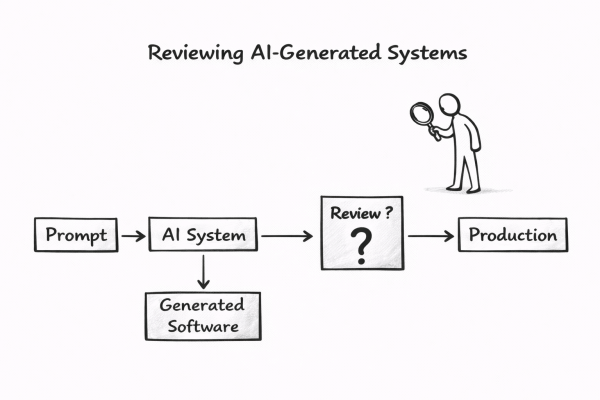
Who Reviews AI-Generated Software?
AI is transforming the software development lifecycle, shifting focus from coding to reviewing AI-generated systems. While AI tools simplify software generation, building trustworthy systems remains complex. Traditional review processes may no longer suffice. This raises a critical question: how can humans responsibly.
AI-Generated Software, Patents, and Global IP Law — A First Deep Dive using AI
The content explores the evolving role of AI in creative processes and its implications for intellectual property (IP) law. It highlights challenges around ownership, patentability, and copyright concerning AI-generated works. As AI advances, existing legal frameworks struggle to keep pace, prompting questions about creativity, innovation, and the need for new regulations.
The Rise of Agentic AI and Managing Expectations
This blog discusses the emergence of agentic AI, capable of planning and executing complex tasks autonomously, contrasting with traditional generative AI. The post emphasizes the importance of managing expectations, oversight, and ensuring transparency due to the unpredictability, including potential hallucinations associated with these systems. LangGraph is highlighted as a powerful tool for developing agentic workflows.