
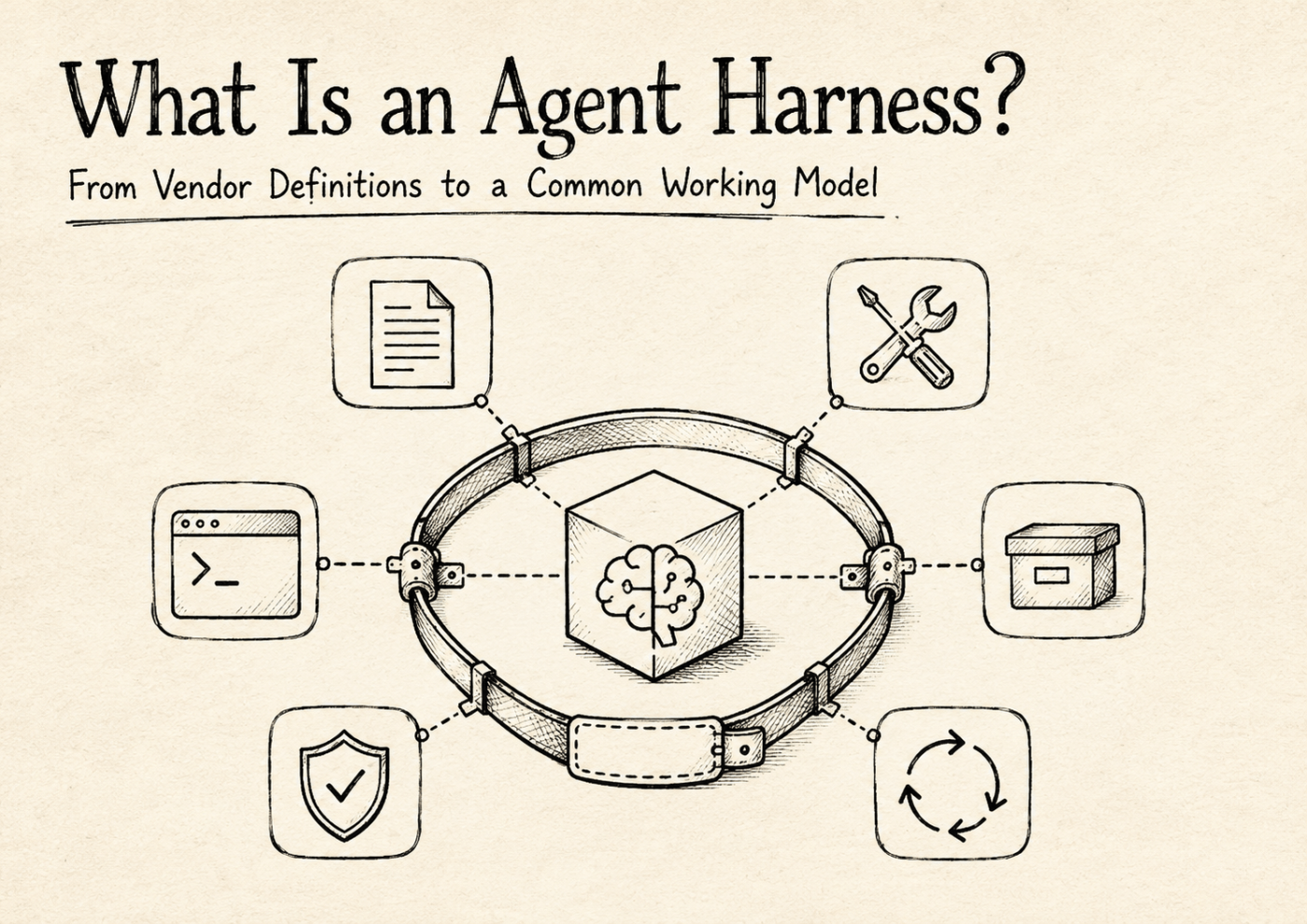
Everyone Talks About Agent Harnesses — But What Exactly Is a Harness?
Over the past few months, I have come across the term agent harness more and more frequently. Is this just another hype word, or does it introduce a useful technical distinction?
OpenAI talks about the Codex harness. IBM describes Bob V2 as one agent and one harness. Google uses the term Antigravity harness. Anthropic describes Claude Code as a flexible agent harness. Microsoft documents an Agent Harness, and Visual Studio Code even calls agent harness an industry term.
At first glance, this sounds simple.
But when I looked more closely, I found that the term is now used across several major AI platforms without being defined in exactly the same way.
So two statements would both be misleading:
There is no definition of an agent harness.
and
There is one generally accepted definition of an agent harness.
Definitions clearly exist. Some are vendor-specific, some describe architectural concepts, and some are increasingly vendor-neutral.
What I could not find is one normative, cross-vendor definition that all vendors officially follow.
This post therefore investigates four questions:
- Is agent harness formally standardized?
- How do vendors use the term?
- Why do we call it a harness rather than simply a framework?
- What common working definition can reasonably be derived from the available evidence?
My research rule is simple:
Source first. Evidence second. Interpretation third.
Don’t want to read? Just listen to the podcast on YouTube.
Table of Contents
- Everyone Talks About Agent Harnesses – But What Exactly Is a Harness?
- Scope and Research Method
- Is “Agent Harness” a Standardized Term?
- Why “Harness”? Why Not “Framework”?
- How Vendors Use the Term
- The Common Functional Core
- My Working Definition
- Why Harnesses Matter Beyond Model Comparisons
- Connection to Engineering Provenance
- Evidence vs. Interpretation
- References
- Research Status
1. Scope and Research Method
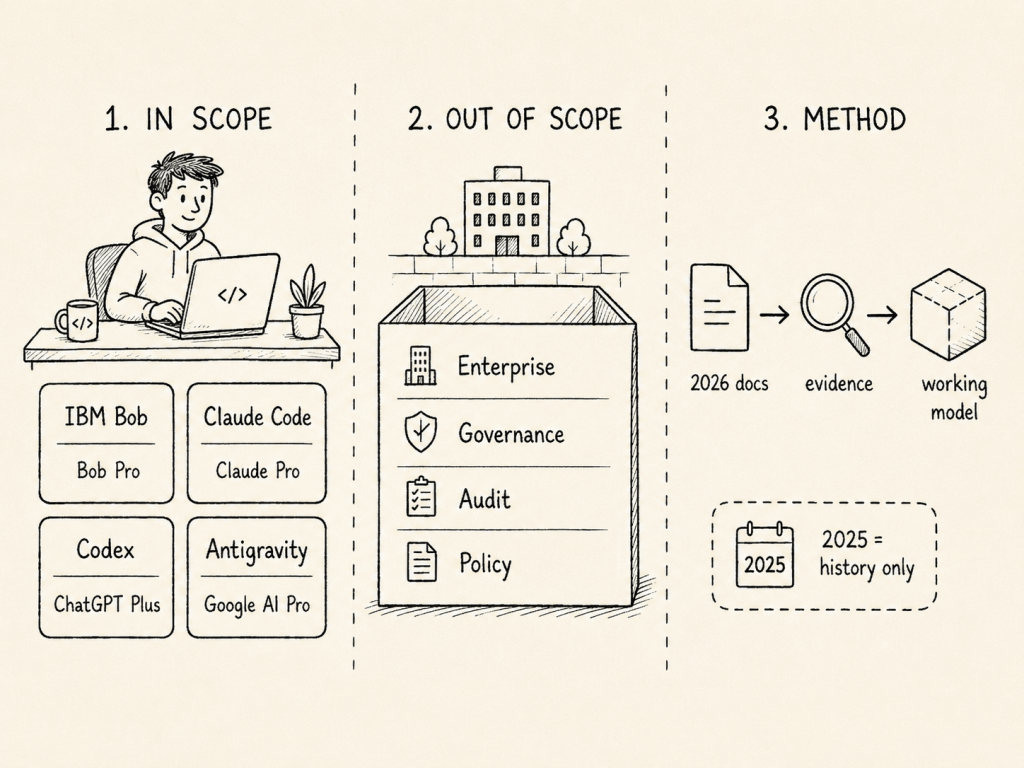
This post is written from the perspective of an individual developer. I work for IBM, but this article reflects my personal analysis and uses the same source-based approach for IBM Bob as for the other products.
I work professionally with AI, but I also use different AI development environments privately. This gives me the opportunity to compare what an individual developer can actually access without relying on enterprise licenses.
To study how the term is used in practice, I focus on four environments:
| Vendor | Environment | Individual plan in scope |
|---|---|---|
| IBM | IBM Bob | Bob Pro |
| Anthropic | Claude Code | Claude Pro |
| OpenAI | Codex | ChatGPT Plus |
| Google Antigravity | Google AI Pro |
The goal is not to create a full product benchmark. The goal is to examine how these environments use harness terminology and what common working model can be derived from that evidence. Enterprise editions are deliberately out of scope because they may include additional governance, security, identity, policy, audit, and contractual capabilities.
These plans are included because they give individual developers direct access to the environments investigated in this article. They should not be interpreted as identical pricing or consumption models.
Because agentic development products change quickly, I mainly use documentation published or updated in 2026, or documentation that is still clearly applicable to the current product.
Older sources are included only where they help explain the development of the terminology.
This is important because the term agent harness did not suddenly appear in 2026. Anthropic, for example, was already using harness terminology in 2025.
My 2026 baseline therefore describes the current product landscape, not the origin of the word.
2. Is “Agent Harness” a Standardized Term?
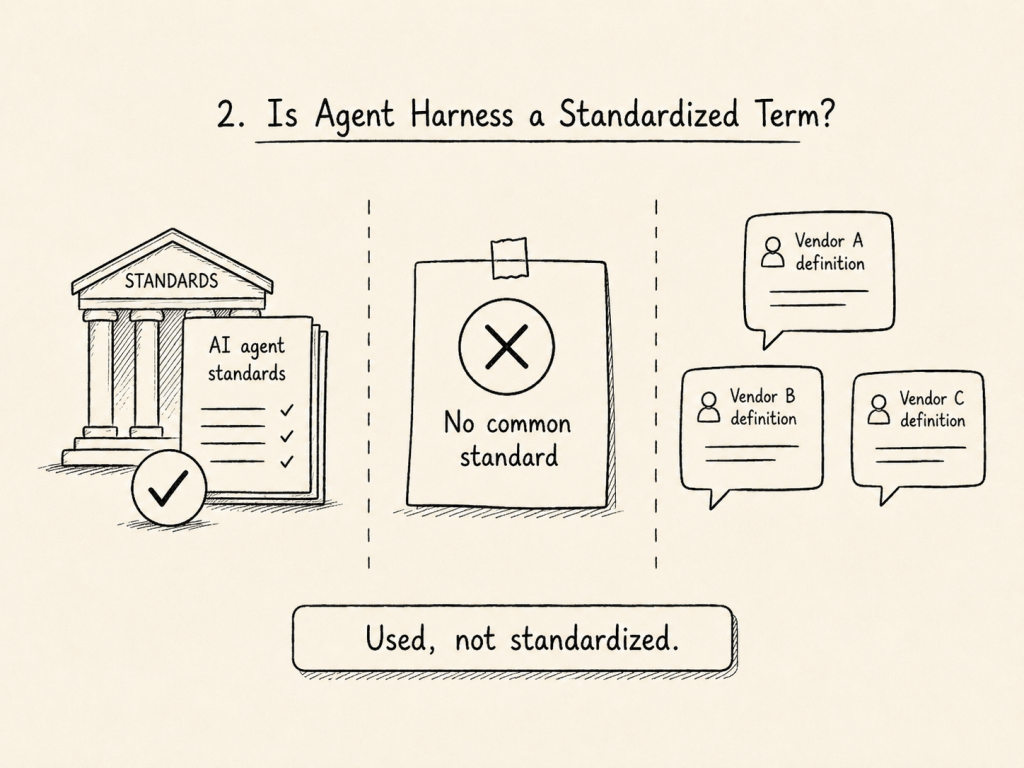
Short answer: not in the sense of one normative definition that all vendors follow.
NIST announced the AI Agent Standards Initiative in February 2026. Its work covers areas including agent interoperability, security, identity, authorization, and protocols.
However, I found no evidence that NIST has standardized the term agent harness itself. At the same time, the opposite statement would also be incorrect. It is not true that nobody defines what an agent harness is.
- Microsoft describes an agent harness as:
“the runtime scaffolding that turns a language model into an agent that can perform work.”
- Visual Studio Code goes further and states:
“Agent harness is the industry term for the software that coordinates an agent.”
This gives us an important distinction:
Standards work around AI agents exists.
But:
I found no normative cross-vendor standard for the term agent harness.
Definitions exist without one common formal standard.
3. Why “Harness”? Why Not “Framework”?
While researching this topic, another question kept coming back to me:
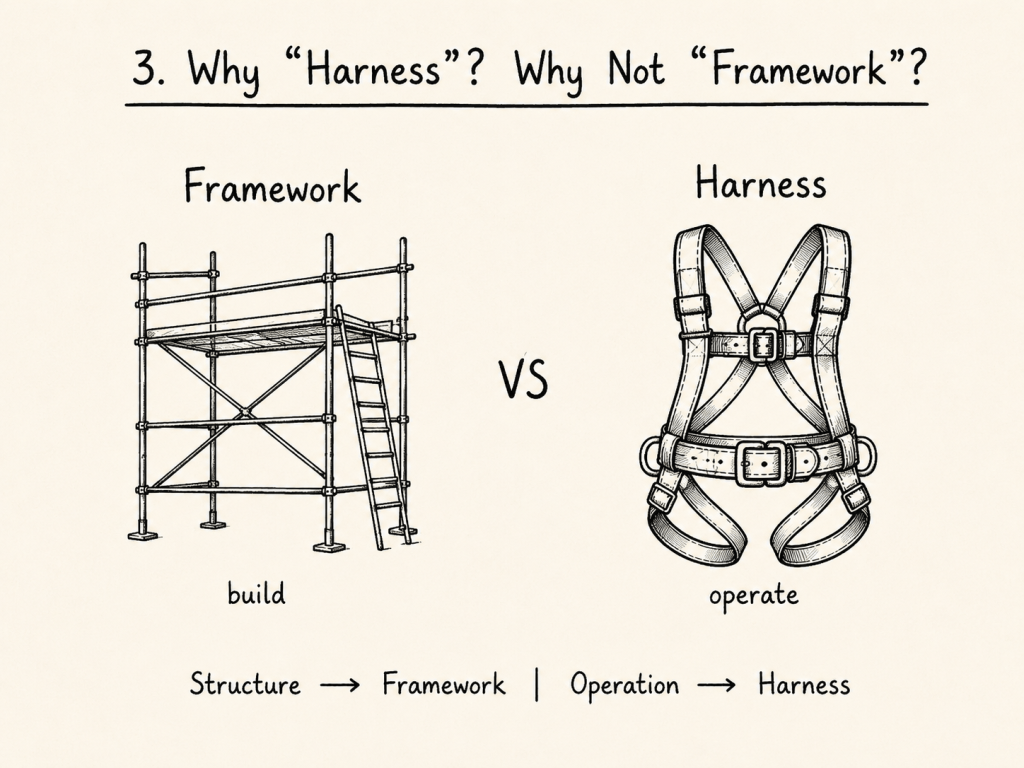
Why did we need the word harness at all? Why not simply call it a framework?
Before looking at the technical usage, the ordinary English meanings are useful.
Cambridge Dictionary describes a framework as a supporting structure around which something can be built, or as a system of rules or ideas used to plan or decide something. [22]
A harness, in its ordinary meaning, is equipment used to hold, connect, or control something. As a verb, to harness can also mean controlling something in order to use its power. [23]
That difference creates an interesting analogy for agentic AI:
Framework → provides structure for building a system.
Harness → connects, guides, and controls capability while the system operates.
This is not an official technical definition. It is a linguistic interpretation. But current technical usage supports a similar distinction.
Microsoft, for example, has an Agent Framework and describes the Agent Harness within that architecture as runtime scaffolding responsible for operational behavior.
This suggests a useful mental model:
A framework helps us build an agent system.
A harness helps operate an agent while it performs work.
I could not find authoritative evidence that the industry deliberately selected the word harness for exactly this reason. So I do not claim that this explains the historical origin of the term. But the metaphor fits surprisingly well with how major vendors now use it.
4. How Vendors Use the Term
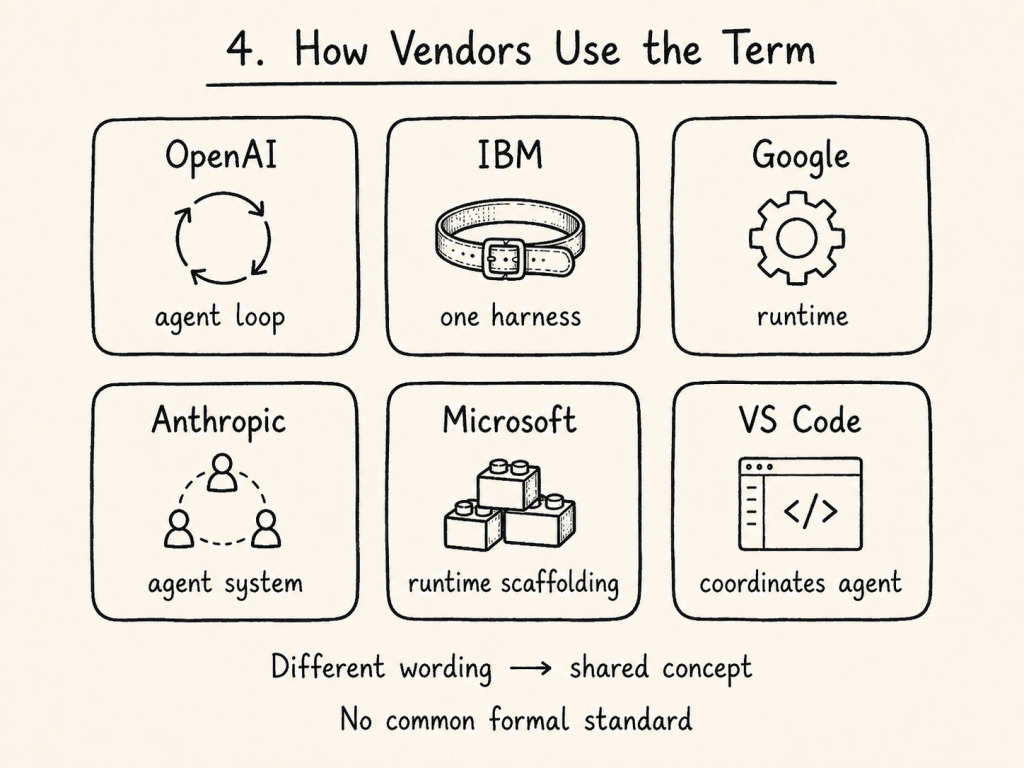
| Source | How the harness is described |
|---|---|
| OpenAI | Core agent loop and execution logic |
| IBM Bob | Shared harness behind one agent and multiple clients |
Shared harness used by Antigravity IDE and the managed Antigravity agent | |
| Anthropic | System that enables a model to act as an agent and orchestrates tools |
| Microsoft | Runtime scaffolding that turns a language model into an agent |
| VS Code | Software that coordinates the agent and agent loop |
The wording differs, but the functional overlap is substantial. More importantly, all six sources across five organizations investigated here now use the term harness explicitly in the context of agentic systems.
- OpenAI separates the Codex harness from individual clients such as the CLI, IDE integrations, web interfaces, and applications. The shared harness provides the underlying agent loop and execution logic.
- IBM Bob provides a similar architectural pattern. IBM describes Bob V2 as one agent and one harness that can be accessed through different clients, including Bob IDE and Bob Shell. This describes the relationship between the harness and its clients, not its deployment model.
- Google states that its managed Antigravity agent uses the same harness as Antigravity IDE. Google also describes managed agents in the Gemini API as providing a configurable agent harness. The commercial scope of Google AI Pro should still be distinguished from the capabilities documented for the Gemini API.
Note: Google’s I/O 2026 material strengthens this pattern further. Antigravity CLI, Antigravity 2.0, the Antigravity SDK, and managed agents are described as sharing the Antigravity harness across different product surfaces. This provides a concrete example of one harness being exposed through multiple clients and execution models.
- Anthropic describes an agent harness as a system that enables a model to act as an agent and explicitly calls Claude Code a flexible agent harness. Anthropic also distinguishes the harness from both the durable session and the sandbox where code executes.
- Microsoft and VS Code provide the most vendor-neutral descriptions in this investigation. Microsoft describes runtime scaffolding around the model, while VS Code explicitly calls agent harness an industry term. At Microsoft Build 2026, the Agent Harness also became a stable part of Microsoft Agent Framework, with capabilities such as context management, memory, tools, approvals, shell and filesystem access, and observability.
What is particularly noticeable in 2026 is the convergence of terminology. OpenAI, IBM, Google, Anthropic, Microsoft, and Visual Studio Code use the word harness even though their products and architectures differ.
For me, this is evidence of an emerging shared technical vocabulary, not of one shared implementation or formal standard.
Across these sources, three distinctions appear repeatedly:
- The model is not the harness
- The user interface is not necessarily the harness
- The execution environment is not necessarily the harness
That is enough evidence to move from vendor terminology toward a common functional model.
5. The Common Functional Core
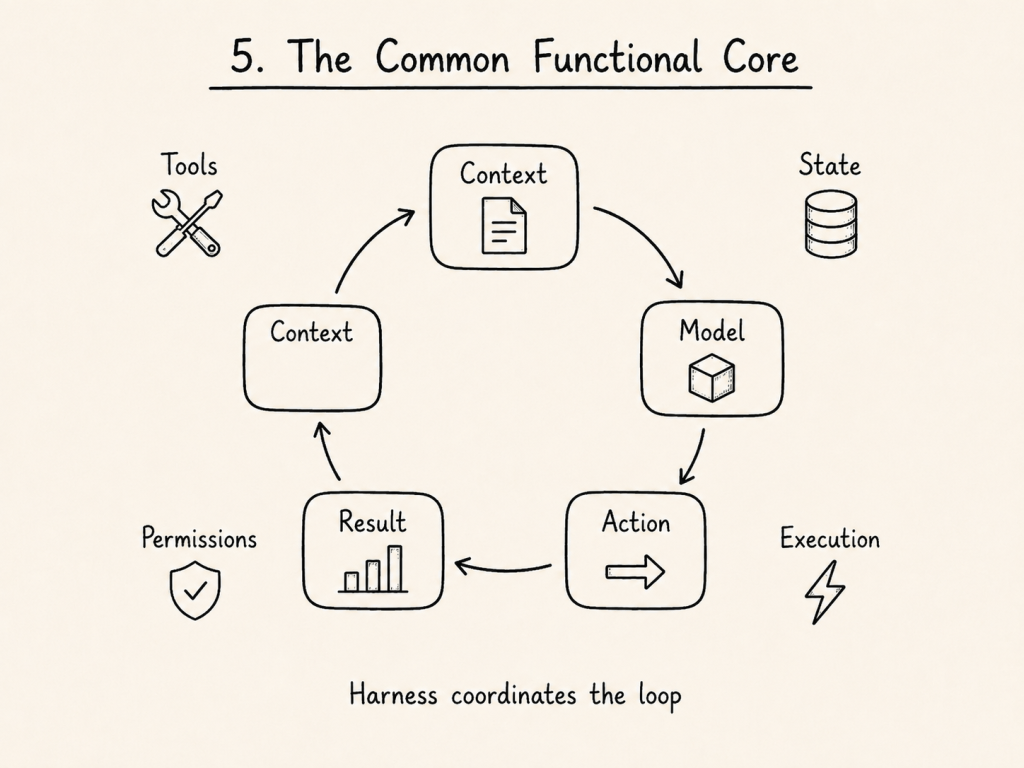
Across the vendor descriptions, several harness responsibilities appear repeatedly.
| Capability | Role of the harness |
|---|---|
| Agent loop | Repeatedly connects model reasoning with actions and observations |
| Context | Determines which instructions, files, history, and results reach the model |
| Tools | Exposes capabilities such as file operations, shell commands, APIs, tests, browsers, or MCP servers |
| State and memory | Preserves information needed across steps, turns, or sessions |
| Execution coordination | Connects requested actions with local, sandboxed, remote, or cloud execution |
| Permissions and policy | Controls which actions are allowed or require approval |
| Feedback | Returns results, errors, and observations to the model so that work can continue |
A simplified agent loop can therefore be described like this:
- The harness sends the current context to the model.
- The model responds or requests an action.
- The harness executes the action or coordinates its execution.
- The result becomes new context.
- The model is called again.
The cycle continues until the task ends or human input is required.
One distinction remains especially important:
Harness ≠ Execution Environment
The harness may coordinate execution without being the sandbox, local machine, or cloud environment in which the action actually runs.
6. My Working Definition
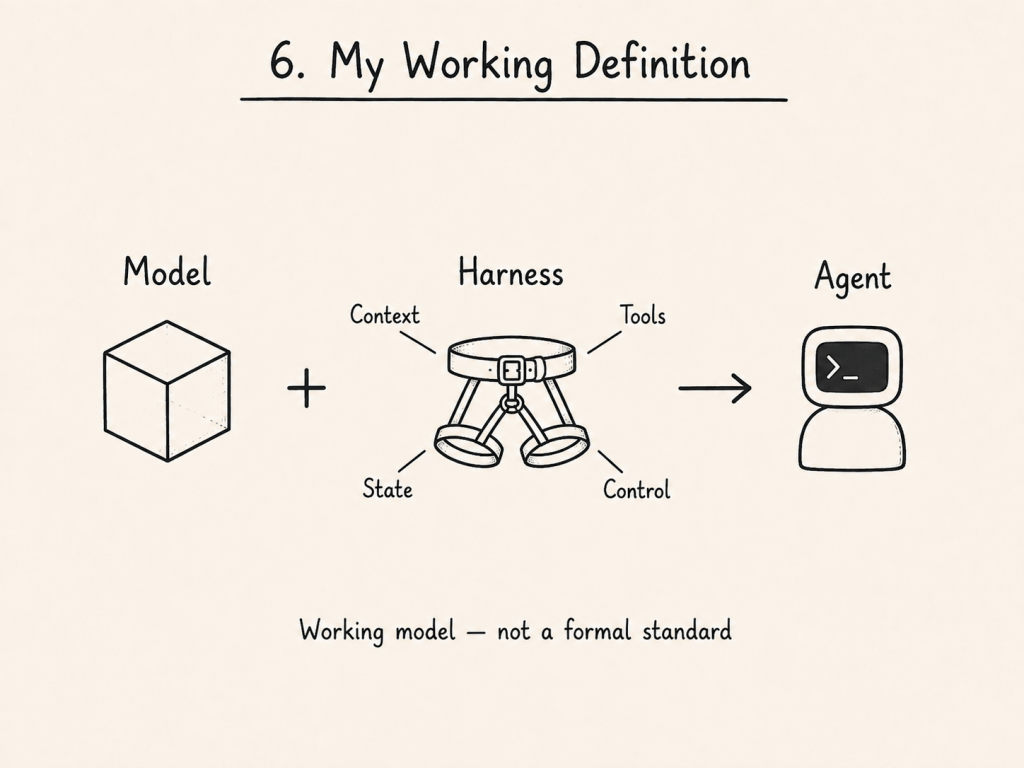
Based on the evidence above, I use this working definition:
An agent harness is the operational software layer around an AI model that coordinates the agent loop and connects the model with context, state, tools, execution, feedback, and control mechanisms so that the model can perform multi-step work.
For software development:
An agentic coding harness is the operational software layer that connects an AI model with repository context, development tools, execution environments, state, permissions, and feedback so that the model can perform multi-step software-engineering tasks.
These are my working definitions. They are not NIST definitions, ISO definitions, or vendor standards.
A useful simplified mental model is:
Agent ≈ Model + Harness
This is an abstraction, not a literal product architecture. Real products may separate additional components such as the user interface, sandbox, session storage, remote infrastructure, or external services.
7. Why Harnesses Matter Beyond Model Comparisons
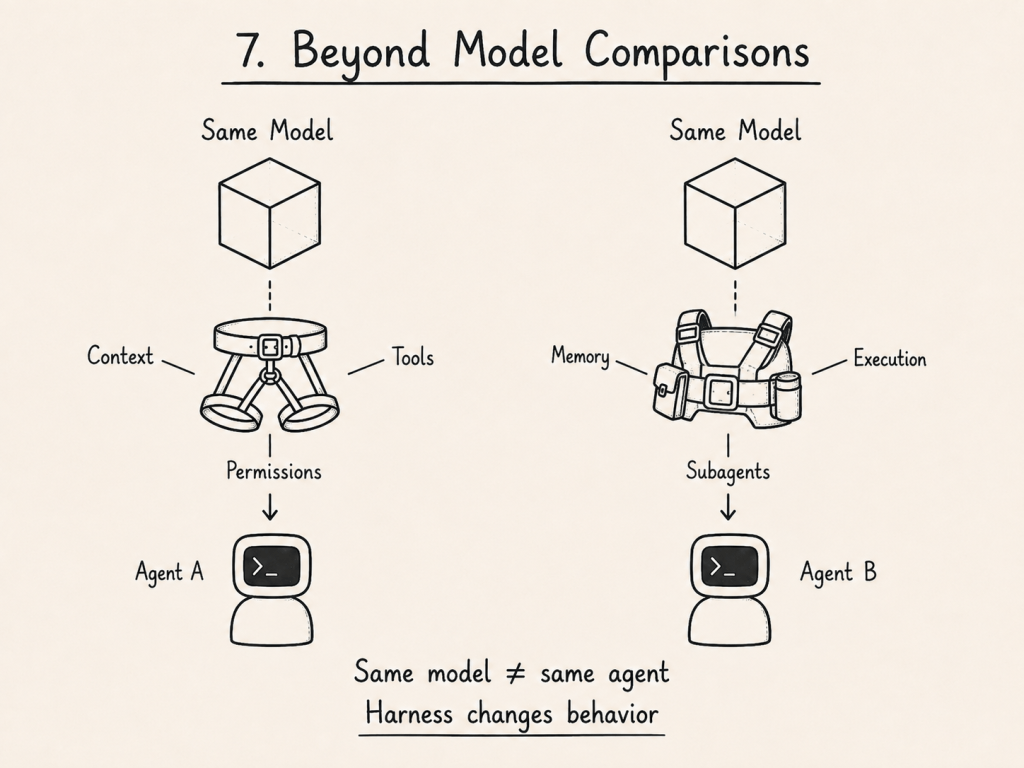
This changes how I think modern AI coding systems should be compared.
For comparing complete agentic development systems, a comparison such as:
Claude vs. Gemini vs. GPT
is no longer sufficient on its own.
When I use Claude Code, Codex, IBM Bob, or Google Antigravity, I interact with a complete agentic system, not only a language model. Two products can therefore use similarly capable models and still behave very differently because their harnesses differ.
How does the harness enable, constrain, observe, and control the model while software-engineering work is performed?
The following dimensions are therefore useful questions for understanding a coding harness. They are not intended as a complete benchmark or product-ranking framework.
| Dimension | Core Question |
|---|---|
| Agent loop | How does the system coordinate and continue multi-step work? |
| Context | What information reaches the model, and how is it selected? |
| Tools and MCP | Which actions, tools, APIs, and protocol integrations can the agent use? |
| Repository access | How can the agent inspect and modify source-code context? |
| Execution | Where and how are commands, builds, and tests executed? |
| Permissions | Which actions require approval or are restricted by policy? |
| State | What task state survives between steps or runs? |
| Memory | What information can the system retain and reuse? |
| Subagents | Can tasks be delegated or parallelized across additional agents? |
| Feedback | How does the system return execution results and failures to the model? |
| Sandbox | How is execution isolated or constrained? |
| Observability | Can I inspect what happened during the run? |
| Provenance | Can I reconstruct how the final result was produced? |
| Model dependency | Can the underlying model be changed? |
| Client independence | Can the same harness be accessed through different interfaces? |
8. Connection to Engineering Provenance
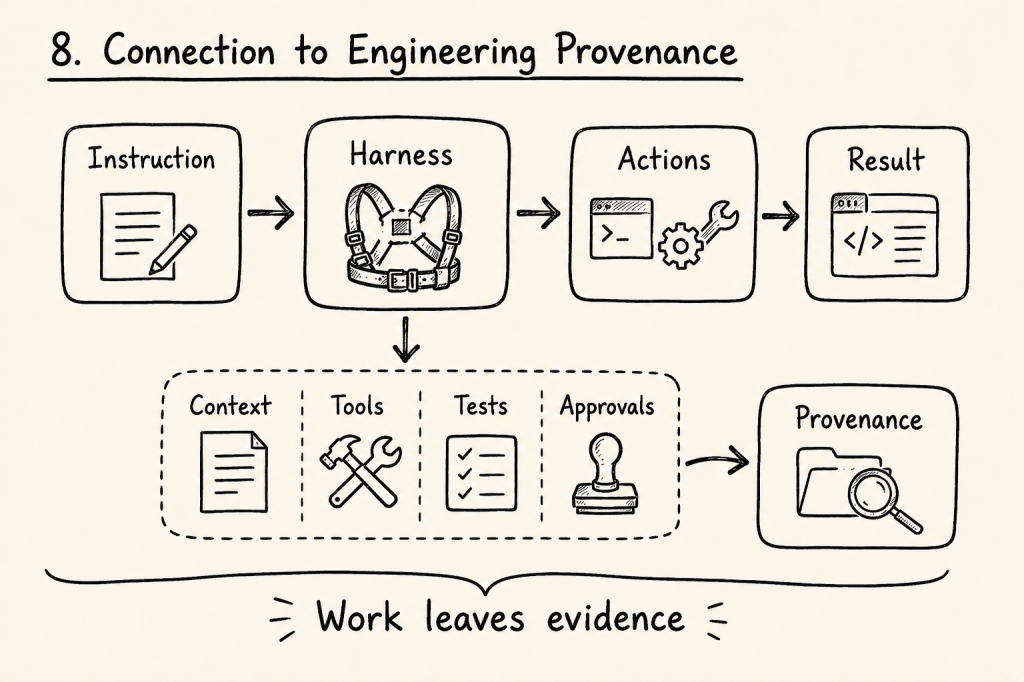
There is another reason why the harness matters. When an AI agent changes software, the resulting code does not tell the complete story.
For later inspection, useful evidence can include:
- The instruction that started the task
- The context and files used
- Tool calls and executed commands
- Models and subagents involved
- Tests and approvals
- Failures and intermediate results.
Much of this evidence does not originate from the model itself. It is created or coordinated by the system around the model.
This leads to another working assumption:
The harness is not only where AI actions are coordinated. It can also become an important source of evidence about how AI-assisted engineering work was performed.
This connects the harness discussion directly to Engineering Provenance.
9. Evidence vs. Interpretation
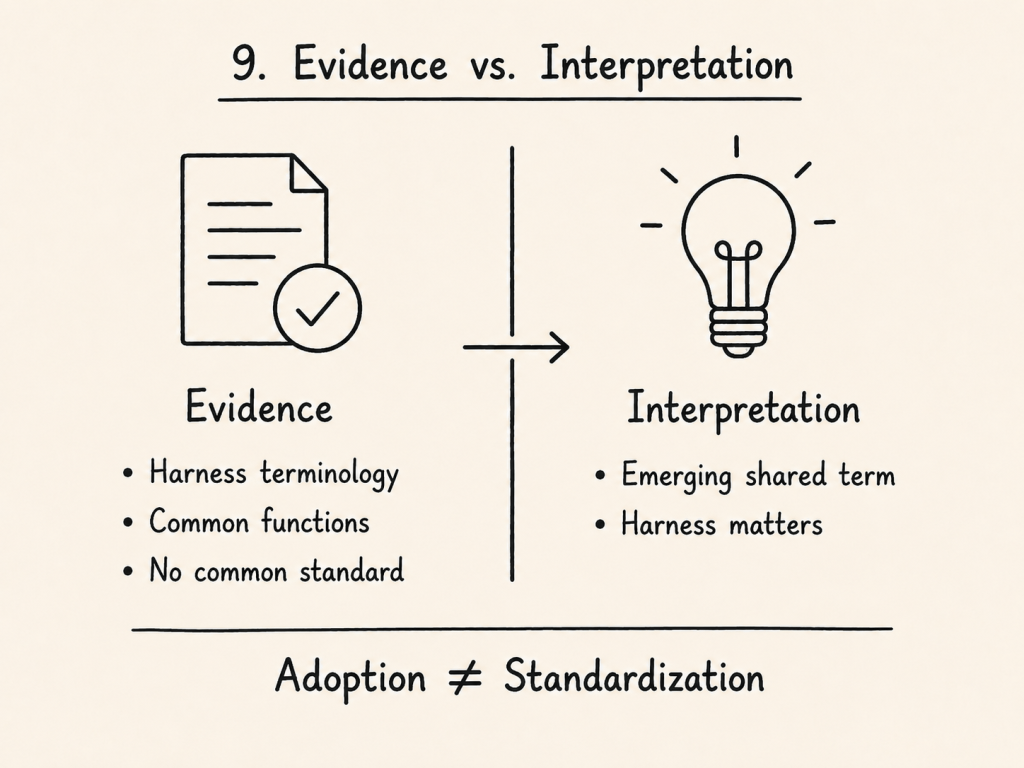
Supported by the evidence
Official technical material from OpenAI, IBM, Google, Anthropic, Microsoft, and Visual Studio Code explicitly uses harness terminology for agentic systems.
Across these sources, harnesses are repeatedly associated with agent-loop orchestration, context, tools, state, execution, and control. The evidence also shows that the harness can be distinct from the model, user interface, and execution environment.
I found no evidence that NIST, ISO, or another cross-vendor standards body has established one normative definition that all these vendors formally follow.
My interpretation
Based on this evidence, I believe agent harness is becoming a de facto technical term in agentic AI engineering.
VS Code explicitly calling it an “industry term” strengthens that interpretation.
I also expect harness engineering to become increasingly important for understanding coding agents because model capability alone does not determine how an agent behaves in a real development environment.
But one distinction remains important:
De facto adoption is not the same as formal standardization.
10. Final Thoughts
For me, it is always important to question a new term when it feels like a hype word. I want to understand whether we really need it and whether introducing it adds real value.
In this case, I think the term makes sense because it helps separate the operational layer around the model from other concepts such as the model itself, the framework, or the execution environment.
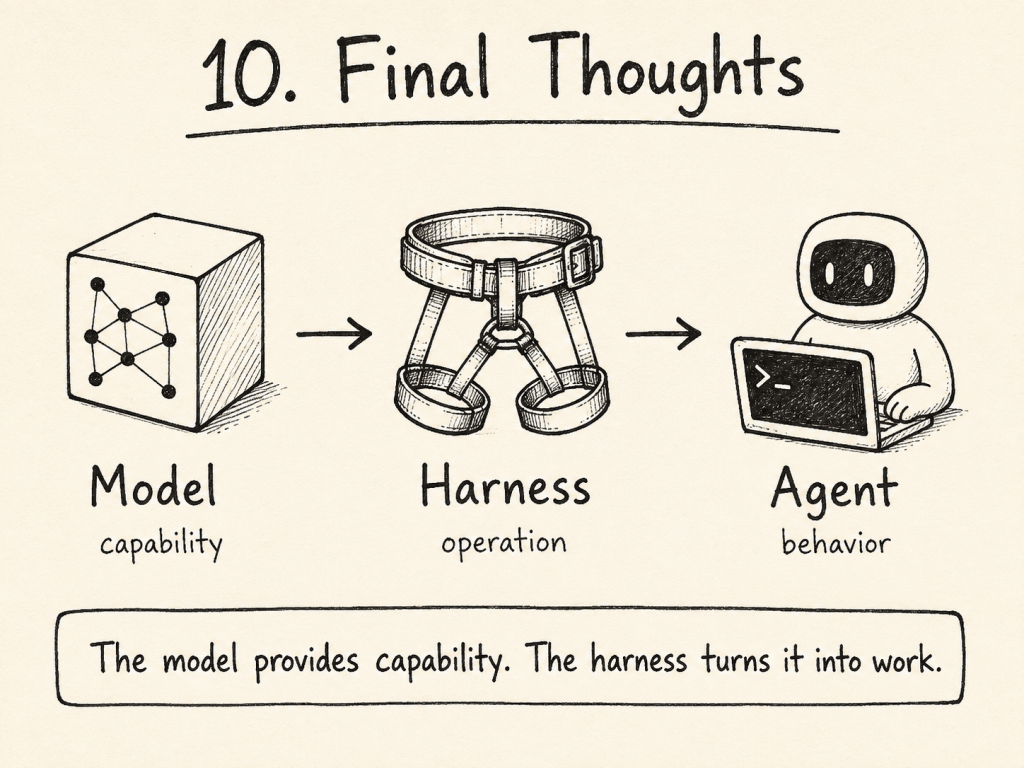
The interesting change in AI-assisted development is not only that models are becoming more capable. The software surrounding these models is becoming more important as well. We started by looking mainly at models. But understanding a modern agentic system requires us to look beyond the model itself.
We also need to understand the operational layer between:
What the model can theoretically do
and
What the agent is actually able and allowed to do
That operational layer is increasingly being described as the agent harness.
There is still no evidence for one normative cross-vendor definition that everyone follows. But there is now enough evidence across vendors and development platforms to identify a common functional core.
For me, that makes the term useful.
Understanding the model tells us what may be possible. Understanding the harness tells us how that capability is actually turned into agentic work.
References
Standards and Cross-Vendor Context
[1] NIST — Announcing the AI Agent Standards Initiative for Interoperable and Secure Innovation — February 17, 2026
Initiative overview:
https://www.nist.gov/artificial-intelligence/ai-agent-standards-initiative
Used for: Current status of AI-agent standardization, interoperability, security, identity, authorization, and open protocols.
[2] Microsoft Learn — Agent Framework — Agent Harness
https://learn.microsoft.com/en-us/agent-framework/concepts/harness
Used for: General harness definition and description of harness capabilities including tool use, state, context, memory, approvals, shell execution, and observability.
[3] Visual Studio Code — Agent Harnesses
https://code.visualstudio.com/docs/agents/concepts/agent-harnesses
Used for: The statement that agent harness is an industry term and the separation between harness, execution environment, agent role, and language model.
[4] Visual Studio Code — Choose and Use an Agent Harness
https://code.visualstudio.com/docs/agents/run/agent-harnesses
Used for: Supported harness-selection targets and the handoff of conversation history and context between harnesses.
[5] Visual Studio Code Blog — The Coding Harness Behind GitHub Copilot in VS Code — May 15, 2026
https://code.visualstudio.com/blogs/2026/05/15/agent-harnesses-github-copilot-vscode
Used for: Agent-loop concepts, context assembly, tools, turns, rounds, and runs.
Microsoft Agent Framework — Microsoft Agent Framework at BUILD 2026: Agent Harness, Hosted Agents, CodeAct, and more — June 3, 2026
https://devblogs.microsoft.com/agent-framework/microsoft-agent-framework-at-build-2026-announce/
Used for: Stable Agent Harness capabilities in Microsoft Agent Framework, including context management, memory, approvals, tools, shell and filesystem access, and observability.
OpenAI
[6] OpenAI — Unrolling the Codex Agent Loop — January 23, 2026
https://openai.com/index/unrolling-the-codex-agent-loop
Used for: Definition of the Codex harness as the core agent loop and execution logic.
[7] OpenAI — Unlocking the Codex Harness: How We Built the App Server — February 4, 2026
https://openai.com/index/unlocking-the-codex-harness
Used for: Shared Codex harness across different Codex surfaces and clients.
[8] OpenAI — Harness Engineering: Leveraging Codex in an Agent-First World — February 11, 2026
https://openai.com/index/harness-engineering
Used for: OpenAI’s broader use of the term harness engineering and the importance of the environment around coding agents.
IBM
[9] IBM Bob — Bob V2: Faster, Better, Smarter — June 24, 2026
https://bob.ibm.com/blog/bob-v2-release-announcement
Used for: Bob V2 single-agent architecture across clients.
[10] IBM Bob — Bob Shell V2 Leads This Month’s Release — August 2026
https://bob.ibm.com/blog/august-2026-release
Used for: Explicit description of Bob V2 as one agent and one harness with different clients.
[11] IBM Bob — Pricing
Used for: Bob Pro individual plan scope and current published pricing.
[12] IBM Bob — Bobcoins Documentation
https://bob.ibm.com/docs/ide/account/bobcoins
Used for: Description of Bobcoin-based consumption and billing.
[13] Google Gemini API — Antigravity Agent
https://ai.google.dev/gemini-api/docs/antigravity-agent
Used for: Google’s statement that the managed Antigravity agent uses the same harness as Antigravity IDE.
[14] Google Gemini API — Building Managed Agents
https://ai.google.dev/gemini-api/docs/custom-agents
Used for: Antigravity harness runtime, tools, execution, and configurable agent capabilities.
[15] Google — Introducing Managed Agents in the Gemini API — May 2026
https://blog.google/innovation-and-ai/technology/developers-tools/managed-agents-gemini-api
Used for: Google’s broader managed-agent and harness direction.
[16] Google AI Plans
https://one.google.com/about/google-ai-plans
Used for: Individual Google AI Pro access and Antigravity availability.
Anthropic
[17] Anthropic — Demystifying Evals for AI Agents — January 9, 2026
https://www.anthropic.com/engineering/demystifying-evals-for-ai-agents
Used for: General agent-harness definition and classification of Claude Code as a flexible agent harness.
[18a] Anthropic — Scaling Managed Agents: Decoupling the Brain from the Hands — April 8, 2026
https://www.anthropic.com/engineering/managed-agents
Used for: Separation of session, harness, and sandbox, and the relationship between improving models and harness assumptions.
[18b] Anthropic — Harness Design for Long-Running Application Development — March 24, 2026
https://www.anthropic.com/engineering/harness-design-long-running-apps
Used for: Anthropic’s use of harness design for long-running software-development tasks, including planner, generator, evaluator, and feedback-loop patterns.
[19] Anthropic — Effective Harnesses for Long-Running Agents — November 26, 2025
https://www.anthropic.com/engineering/effective-harnesses-for-long-running-agents
Used for: Earlier explicit use of harness terminology and historical context before 2026.
[20] Anthropic Help Center — Claude Pro
Used for: Individual Claude Pro scope and Claude Code access.
OpenAI Individual Plan Scope
[21] OpenAI Help Center — Using Codex With Your ChatGPT Plan
https://help.openai.com/en/articles/11369540-using-codex-with-chatgpt
Used for: Codex availability through individual ChatGPT subscriptions such as ChatGPT Plus.
Language and Dictionary Sources
[22] Cambridge Dictionary — Framework
https://dictionary.cambridge.org/dictionary/english/framework
Used for: Ordinary English meaning of framework as a supporting structure or system.
[23] Cambridge Dictionary — Harness
https://dictionary.cambridge.org/dictionary/english/harness
Used for: Ordinary English meaning of harness and the verb to harness.
Additional References for Google
[24] Google Cloud Blog — What Google I/O ’26 Means for Developing Agents on Google Cloud — May 20, 2026
https://cloud.google.com/blog/topics/developers-practitioners/io26-news-for-agent-developers-on-google-cloud
Used for: Google’s I/O 2026 description of a unified Antigravity development ecosystem across multiple agent-development surfaces.
[25] Google Antigravity Blog — Google Antigravity SDK — May 19, 2026
https://antigravity.google/blog/introducing-google-antigravity-sdk
Used for: The statement that the SDK exposes the same agent runtime and harness as Antigravity 2.0 and Antigravity CLI, including built-in tools, safety policies, lifecycle hooks, and persistent sessions.
Research Status
Research state: August 2026
This article does not claim to establish a formal standard. It summarizes current vendor evidence and derives a working model from that evidence.
The purpose of this article is to clarify the emerging meaning of agent harness and identify its common functional characteristics. A complete benchmark of agentic development environments is outside the scope of this investigation.
Note: This post reflects my own ideas and experience. AI was used as a writing and thinking aid to structure and check the arguments, not to define them.
#AIEngineering, #AgenticAI, #CodingAgents, #AgentHarness, #AgentHarnesses, #AICoding, #EngineeringProvenance


Leave a Reply