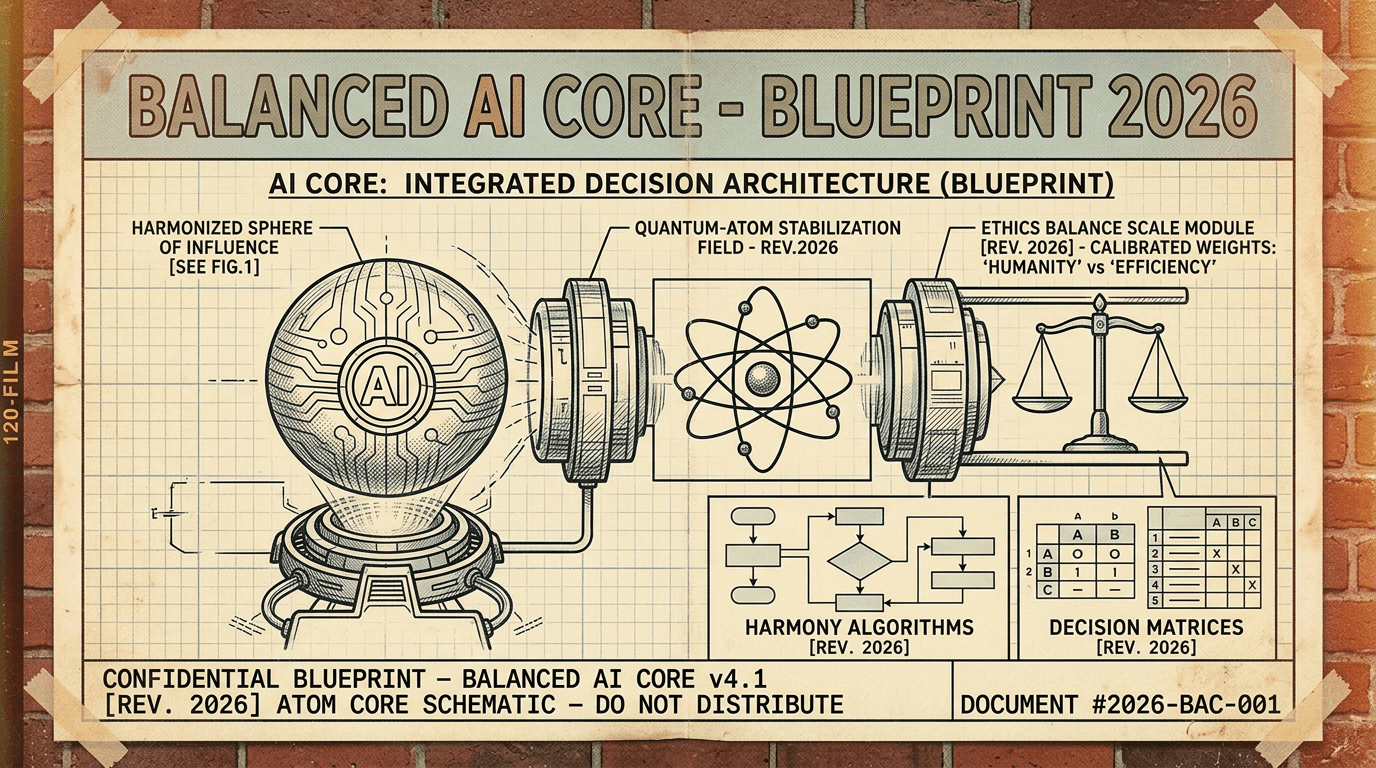
How Spec-Driven Development, Architecture Review Boards, Traceability, and Human Accountability may become the most important components of Agentic Software Engineering.
Introduction: We Are Solving the Wrong Problem
The Evolution of Software Engineering: From Coding to Decision Automation
Phase 1: Human-Centric Development
Phase 2: AI-Assisted Development
Phase 3: Agentic Development
Decision Participation Changes the Game
AI Is a Tool, Never a Partner
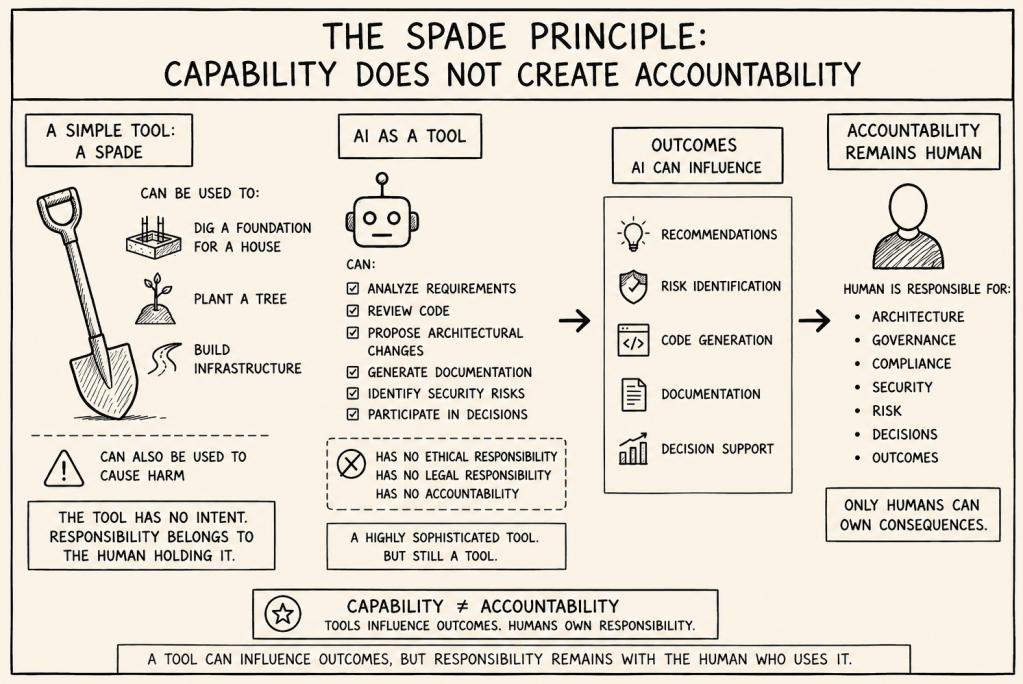
The Spade Principle
Why Traditional Architecture Reviews No Longer Scale
Review Capacity Becomes the Constraint
The Emergence of the Automated Architecture Review Board
From Static Documentation to Executable Governance
Governance Inside the Development Lifecycle
The Human Role Does Not Disappear
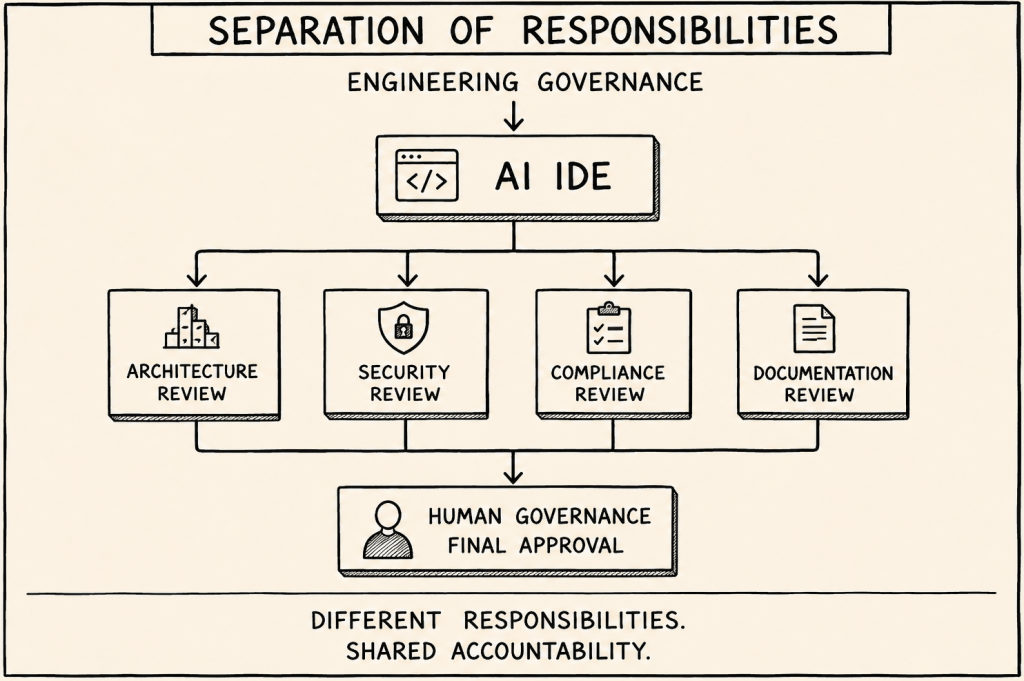
Modes, Skills, and Engineering Guardrails
Why Separation Matters
Architecture Review Mode
Security Review Mode
Compliance Review Mode
Documentation Review Mode
Guardrails Are Not Restrictions
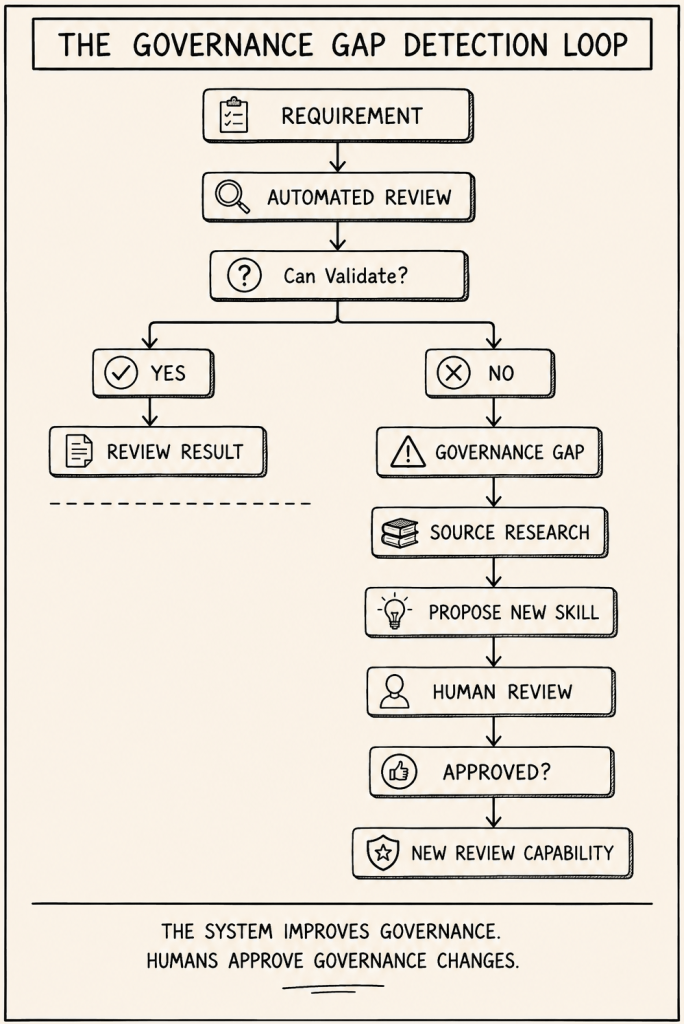
The Gap Detector: When AI Starts Reviewing Its Own Governance
The Gap Detector Concept
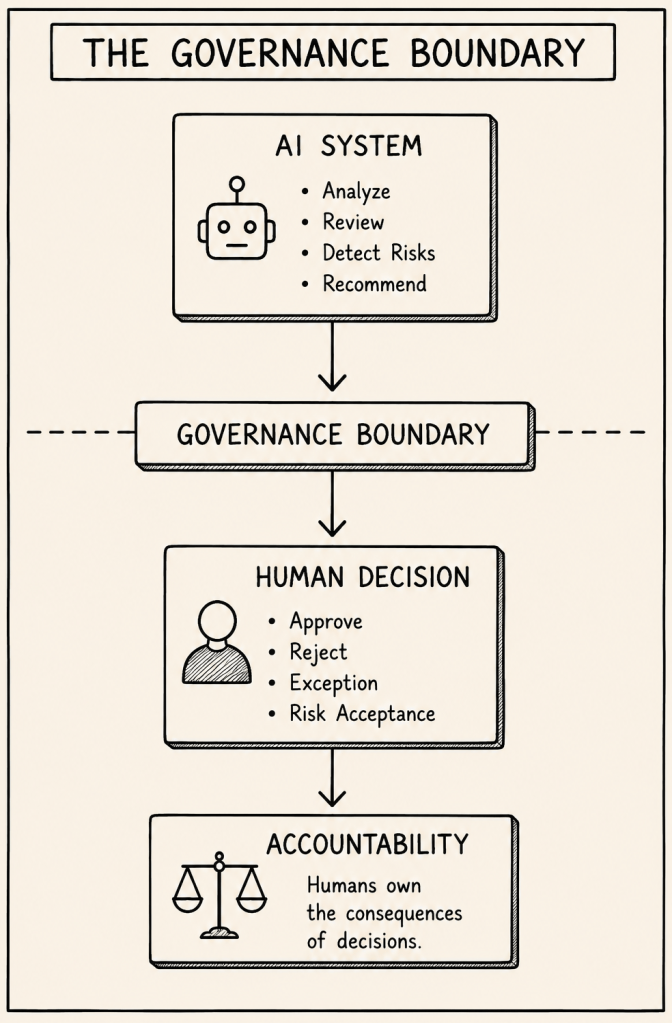
Human-in-the-Loop: The Final Authority
Approval Is Different from Participation
The Hacker Paradox: When Requirements Become the Attack Surface
From Code Injection to Requirement Injection
A Simple Example: Disabling OAuth for Testing
Why Traceability Becomes Security
AI IDEs Versus Self-Improving Production Systems
AI IDE
Self-Improving Production Application
A Practical Example: IBM Bob, Spec-Driven Development, and Traceability
Governance Requires Traceability
GitHub Issues as Governance Artifacts
Innovation Versus Invention
Governance Is Not the Opposite of Innovation
The Rise of Governance Engineering
Conclusion: The Ultimate Sorcerer’s Apprentice
Resources
Related Articles
Project Reference
External References
1. Introduction: We Are Solving the Wrong Problem
A large part of today’s AI discussion focuses on productivity:
Faster code generation
Autonomous agents
AI-powered IDEs
Automated workflows
Self-healing systems
The underlying assumption is simple:
More automation leads to better software.
In a previous article, I explored privacy in AI coding assistants and argued that modern AI tools are evolving from simple chatbots into operational engineering environments. Once AI starts participating in architecture decisions, reviews, testing, and deployment preparation, privacy becomes only one part of a much larger challenge: governance.
Once AI systems participate in planning, reviewing, testing, and deployment preparation, questions of accountability, traceability, and decision ownership become just as important as questions of data protection.
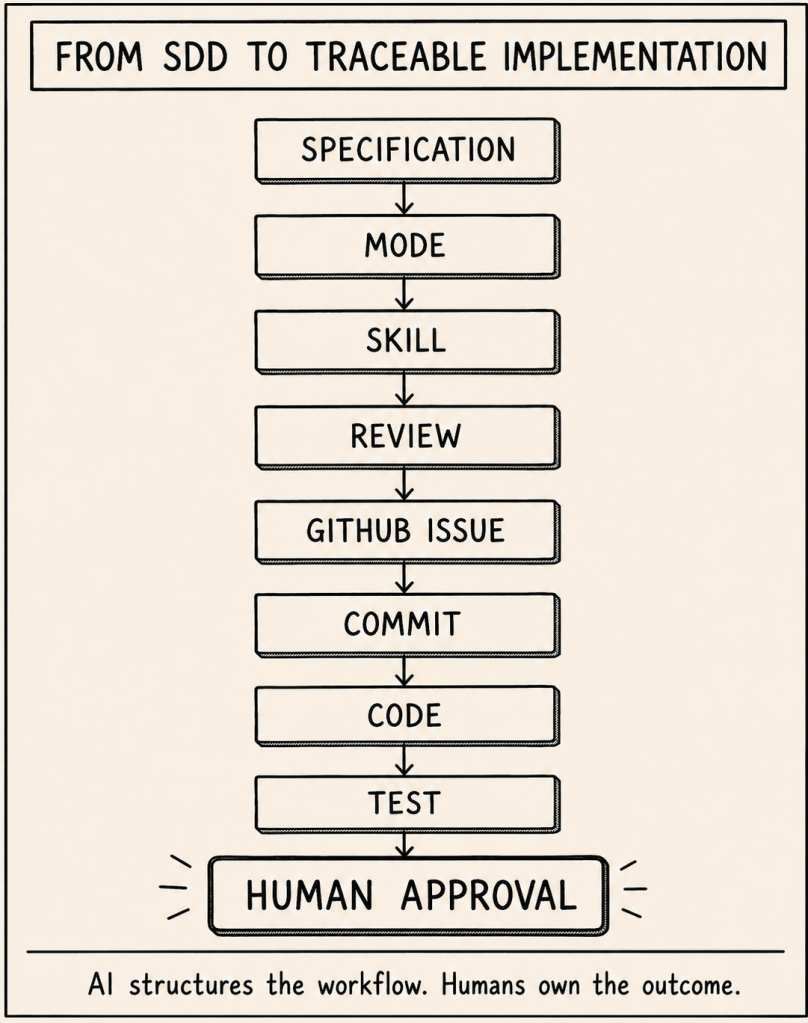
After working with AI-assisted software engineering, building custom IBM Bob modes and skills, experimenting with architecture review automation, and applying Spec-Driven Development (SDD), I increasingly believe that we are asking the wrong question.
The real question is no longer:
Can AI generate software?
The more important question is:
How do we govern systems that increasingly participate in engineering decisions?
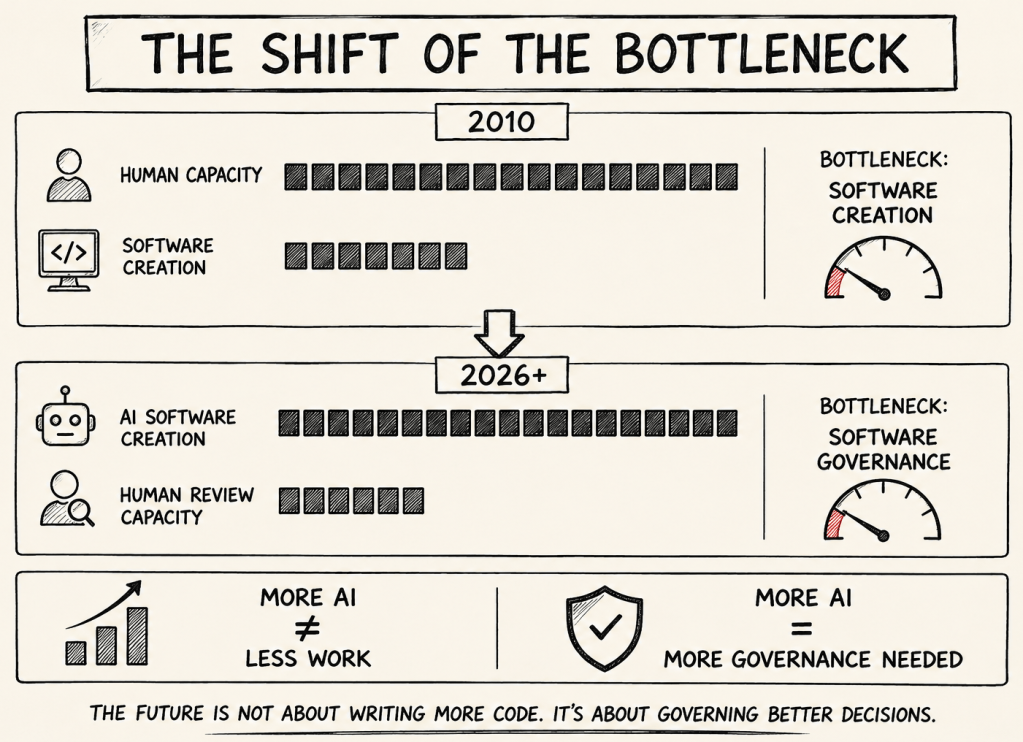
As AI systems become more capable, the bottleneck shifts.
For decades, software engineering was constrained by our ability to create software. Today, we are rapidly approaching a world where software can be generated faster than it can be reviewed. The bottleneck is no longer software creation. The bottleneck is software governance.
2. The Evolution of Software Engineering: From Coding to Decision Automation
To understand why governance is becoming increasingly important, we first need to look at how engineering responsibility has evolved.
Software engineering is not only expanding or changing in terms of technology. It is changing in terms of decision ownership. For decades, software systems were constrained by human implementation capacity.
Today, AI systems increasingly participate in activities that were traditionally performed by developers, architects, security specialists, and reviewers.
The most important shift is not who writes the code.
The most important shift is who participates in engineering decisions.
2.1 Phase 1: Human-Centric Development
The human is both the creator and the reviewer.
The engineer owns every decision.
Requirements are interpreted by humans.
Architecture is designed by humans.
Code is written by humans.
Reviews are performed by humans.
Deployment decisions are approved by humans.
This does not mean that traditional software engineering is perfect. Human decisions can still be incomplete, biased, inconsistent, or wrong.
But responsibility is clear.
The same people who interpret the requirements, design the architecture, write the implementation, and review the result remain accountable for the outcome.
In this phase, governance is mostly organizational.
It happens through:
Architecture reviews
Code reviews
Security checks
Release approvals
Documentation standards
The bottleneck is software creation.
2.2 Phase 2: AI-Assisted Development
The next major evolution in software engineering introduced AI-assisted development.
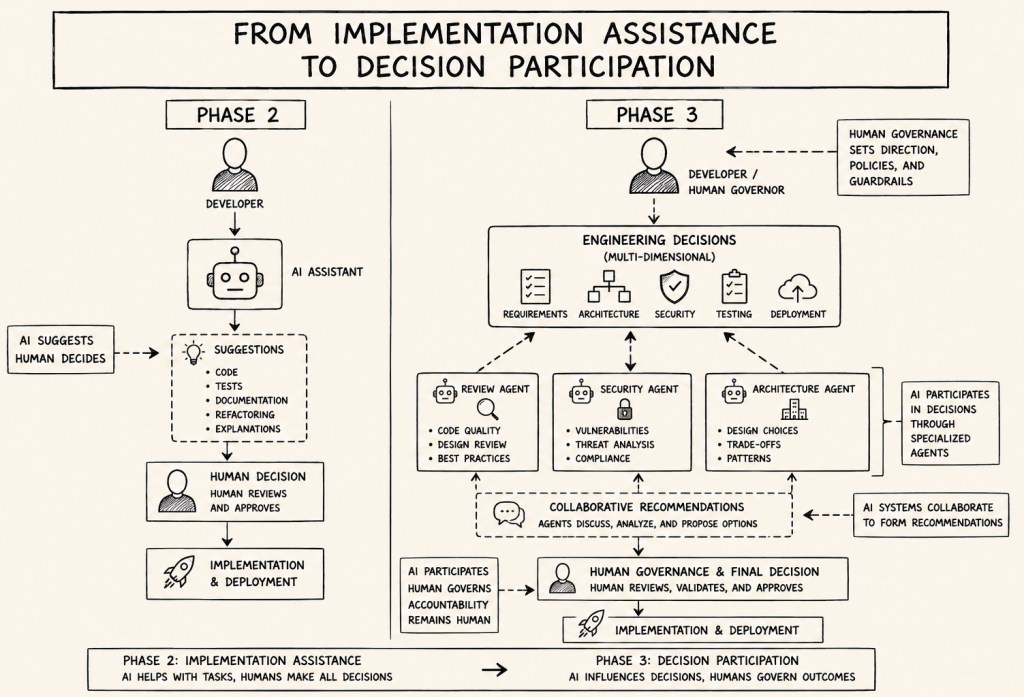
In this model, developers remain responsible for the engineering process, but AI systems begin to assist with implementation tasks.
AI suggests. Humans decide.
Productivity increases, but accountability remains unchanged.
The AI acts as a productivity multiplier.
It can:
Generate code
Explain code
Create tests
Suggest documentation
Propose refactorings
Accelerate troubleshooting
The engineer remains the primary decision-maker.
The AI suggests.
The human approves.
This distinction is important.
Although the amount of generated code may increase significantly, responsibility remains relatively clear because the developer still controls the decision-making process.
The AI participates in implementation. It does not own the implementation. Governance in this phase remains largely unchanged.
Organizations continue to rely on:
Architecture reviews
Code reviews
Testing
Security validation
Deployment approvals
The bottleneck shifts slightly. Software creation becomes faster. Software review becomes more important.
However, humans still remain the final authority.
2.3 Phase 3: Agentic Development
he current generation of AI systems is moving beyond traditional coding assistance.
Instead of supporting individual implementation tasks, AI systems increasingly participate in broader engineering activities.
These systems can assist with:
Requirements interpretation
Architecture analysis
Design reviews
Documentation generation
Test creation
Security validation
Deployment preparation
Compliance checks
This is a significant shift.
In previous phases, AI primarily participated in implementation. Now AI increasingly participates in engineering decisions. The distinction may appear subtle. In practice, it changes everything. Code can be reviewed. Generated documentation can be reviewed.
Engineering decisions are much harder to audit after they have been made.
As AI systems become involved in planning, architecture, testing, security, and deployment activities, the volume of engineering decisions grows much faster than the human capacity to review them manually.
This creates a new bottleneck.
The challenge is no longer software creation.
Governance has always mattered, but AI-assisted engineering increases the pressure.
3. Decision Participation Changes the Game
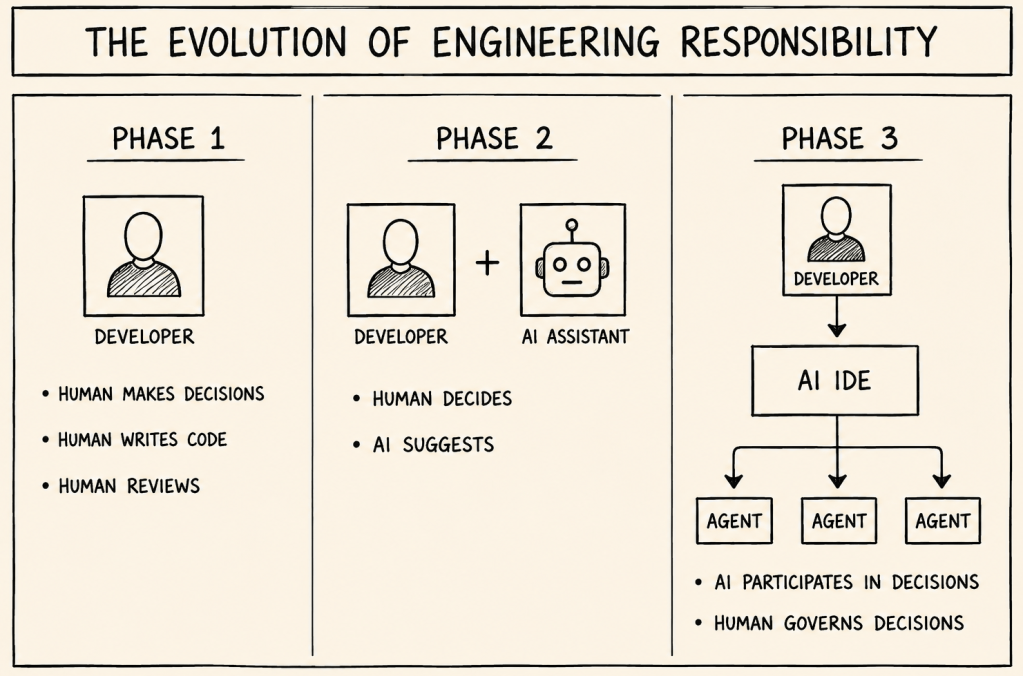
In Phase 1, humans made the decisions and implemented them.
In Phase 2, humans made the decisions and AI assisted with implementation.
In Phase 3, AI starts participating in the decision-making process itself.
Phase 1
Human decides
Human implements
Phase 2
Human decides
AI assists
Phase 3
AI participates
Human governs
This is the moment where governance becomes a first-class engineering concern.
The question is no longer:
“Can the AI generate code?”
The question becomes:
“How do we validate, review, audit, and govern the decisions that AI systems increasingly influence?”
Key Observation: The biggest change is not that AI writes code.The biggest change is that AI increasingly participates in engineering decisions.
4. AI Is a Tool, Never a Partner
One trend in the AI industry deserves careful attention.
As AI systems become more capable, the language used to describe them is changing.
Many people describe AI as a:
Partner
Colleague
Teammate
Co-worker
At first glance, this may appear harmless.
However, language influences how we think about responsibility. The more capable AI systems become, the greater the temptation to treat them as participants rather than tools. That distinction matters because accountability cannot be delegated to software. This becomes especially important in Agentic Software Engineering.
Modern AI systems can increasingly:
Analyze requirements
Review code
Propose architectural changes
Generate documentation
Identify security risks
Participate in engineering decisions
As their capabilities grow, it becomes easy to blur the line between assistance and responsibility.
That is where governance becomes important.
Regardless of how sophisticated an AI system becomes, accountability remains entirely human. The challenge is not whether AI can produce useful outcomes. The challenge is understanding where responsibility remains when those outcomes influence real-world decisions.
To illustrate this distinction, consider a much simpler tool.
4.1 The Spade Principle
Consider a simple spade.
A spade can be used to:
Dig a foundation for a house
Plant a tree
Build infrastructure
The same spade can also be used to cause harm. The tool itself carries no intent. The responsibility belongs entirely to the human holding it.
The same principle applies to AI.
An LLM:
Has no ethical responsibility
Has no legal responsibility
Has no accountability
It is a tool.
A highly sophisticated tool.
But still a tool.
Key Principle
Capability does not create accountability.
A tool may participate in work.
Only humans can own responsibility.
The capability of a system and the accountability for its actions are fundamentally different concepts.
A powerful AI system may:
Generate recommendations
Identify risks
Analyze repositories
Participate in engineering decisions
But it cannot own those decisions.
Responsibility for:
Architecture
Governance
Compliance
Security
Risk
remains entirely human.
Once we start calling AI a partner, we begin shifting responsibility away from ourselves.
As architects and engineers, we must resist that temptation.
AI may participate in engineering activities.
AI may influence engineering decisions.
But AI cannot own the consequences.
The human remains accountable for the outcome.
5. Why Traditional Architecture Reviews No Longer Scale
Consider a simple example. A human architecture review board might review five to ten major design decisions during a project iteration. An AI-assisted engineering environment can generate dozens of implementation alternatives, architectural recommendations, test strategies, deployment options, and review findings within hours. The challenge is not that the AI is making better or worse decisions. The challenge is that the number of decisions grows much faster than the available review capacity. This creates a review gap. The larger the review gap becomes, the more difficult it becomes to maintain accountability, traceability, and governance.
Modern software systems are becoming increasingly complex.
Organizations must deal with:
Cloud-native architectures
Microservices
Distributed systems
Security requirements
Compliance regulations
Platform engineering
AI-assisted software development
However, complexity alone is not the primary challenge.
The real challenge is scale.
Traditional Architecture Review Boards were designed for a world where humans created software at human speed.
Architects reviewed designs. Security teams reviewed risks. Compliance teams reviewed documentation. The number of engineering decisions remained manageable. AI-assisted engineering changes this assumption.
Modern AI systems can generate:
Implementation alternatives
Architectural recommendations
Test strategies
Documentation
Deployment configurations
Security suggestions
within minutes.
As a result, the number of engineering decisions grows significantly faster than the human capacity to review them.
This creates a growing gap between software generation and software governance. The challenge is not replacing architects. The challenge is enabling architects to focus on the decisions that truly require human judgment.
Without new governance mechanisms, organizations risk creating software faster than they can responsibly review it. The solution is allowing architects to focus on decisions that actually require human judgment.
5.1 Review Capacity Becomes the Constraint
For decades, software engineering was constrained by implementation capacity. Today, implementation is increasingly automated. This shifts the bottleneck.
The question is therefore not whether architecture reviews remain necessary. The question is how architecture reviews can evolve to operate at the speed of modern software engineering.
This is where the concept of an Automated Architecture Review Board becomes interesting.
6. The Emergence of the Automated Architecture Review Board
Traditional Architecture Review Boards were created to ensure that engineering decisions align with organizational standards.
Typical review activities include:
Architecture validation
Security reviews
Compliance checks
Documentation reviews
Operational readiness assessments
Historically, these reviews happened periodically and were performed manually.
That model worked well when software evolved at human speed. AI-assisted engineering changes this assumption. Modern AI systems can generate implementation options, design recommendations, deployment configurations, and review findings within minutes.
The volume of engineering decisions increasingly exceeds the capacity of human review processes. This creates an opportunity. Instead of reviewing architecture after implementation, governance can move directly into the engineering lifecycle. Instead of being a document on a wiki, it becomes an active participant in the software lifecycle.
The concepts described here are not purely theoretical.
In the repository used later in this article, custom IBM Bob modes and skills are used to demonstrate how governance-oriented reviews can be integrated directly into an AI-assisted engineering workflow.
The objective is not only autonomous software generation.
The objective was automated code generation combined with controlled, traceable, and reviewable software engineering.
6.1 From Static Documentation to Executable Governance
Traditional architecture documents are often treated as reference material.
They describe:
Standards
Principles
Constraints
Recommendations
However, documentation alone cannot enforce compliance.
A document cannot automatically detect:
Security violations
Missing traceability
Architectural inconsistencies
Deployment risks
Governance therefore becomes reactive.
Problems are often discovered after implementation.
An Automated Architecture Review Board changes this model.
Architecture principles become executable review criteria that can be evaluated continuously throughout the software lifecycle.
The architecture no longer acts only as documentation.
It becomes a governance mechanism.
6.2 Governance Inside the Development Lifecycle
Instead of waiting for periodic reviews, governance activities can occur continuously.
BUSINESS REQUIREMENT
↓
FEATURE
↓
EPIC
↓
TECHNICAL TASK
↓
IMPLEMENTATION
↓
REVIEW
↓
DEPLOYMENT
At every stage, review capabilities can validate whether engineering outcomes remain aligned with architectural intent.
Examples include:
Security policies
Cloud architecture standards
Compliance requirements
Documentation completeness
Traceability requirements
Operational readiness criteria
This does not replace architects.
It allows architects to focus on exceptions, trade-offs, and decisions that require human judgment.
6.3 The Human Role Does Not Disappear
One common misconception is that an Automated Architecture Review Board replaces human governance.
The opposite is true.
Automation improves consistency.
Humans provide accountability.
The system may:
Identify issues
Highlight risks
Propose improvements
Collect evidence
The human architect remains responsible for:
Accepting recommendations
Approving exceptions
Balancing trade-offs
Accepting risk
Governance becomes scalable without removing accountability.
7. Modes, Skills, and Engineering Guardrails
A critical lesson from governance-oriented engineering is that responsibilities should remain separated.
Organizations rarely ask a single person to simultaneously act as:
Architect
Security officer
Compliance specialist
Auditor
Developer
The reason is simple.
Different responsibilities optimize for different outcomes.
A security specialist focuses on risk reduction.
An architect focuses on maintainability and scalability.
A compliance specialist focuses on regulatory obligations.
A developer often focuses on implementation efficiency.
The same principle applies to AI-assisted engineering.
If AI systems increasingly participate in engineering decisions, governance requires clear boundaries and clearly defined responsibilities.
This is where modes, skills, and engineering guardrails become valuable. The idea of specialized responsibilities is reflected in the custom modes and skills used in the IBM Bob configuration example discussed later in this article.
The objective is not to create more autonomous agents. The objective is to create more transparent, reviewable, and governable engineering workflows.
7.1 Why Separation Matters
A common assumption is that a single powerful AI agent can optimize every aspect of software engineering simultaneously.
In practice, this creates risks.
Different goals often conflict with each other.
For example:
Security may reduce convenience.
Compliance may reduce flexibility.
Performance may increase operational complexity.
Cost optimization may reduce resilience.
A governance-oriented engineering system should therefore avoid concentrating all decision-making logic in a single autonomous workflow.
Instead, specialized review capabilities can focus on specific responsibilities.
This mirrors the traditional concept of separation of duties that already exists in mature engineering organizations.
7.2 Architecture Review Mode
The objective is to ensure that implementation decisions remain aligned with architectural principles and long-term system sustainability.
Focuses on:
Scalability
Maintainability
Architectural consistency
7.3 Security Review Mode
The objective is to identify security weaknesses and reduce organizational risk before vulnerabilities reach production environments.
Focuses on:
Threat detection
Secrets management
Attack surface analysis
7.4 Compliance Review Mode
The objective is to ensure that engineering outcomes remain aligned with legal, regulatory, and organizational obligations.
Focuses on:
GDPR
Auditability
Documentation
Regulatory requirements
7.5 Documentation Review Mode
The objective is to preserve transparency, traceability, and maintainability across the software lifecycle.
Focuses on:
Completeness
Traceability
Consistency
The purpose of these modes is not technical convenience.
The purpose is governance.
Just as organizations separate responsibilities among different teams, AI systems may require similar separation through dedicated modes and skills.
This mirrors the traditional concept of separation of duties, implemented directly in software.
7.6 Guardrails Are Not Restrictions
When people hear the term guardrail, they often assume restrictions.
That interpretation is misleading.
The purpose of a guardrail is not to prevent progress. The purpose is to prevent unintended outcomes. Roads have guardrails because vehicles occasionally leave their intended path. Engineering systems require guardrails for the same reason.
The more autonomous a system becomes, the more important guardrails become. Good guardrails enable innovation while reducing unnecessary risk.
8. The Gap Detector: When AI Starts Reviewing Its Own Governance
One of the most interesting limitations of governance systems is that rules age.
New regulations emerge.
New attack vectors appear.
New compliance requirements are introduced.
Static review systems eventually become outdated.
The idea of generating review capabilities from identified governance gaps aligns naturally with the use of specialized review modes and skills.
Rather than treating governance as a static rule set, governance itself becomes an evolving engineering artifact that can be reviewed, improved, and versioned.
Every generated recommendation should remain traceable to:
the original requirement
the identified governance gap
the information sources consulted
the generated review capability
the human approval decision
Without source history governance becomes impossible.
8.1 The Gap Detector Concept
Imagine an Architecture Review Board that discovers:
I cannot validate this requirement because I do not possess the necessary capability.
Instead of silently ignoring the problem, the system could:
Identify the missing capability
Search authoritative sources
Collect relevant information
Synthesize a proposed solution
Generate a new review skill
Document complete provenance information
This is a significant shift. The system is no longer reviewing code. The system is reviewing deficiencies in its own governance model. That may become one of the most valuable applications of AI in engineering.
However, the most important output is not the generated rule itself. The most important output is transparency.
Every generated recommendation should be traceable to the sources, assumptions, and reasoning that produced it.
Without source history, governance becomes impossible.
9. Human-in-the-Loop: The Final Authority
The concepts described so far may raise an obvious question:
If AI systems can review software, identify governance gaps, generate new review capabilities, and continuously improve governance, why do humans remain necessary?
The answer is accountability.
Governance is not only about making decisions. Governance is about owning the consequences of those decisions.
AI systems can assist with governance activities.
They can:
Identify risks
Review implementations
Detect policy violations
Collect evidence
Recommend actions
However, none of these capabilities transfer responsibility. A recommendation is not an approval. A review is not a decision. A generated capability is not an accepted policy. For that reason, one principle remains unchanged:
Automation may prepare decisions.
Humans approve decisions.
The objective of governance automation is not to remove humans from the process. The objective is to improve the quality, consistency, and scalability of governance while preserving accountability.
The AI may act as an advisor.
The AI may act as an analyst.
The AI may act as a reviewer.
But it must not become the final authority.
The human remains accountable for:
Architectural decisions
Compliance decisions
Risk acceptance
Governance exceptions
Organizational consequences
Participation is not ownership. Recommendation is not approval.
Automation is not accountability. The human remains accountable.
The challenge therefore is not how to remove humans from governance.
The challenge is how to use automation to make human governance more effective.
This distinction becomes even more important when the requirements themselves become the attack surface.
9.1 Approval Is Different from Participation
One of the most important distinctions in Agentic Software Engineering is the difference between participation and approval.
An AI system may participate in a decision process by:
Collecting information
Analyzing alternatives
Identifying risks
Proposing recommendations
Participation does not imply ownership. Approval remains a uniquely human responsibility. This distinction allows organizations to benefit from automation without losing accountability.
Key Principle
Participation is not ownership.
Recommendation is not approval.
Automation is not accountability.
The challenge therefore is not how to remove humans from governance. The challenge is how to use automation to make human governance more effective. This distinction becomes even more important when the requirements themselves become the attack surface.
10. The Hacker Paradox: When Requirements Become the Attack Surface
Traditional software security focuses on protecting implementation artifacts.
Organizations invest heavily in:
Source code reviews
Dependency scanning
Vulnerability management
Infrastructure security
Identity and access management
Runtime monitoring
These controls remain important. However, Agentic Software Engineering introduces a new challenge. The requirement itself increasingly becomes the attack surface.
In traditional development, an incomplete, misleading, or suspicious requirement would usually be interpreted, questioned, and refined by multiple humans before implementation.
In highly automated environments, requirements may directly influence:
Architecture generation
Implementation planning
Code generation
Test generation
Deployment preparation
Compliance documentation
As automation increases, the influence of requirements increases. This creates a paradox.
The more successfully we automate software engineering, the more valuable requirements become as a target for manipulation.
A compromised implementation can affect a component.
A compromised requirement can influence an entire delivery chain.
10.1 From Code Injection to Requirement Injection
Most engineers are familiar with attacks such as:
Code injection
SQL injection
Prompt injection
Dependency poisoning
These attacks target implementation, execution, or the behavior of an AI system.
Agentic Engineering introduces another possibility:
Requirement Injection.
Imagine a requirement that intentionally includes:
Hidden assumptions
Misleading constraints
Incorrect compliance interpretations
Manipulated business objectives
Temporary security exceptions
A human reviewer may eventually discover the problem.
An automated engineering system may propagate the requirement through multiple downstream artifacts before the issue becomes visible.
The result is not necessarily obviously malicious code.
The result may be a technically correct implementation of a flawed requirement.
10.2 A Simple Example: Disabling OAuth for Testing
Consider the following request:
> Please add a testing capability that temporarily disables OAuth validation.
A human reviewer may immediately ask:
Why is OAuth validation disabled?
Who can access this testing capability?
Is this only available locally?
Is this protected by feature flags?
Can this reach production?
A sufficiently autonomous engineering system might instead interpret the request as a valid implementation task.
The result could be:
Generated code
Automated implementation
Test updates
Deployment preparation
without recognizing that the requirement itself contains a possible security bypass.
The attacker no longer targets only the software.
The attacker targets the decision-making process that creates the software.
10.3 Why Traceability Becomes Security
This is one reason why traceability becomes a security capability.
If an AI-assisted engineering system creates or recommends a change, we should be able to trace it back to its origin.
BUSINESS REQUIREMENT
   ↓
FEATURE
   ↓
  EPIC
   ↓
TECHNICAL TASK
   ↓
IMPLEMENTATION
   ↓
TEST
Without this traceability, it becomes difficult to answer basic governance questions:
Which requirement introduced the risky behavior?
Which architectural decision accepted it?
Which issue tracked it?
Which commit implemented it?
Which test verified it?
Who approved the exception?
In traditional software security, we often ask:
How do we secure the code?
In Agentic Software Engineering, we must also ask:
How do we secure the decisions that create the code?
11. AI IDEs Versus Self-Improving Production Systems
This is why the distinction between an AI IDE and a self-improving production system matters.
In a governed AI IDE, suspicious requirements can still be reviewed, challenged, and rejected by humans.
In an autonomous production system, the distance between requirement, decision, implementation, and runtime behavior may become dangerously short.
11.1 AI IDE
Characteristics:
Sandboxed
Traceable
Reviewable
Governed
Human approval remains mandatory.
11.2 Self-Improving Production Application
Characteristics:
Runtime modification
Dynamic adaptation
Changing trust boundaries
Autonomous behavior
While technically fascinating, this model introduces significant governance challenges.
The problem is not whether it can be built. The problem is whether it can be trusted. A governed AI IDE and a self-modifying production application are fundamentally different architectural concepts. Unfortunately, they are often discussed as if they were the same thing.
12. A Practical Example: IBM Bob, Spec-Driven Development, and Traceability
The concepts described in this article are not purely theoretical.
In my GitHub project Review & SDD Custom IBM Bob Configuration Template, I explored how AI-assisted engineering can be structured around governance principles.
The repository demonstrates how IBM Bob can be extended with custom modes and reusable skills to support architecture review, Spec-Driven Development, traceability, and review automation.
The objective is not to create a self-governing system.
The objective is to create a controlled AI-assisted engineering workflow where AI can support the process, but humans remain responsible for the outcome.
This distinction is important.
The repository is not about unrestricted autonomy.
It is about making AI-assisted engineering more:
Structured
Traceable
Reviewable
Auditable
Governable
The repository combines:
Custom modes
Reusable skills
Architecture review workflows
GitHub issue traceability
Specification-driven implementation
Review automation
In other words, it demonstrates the safe boundary discussed earlier in this article:
The AI helps generate, review, and structure engineering artifacts. The engineer remains responsible for approving, rejecting, or adapting the outcome.
12.1 Governance Requires Traceability
If an AI system recommends a change, we should be able to trace that recommendation back to its origin. This is not only useful documentation. It is a governance requirement. A governance-oriented engineering workflow should be able to answer:
Which business requirement triggered the change?
Which feature or epic translated the requirement?
Which technical task described the implementation work?
Which GitHub issue tracked the decision?
Which commit implemented the change?
Which files changed?
Which tests verified the result?
Who reviewed or approved the outcome?
This traceability chain matters because AI-assisted engineering can produce many artifacts quickly.
Without traceability, it becomes difficult to understand why a change exists, who accepted it, and whether the implementation still reflects the original intent.
Without traceability, governance becomes extremely difficult.
Without governance, trust eventually breaks down.
12.2 GitHub Issues as Governance Artifacts
GitHub issues are often treated as simple work items. In a governance-oriented workflow, they become more important.
They can document:
Requirements
Architectural decisions
Review findings
Implementation tasks
Exceptions
Risks
Follow-up actions
This makes them useful governance artifacts.
If AI participates in planning, reviewing, or implementation, the resulting decisions should not disappear into a chat history. They should be captured in a place where they can be reviewed, linked, discussed, and audited. That is why GitHub-based traceability is important.
It creates a practical bridge between AI-assisted engineering and human governance.
The practical lesson is simple.
AI-assisted software engineering becomes much more valuable when it is connected to clear specifications, review boundaries, and traceability mechanisms. The goal is not to let AI replace engineering governance. The goal is to make governance visible, repeatable, and easier to review.
13. Innovation Versus Invention
Discussions about autonomous systems often blur the distinction between innovation and invention. This distinction matters for Agentic Software Engineering.
Current AI systems are very effective at:
Pattern recognition
Optimization
Synthesis
Knowledge recombination
Generating alternatives
Accelerating implementation
This is powerful. It can accelerate innovation. An AI-assisted engineering system can quickly generate:
Architecture options
Implementation variants
Test strategies
Documentation drafts
Deployment configurations
Review findings
However, innovation should not automatically be confused with invention. Innovation often means recombining, improving, adapting, or scaling existing knowledge. Invention means creating something fundamentally new.
A self-improving engineering system may continuously evolve its capabilities, but it still operates within:
Its architecture
Its training
Its available knowledge
Its configured tools
Its operational boundaries
Its governance constraints
The system can explore and recombine the landscape it already knows. Whether it can genuinely create entirely new landscapes remains an open question. For software engineering, the more important point is different:
Even if AI accelerates innovation, it does not remove the need for governance. In fact, the opposite is true. The faster innovation becomes, the more important governance becomes.
Key Principle
AI may accelerate innovation.
Governance determines whether that innovation remains trustworthy.
Without governance, accelerated innovation can also accelerate:
Architectural drift
Security risks
Compliance gaps
Inconsistent decisions
Undocumented assumptions
Technical debt
This is why governance is not a secondary concern.
It is the mechanism that allows innovation to scale without losing accountability.
14. Governance Is Not the Opposite of Innovation
When people hear the word governance, they often think about:
Bureaucracy
Restrictions
Slower delivery
Additional overhead
That interpretation is understandable, but incomplete.
Bad governance can slow organizations down. Good governance does the opposite. Good governance creates the conditions under which innovation can scale.
Without governance, organizations eventually lose trust in their own engineering process.
They start asking:
Why was this decision made?
Who approved this change?
Which requirement triggered this implementation?
Which risk was accepted?
Which policy was violated?
Which system behavior changed?
If these questions cannot be answered, organizations slow down.
They introduce more meetings. They add more manual reviews. They delay approvals. They reduce autonomy because they no longer trust the process.
This is the paradox.
A lack of governance does not create freedom.
A lack of governance often creates hesitation, rework, and control overhead.
Good governance enables teams to move faster because important questions are answered by design:
Decisions are traceable
Responsibilities are clear
Risks are visible
Exceptions are documented
Approvals are explicit
Accountability remains human
This is especially important in Agentic Software Engineering.
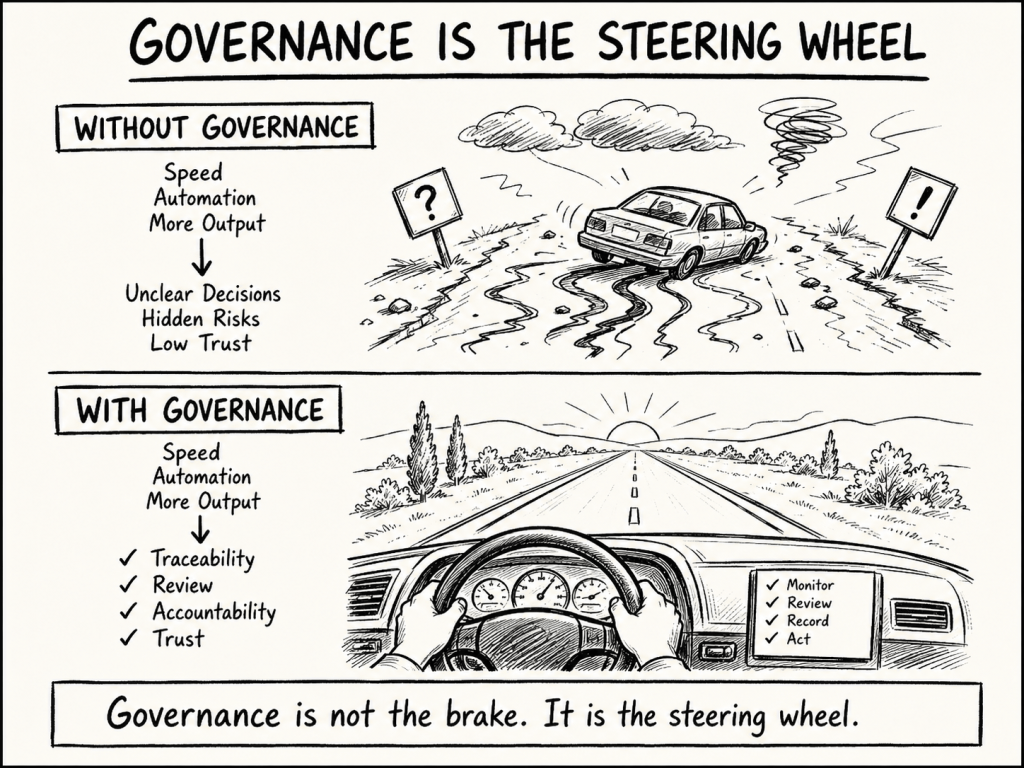
The more autonomous our systems become, the more important governance becomes. Governance is not the opposite of innovation. Governance is what makes innovation repeatable, reviewable, and trustworthy.
Governance is not a brake.
It is the steering wheel.
15. The Rise of Governance Engineering
For decades, software engineering focused primarily on implementation.
The central questions were:
How do we build the system?
How do we write the code?
How do we test it?
How do we deploy it?
These questions remain important. But AI-assisted engineering changes the balance. When implementation becomes increasingly automated, the value of engineering shifts.
The most important questions become:
Why was this decision made?
Which requirement triggered it?
Which system generated or recommended it?
Which human approved it?
Which risk was accepted?
Which evidence supports the decision?
Can the decision be reviewed later?
This is where Governance Engineering becomes relevant. Governance Engineering is not about slowing teams down. It is about designing software engineering systems where decisions remain:
Traceable
Reviewable
Explainable
Accountable
Compliant
Trustworthy
In traditional software engineering, governance often appeared late in the process. In Agentic Software Engineering, governance must move earlier.
It must become part of:
requirements
architecture
review workflows
implementation planning
testing
deployment preparation
operational monitoring
The emerging discipline may therefore not be defined only by better prompts, better agents, or better models.
It may be defined by better governance systems.
Future engineering organizations may differentiate themselves less by how quickly they generate code and more by how effectively they govern the decisions that create that code.
That is the rise of Governance Engineering.
16. Conclusion: The Ultimate Sorcerer’s Apprentice
We are facing a modern version of Goethe’s *Der Zauberlehrling* — *The Sorcerer’s Apprentice*. We worry about automated systems running beyond our control.
Yet our own software designs, optimization goals, productivity expectations, and competitive pressures continuously push us toward greater autonomy.
The AI bears no responsibility for this acceleration.
The human remains the driving force.
That is why governance matters.
AI can generate code.
AI can analyze repositories.
AI can propose architectures.
AI can identify risks.
AI can create documentation.
AI can even participate in engineering decisions.
But AI cannot own the consequences.
The central challenge of Agentic Software Engineering is therefore not only technical.
It is organizational.
It is architectural.
It is ethical.
It is about accountability.
As AI systems become more capable, the question is no longer only:
> How intelligent is the system?
The more important question becomes:
> How well is the system governed?
This requires more than better prompts or better models.
It requires:
Traceability
Reviewability
Human approval
Source history
Separation of responsibilities
Risk visibility
Governance boundaries
If we fail to establish these principles, we risk building increasingly complex systems that society, organizations, and even engineering teams can no longer audit, understand, or control.
The future of software engineering may not be defined by the intelligence of our agents. It may be defined by the quality of the governance systems that guide them.
AI can generate the building blocks. Humans must still own the architecture, the accountability, and the consequences.
NIST AI Risk Management Framework (AI RMF) https://www.nist.gov/itl/ai-risk-management-framework Supports AI risk management, governance, trustworthiness, and accountability framing. NIST is the official source for the AI RMF.
ISO/IEC 42001:2023 — Artificial Intelligence Management System https://www.iso.org/standard/42001 Supports the AI management-system and governance framing. ISO describes ISO/IEC 42001 as an AI management system standard for managing AI risks and opportunities.
The Twelve-Factor App Methodology https://12factor.net/ Supports cloud-native architecture and application delivery practices.
Google Secure AI Framework (SAIF) https://saif.google/ Supports secure AI system design and AI security governance. Google describes SAIF as a framework for building AI securely and responsibly.
Microsoft Responsible AI https://www.microsoft.com/en-us/ai/responsible-ai Supports the responsible AI framing, especially human-centered design, transparency, accountability, privacy, and safety.
IBM Responsible AI / AI Governance https://www.ibm.com/think/topics/responsible-ai Supports the governance lifecycle view. IBM describes responsible AI as combining people, processes, tools, and governance across the AI lifecycle.
Note: This post reflects my own ideas and experience; AI was used only as a writing and thinking aid to help structure and clarify the arguments, not to define them.