This blog post addresses the topic, how to use environment variables to make a containerized Vue.js frontend application more flexible. We will touch following technologies Vue.js, NGINX, JavaScript, Dockerfile and Code Engine.
How to use environment variables to make a containerized Quarkus application more flexible
When you run a containerized application on a container orchestration platform like Kubernetes, Open Shift or with a serverless framework like Knative or Code Engine or on other platforms, it is helpful to pass endpoints to other applications to the containerized application by using environment variables. When the container will be restarted, these variables can be provided to the container and no adjustment in the source code is necessary. You can use configmaps or in Code Engine simple the environment variable itself.
New hands-on workshop: Get started to deploy a Java Microservices application to Code Engine
Code Engine is build to create modern, source-centric, containerized, and serverless apps and jobs. Take a quiz to get started with the Code Engine terminology.
Build a Docker image, push it to Docker hub and clean up local disk space
This blog post does contain the tasks to create a Docker image and upload the image to dockerhub and clean up the image and container on the local machine. Upload Run Push (or save) Clean up Upload the image 1. Create a local Docker image using docker build Dockerhub account name: tsuedbroecker Dockerhub repository name:... Continue Reading →
IBM Cloud Container Registry is Deprecating Container Builds
In this blog post I want to point out that I noticed that the IBM Cloud Container Registry is deprecating container builds.
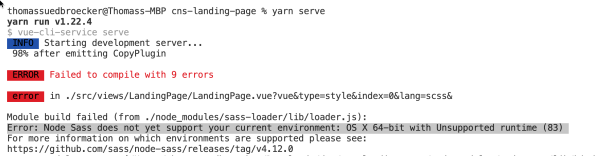
Error: Node Sass does not yet support your current environment: OS X 64-bit with Unsupported runtime (83) … using a remote development container to run the Vue.js application
OS X 64-bit with Unsupported runtime (83) ... In this blog post I want to show, how to setup a remote development container for a Vue.js application, which isn't able to run on my local machine, even after the update of Node.js, npm and yarn.
Run a PostgreSQL container as a non-root user in OpenShift
In this blog post I want to point out a simple topic: How to run a simple PostgreSQL Docker image as a non-productive container in OpenShift? As you maybe know, OpenShift doesn't allow by default to run container images as root. The image below shows the result of the simply deployed postgreSQL image from dockerhub. It's possible... Continue Reading →
Setup a MongoDB in less than 4 min on a free IBM Cloud Kubernetes cluster at a Hackathon
In this blog post I want to highlight that I just created a GitHub project and a 10 min YouTube video to "How to setup mongoDB in less than 4 min on a free IBM Cloud Kubernetes cluster at a Hackathon". My objective is to provide a small guide, how to setup a MongoDB server... Continue Reading →
Use distributed Logging for Mircoservices
In this blog post I want to point out that I just created a 9 min YouTube video related to the great Hands-on workshop: Reactive Endpoints with Quarkus on OpenShift. In this video you can watch and follow the steps of the exercise 5 "Use distributed Logging". https://youtu.be/LHncW_HUwFU Let me give you a short preview... Continue Reading →
Deploy a Microservice to OpenShift
In this blog post I want to point out that I just created a 9 min YouTube video related to the great Hands-on workshop: Reactive Endpoints with Quarkus on OpenShift. In this video you can watch and follow the steps of the exercise 4 "Deploy Service to OpenShift". Let me give you a short preview... Continue Reading →