This post shares lessons from a 14-day engineering project using IBM Bob’s Agentic IDE. It is not a product review or benchmark, but a personal experience report about how intensive Agentic Coding changed the author’s engineering behavior. A central observation is the “Navigation System Syndrome”: as trust in the Agentic IDE increased, the author worked at a higher abstraction level and inspected fewer implementation details. The post explores why continuous specification management, verification, documentation, observability, Engineering Provenance, and human responsibility remain essential when AI becomes a more capable part of software engineering.
From Idea to Responsibility: Why AI Coding Needs Engineering Provenance
AI coding agents increasingly participate in planning, implementation, review, testing, and documentation. This raises a new engineering question: who actually created the software artifact? This post explores why Git history alone is no longer sufficient, how engineering provenance could capture the role of humans, agents, models, tools, and context, and why this matters for intellectual property, accountability, and risk. The broader shift may no longer be from coding to review, but from idea to responsibility.
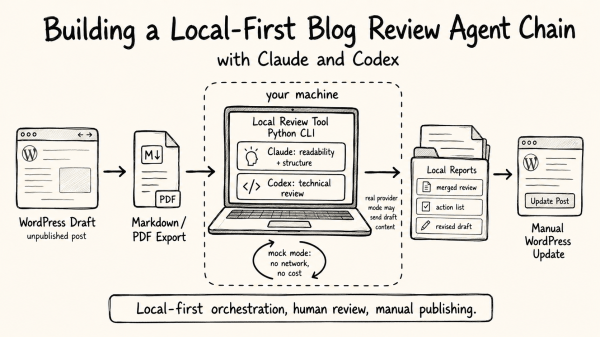
Building a Local-First Blog Review Agent Chain with Claude and Codex
I built a local-first Python CLI that reviews unpublished blog drafts with Claude and Codex in sequence. The tool keeps orchestration, reports, and publishing manual, while supporting mock mode for no-network testing. This post explains the workflow, privacy boundaries, provider authentication, and why human review remains essential.
From AI Coding Assistants to Autonomous Engineering Systems
This article explores why governance becomes more important as software engineering becomes increasingly automated. It describes the evolution from human-centric development to AI-assisted and agentic engineering, where AI systems no longer only generate code but increasingly participate in engineering decisions. The main argument is that faster software creation does not automatically lead to better software. As AI accelerates implementation, accountability, traceability, reviewability, and human approval become more important. Effective governance allows organizations to use AI capabilities without losing human responsibility. It helps make AI-assisted software engineering more transparent, more reviewable, and more trustworthy.
The Rise of Agentic AI and Managing Expectations
This blog discusses the emergence of agentic AI, capable of planning and executing complex tasks autonomously, contrasting with traditional generative AI. The post emphasizes the importance of managing expectations, oversight, and ensuring transparency due to the unpredictability, including potential hallucinations associated with these systems. LangGraph is highlighted as a powerful tool for developing agentic workflows.