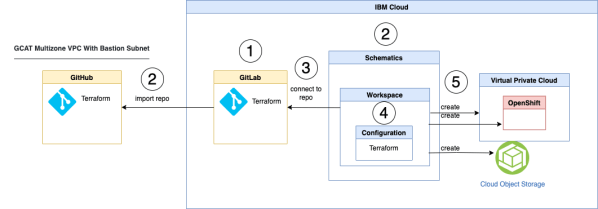
This small cheat sheet is about "how you update a master node of an IBM Cloud OpenShift cluster" and it is also related to an older blog post I wrote called Using a Red Hat OpenShift cluster on IBM Cloud some basic thoughts. (Link to the IBM Cloud documentation) Step 1: Login to your IBM Cloud account where... Continue Reading →
Where to get free OpenShift training on IBM Developer?
This short cheat sheet is about how to get free OpenShift trainings on IBM Developer.This can be useful when you want to get started with OpenShift on IBM Cloud or even when you get started with OpenShift only. In these hands-on labs you will get a free OpenShift cluster on IBM Cloud to run your... Continue Reading →
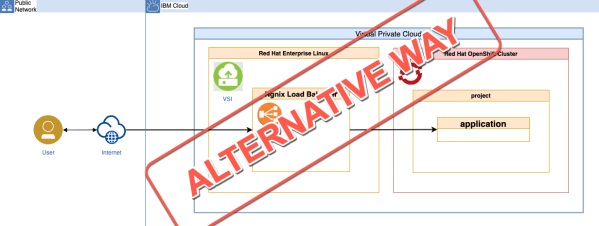
An alternative way for access the example application on OpenShift in VPC
alancer on the Virtual Service Instance (VSI) from the last blog post titled Use a Ngnix load balancer on a VSI to access an application on OpenShift in VPC.
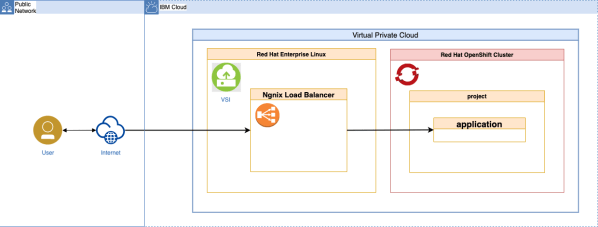
Use a Ngnix load balancer on a VSI to access an application on OpenShift in VPC
This blog post is a (bigger) cheat sheet about: - How to setup a simple Ngnix as a load balancer on a Virtual Server Instance (VSI) that runs in a Virtual Private Cloud (VPC)? - How to configure a Red Hat OpenShift project, to allow a REST endpoint invocation of an application inside the OpenShift project from a VSI instance that runs in the same VPC as the Red Hat OpenShift cluster?
Open the door for root users in Red Hat OpenShift (example StatefulSet)
This "blog post"/"cheat sheet" is about "Open the door for root users in OpenShift (example StatefulSet)". The topic is in context of two blog posts I wrote called Run a PostgreSQL container as a non-root user in OpenShift and Open the door for root users in Red Hat OpenShift¶.
Open the door for root users in Red Hat OpenShift (example Deployment)
This "blog post"/"cheat sheet" is about "Open the door for root users in OpenShift". The topic is in context of an older blog post I wrote called Run a PostgreSQL container as a non-root user in OpenShift. Let's look for the opposite perspective this blog post.
Automated creation of a Red Hat OpenShift cluster on IBM Cloud using the existing CLIs and plugins
This blog post is about automating the creation of a Red Hat OpenShift cluster on IBM Cloud in a Virtual Private Cloud. I used bash scripting with the IBM Cloud CLI and and the associated IBM Cloud CLI plugins vpc-infrastructure and kubernetes-service. I also use jq to handle json output.
Create an edge route for an example application on a Red Hat OpenShift Cluster on IBM Cloud
the content, with some small modifications, to my existing example application. It's the same application I used in this blog post Using the internal OpenShift container registry to deploy an application.
Networking videos – used as refresh or intro
This very short blog post contains only links to two awesome very old refresh and introduction YouTube videos related to the networking topic. I just want to share these video links, because from my perspective it's useful to know when you’re working with containers and container orchestrations for example in context of Kubernetes clusters and virtual private clouds.
Using the internal OpenShift container registry to deploy an application
This cheat sheet is an extension to a blog post I made which is called: Configure a project in an IBM Cloud Red Hat OpenShift cluster to access the IBM Cloud Container Registry . In that related blog post we used the IBM Cloud Container registry to get the container images to run our example application. Now in this cheat sheet we will use the Red Hat OpenShift internal container registry and the Docker build strategy to deploy the same example application to OpenShift.