This post looks at how today’s GenAI landscape strongly favors fast, outcome-driven innovation — and how this focus can quietly push invention into the background. While innovation fits well into KPI-driven environments and short delivery cycles, invention needs time, uncertainty, and space to explore new possibilities. The goal of this post is not to argue against innovation, but to show why we need a more deliberate balance if we want genuinely new ideas to emerge in the future.
Table of content
The zeitgeist I notice (and how I catch myself in it)
First: definitions that don’t come from marketing
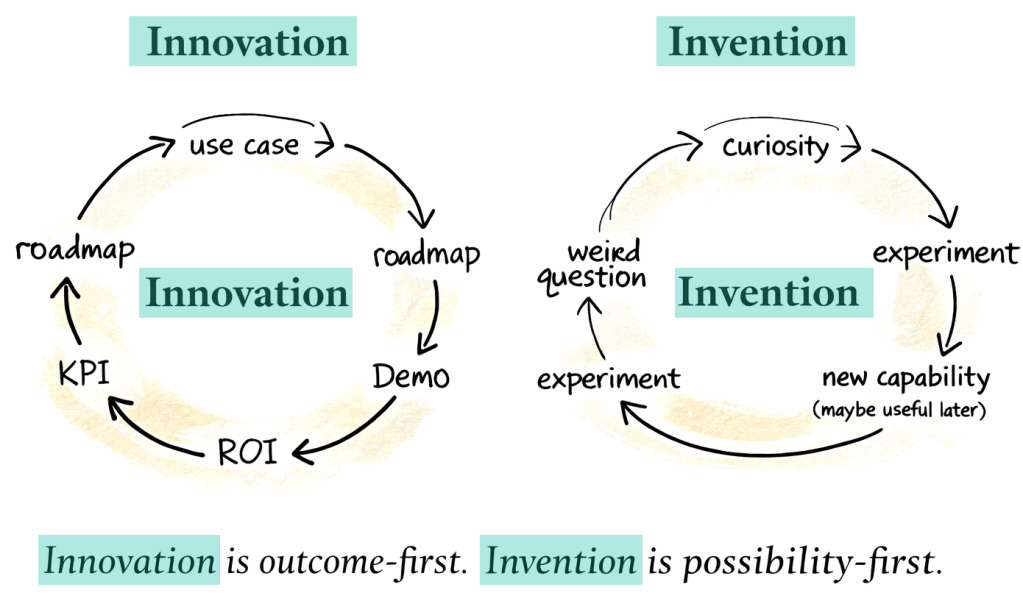
The tension: innovation is measurable, invention is not
Why GenAI turbocharges “innovation mode”
A necessary nuance: RAG, agents, and “self-learning” can move the boundary — but they don’t remove it
I feel this personally: Suno and the “producer vs artist” shift
My conceptual hypothesis: fast outcomes bias us against new possibilities
The irony: innovation depends on invention (but forgets it)
So… do we still need invention?
Practical habits to keep invention alive (even in “innovation cultures”)
Crisp takeaway
Summary
Resources
1. The zeitgeist I notice (and how I catch myself in it)
Over the last few months (and two years ;-), I’ve been catching myself in the same loop:
I see something new in the GenAI space.
I immediately translate it into a use case.
I ask, almost automatically: “Where is the value? What is the outcome? How fast can we ship it?”
That mindset is practical. It’s also a little scary.
Because it feels like we’re optimizing everything around innovation (outcomes, adoption, monetization) — while slowly losing the muscle for invention (new technical possibilities, curiosity-driven exploration).
This post is my attempt to pin down that difference and to ask a slightly uncomfortable question:
Are we building a world where innovation becomes so dominant that it quietly kills invention?
2. First: definitions that don’t come from marketing
If we don’t define terms, this topic turns into vibes.
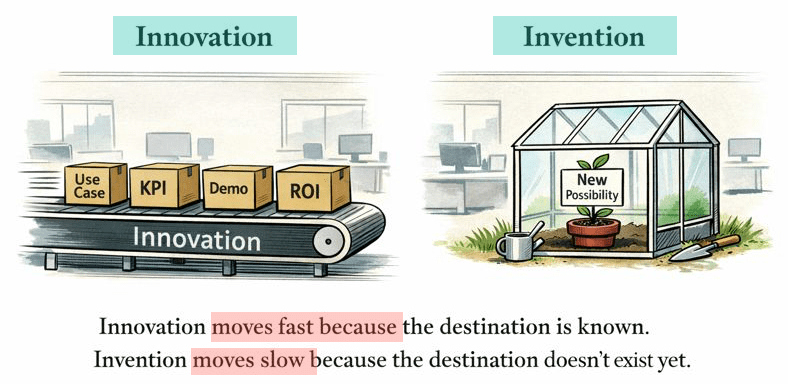
The OECD/Eurostat Oslo Manual 2018 defines innovation as a new or improved product or process that differs significantly from what existed before and is made available to users or brought into use.
ISO 56000:2020 makes the value dimension explicit: innovation is a new or changed entity that realizes or redistributes value.
So innovation is not “a clever idea.” Innovation is an idea that escaped the lab.
2.2 Invention (new technical possibility)
“Invention” is fuzzier in everyday language, so I like to borrow the precision of patent law as a boundary.
The European Patent Convention states that patents are granted for inventions that are:
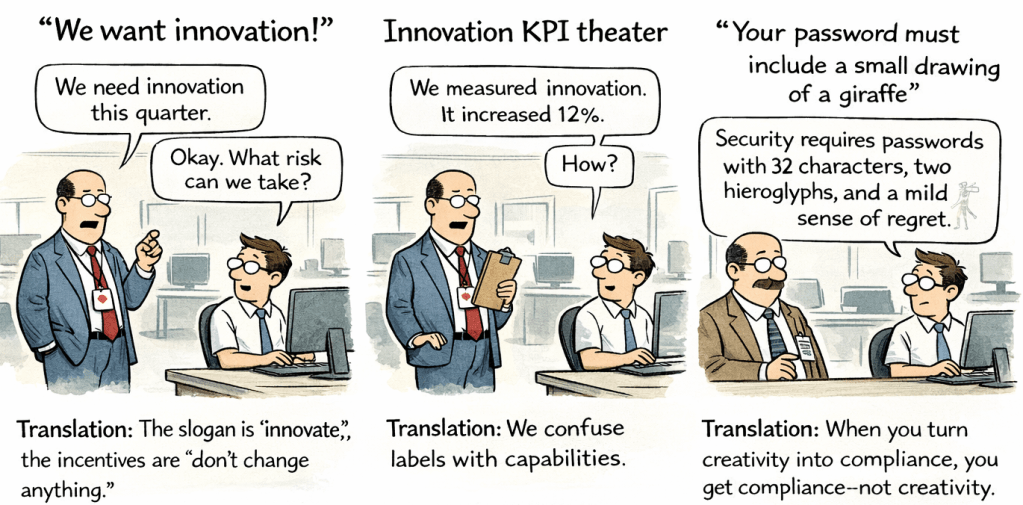
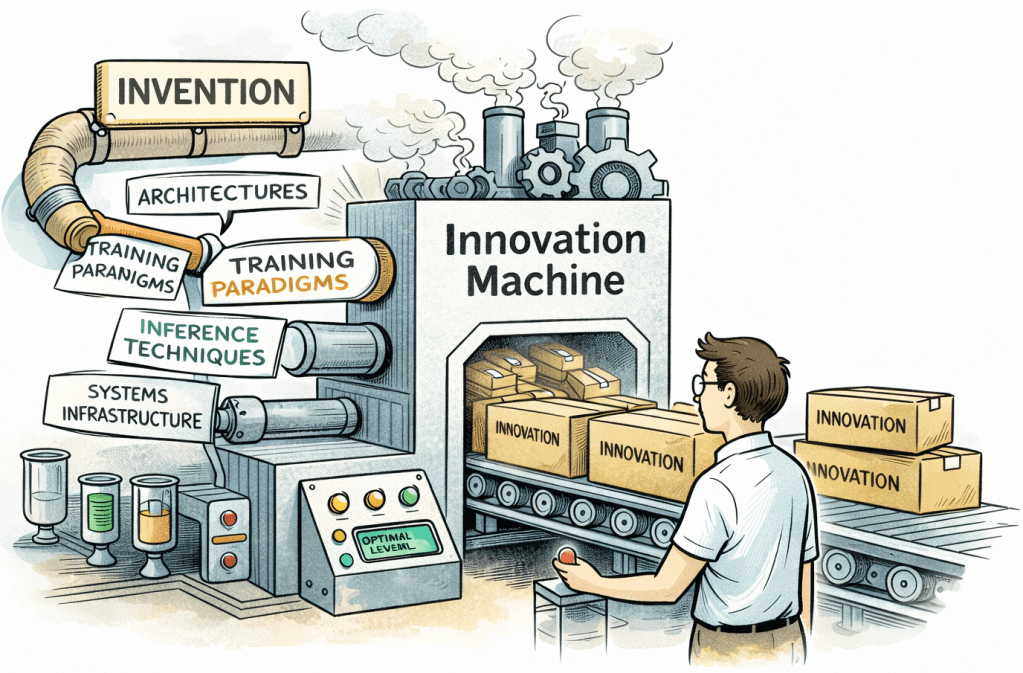
In a world optimized for speed and outcomes, that looks like a luxury. The following cartoons illustrate exactly this tension.
4. Why GenAI turbocharges “innovation mode”
GenAI is a recombination machine.
Large language models are extremely good at producing plausible, structured combinations of existing knowledge. That is a superpower for many innovation activities:
product ideation
drafting and prototyping
code scaffolding
documentation and enablement
workflow automation
When you add agents on top, the system becomes even more outcome-oriented.
IBM frames agentic AI as systems that can accomplish goals with limited supervision, often via coordinated agents. IBM defines AI agents as systems that autonomously perform tasks by designing workflows using available tools.
That’s not invention energy. That’s execution energy.
GenAI compresses the time between:
“I have an idea” → “I have something that looks shippable.”
5. A necessary nuance: RAG, agents, and “self-learning” can move the boundary — but they don’t remove it
Yes — with RAG-based agents, feedback loops, and systems that adapt over time, something closer to invention canemerge inside GenAI frameworks.
RAG allows models to work with new information beyond training.
Agents can explore, test, and refine actions across environments.
Feedback loops can shift system behavior.
At first glance, this feels like a step toward invention.
But here’s the distinction that matters to me:
Even with RAG and self-improving loops, the way we use GenAI remains innovation-driven — because the system is optimized for fast, concrete outcomes.
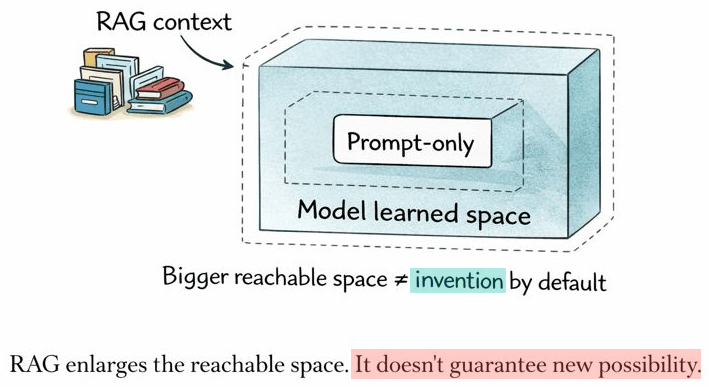
RAG expands the reachable space (what can be answered with the right context). It does not automatically expand the possible space (new primitives, new fundamentals).
So yes, the box gets bigger. But it is still a box.
6. I feel this personally: Suno and the “producer vs artist” shift
This is not abstract for me. I feel it when I use GenAI creatively to generate music for my videos.
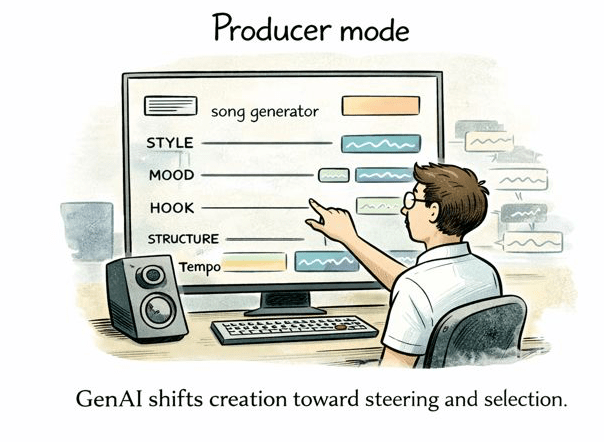
When I generate a song with Suno, I still do a lot of human work:
I write lyrics.
I define structure (intro, verse, chorus, bridge).
I iterate on hooks and phrasing.
I steer style, mood, and “what the song is about.”
I refine until it matches the picture in my head (heart).
The output can be genuinely impressive.
But the role I’m playing feels different from what we traditionally call an artist.
It feels much more like being a producer:
I’m directing a system.
I’m choosing takes and variations.
I’m shaping constraints and selecting outputs.
I’m curating until something “works.”
And even when the result sounds “new,” the underlying dynamic remains:
I’m not creating new musical primitives.
I’m recombining patterns learned from massive prior data.
I’m operating inside the space the model already knows.
6.1 It’s new to me, but not new in principle
It’s novelty as composition and selection, not novelty as capability.
That’s why this feels like innovation, not invention:
I can produce a usable artifact fast.
I can tailor it to a purpose (vibe, message, maybe monetization).
I can iterate until it fits a target.
But I will most likely not invent something totally new in the “new possibility” sense — because I’m bounded by:
what the model was trained on,
what it can express,
what it considers “likely” enough to generate.
As a drummer, I even feel how quickly “an idea could become real.” But that speed is exactly the point: it’s outcome-first.
7. My conceptual (not empirical) hypothesis: fast outcomes bias us against new possibilities
When the cost of producing outcomes drops, the pressure to justify everything via outcome rises.
GenAI accelerates this effect.
Even with advanced setups—RAG, agents, feedback loops—the dominant question stays:
“What does this produce?”
“How fast?”
“For whom?”
So we filter too early.
We ask first:
“What is the concrete use case?”
“Who will pay?”
“What’s the adoption path?”
“Can we demo it next week?”
And we ask less often:
“What new capability could exist here?”
“What if this has no immediate application?”
“What would we learn even if this never ships?”
The result is not stagnation.
The result is acceleration inside a smaller box.
7.1 Innovation selects for the “likely”
fast wins
incremental improvements
safer bets
what can be explained in slides
7.2 Invention selects for the “strange”
new primitives
weird capabilities
unintuitive effects
things you can’t justify yet
If you only optimize for the first, you don’t just ship faster.
You ship into a smaller future.
8. The irony: innovation depends on invention (but forgets it)
Innovation is not “bad.” We need it. But it’s downstream.
Without invention, innovation becomes:
optimization
packaging
distribution
incremental recombination
And in GenAI, I see a lot of real value-generation built on already-invented foundations:
architectures
training paradigms
inference techniques
systems infrastructure
Most “GenAI innovation” today is about making those inventions usable.
9. So… do we still need invention?
My answer: yes — but we have to protect invention on purpose, because today’s environment does not reward it automatically.
Invention creates new options. Innovation uses existing options — or discovers options that already existed but were not visible before (research).
If we focus too much on using what already exists, we slowly lose the ability to explore new things.
GenAI did not create this problem. It simply makes the imbalance easier to see.
10. Practical habits to keep invention alive (even in “innovation cultures”)
10.1 Create an “invention budget” not tied to ROI
Not “10% time” as a slogan — a real commitment:
time-boxed experiments
permission to fail
learning as the metric
10.2 Prototype as a question, not as a product
Instead of “Can we ship this?” ask:
“What would we have to believe for this to work?”
“What breaks first?”
“What new primitive could exist here?”
10.3 Separate discovery work from delivery work
Mixing them is how invention dies.
Discovery needs space, ambiguity, and permission to look stupid. Delivery needs deadlines and constraints.
10.4 Make “novel capability” a first-class review topic
Ask explicitly:
What is the new capability here?
Is it truly new, or just a wrapper?
If it’s recombination: what is the new leverage?
10.5 Treat agents as execution engines, not frontier engines
Agentic systems excel at end-to-end workflows. But accelerating delivery accelerates the existing roadmap, not the frontier.
Sometimes the best use of agents is to automate the boring parts — so humans can invent.
11. Crisp takeaway
Innovation is necessary — but not sufficient.
GenAI accelerates innovation by compressing “idea → outcome.”
Faster outcomes bias us toward what is immediately valuable.
Invention is the oxygen that keeps the option space alive.
If we want a future that is more than recombination, we must protect invention deliberately — with time, permission, and different success criteria.
12. Summary
This post argues that the current GenAI zeitgeist strongly favors innovation — fast, outcome-driven reuse of existing knowledge — while unintentionally sidelining invention, which is about creating genuinely new possibilities without a predefined destination.
By grounding the discussion in clear definitions, it shows why innovation thrives in KPI-driven environments, while invention struggles to justify itself. Concrete examples, especially music generation with Suno, illustrate how creators increasingly act as producers — steering and selecting — rather than inventing new primitives.
The central conceptual (not empirical) hypothesis is that fast outcomes shrink the search space for new possibilities. Innovation depends on invention, but often forgets it.
The conclusion is not anti-innovation, but a call for balance: if we want a future that is more than recombination, we must deliberately make room for invention.
Note: This post reflects my own ideas and experience; AI was used only as a writing and thinking aid to help structure and clarify the arguments, not to define them.
I hope this was useful to you and let’s see what’s next?

 Thomas Suedbroecker's Blog
Leave a comment