

This blog post does not try to provide final answers. It simply captures a set of observations and concerns I have developed while working with AI tools in practice.
- Introduction
- Why This Could Lead to Less Openness
- A Possible Future: AI Driving Digital Protectionism
- The Paradox of the AI Era
- Summary with Open Questions
- References
1. Introduction
During the last months, I spent a lot of time working with AI tools for code
generation and application development. I experimented with tools such as IBM Bob, Codex, and other AI and agent development tooling.
One observation became very clear during this work, even if the point itself is not entirely new:
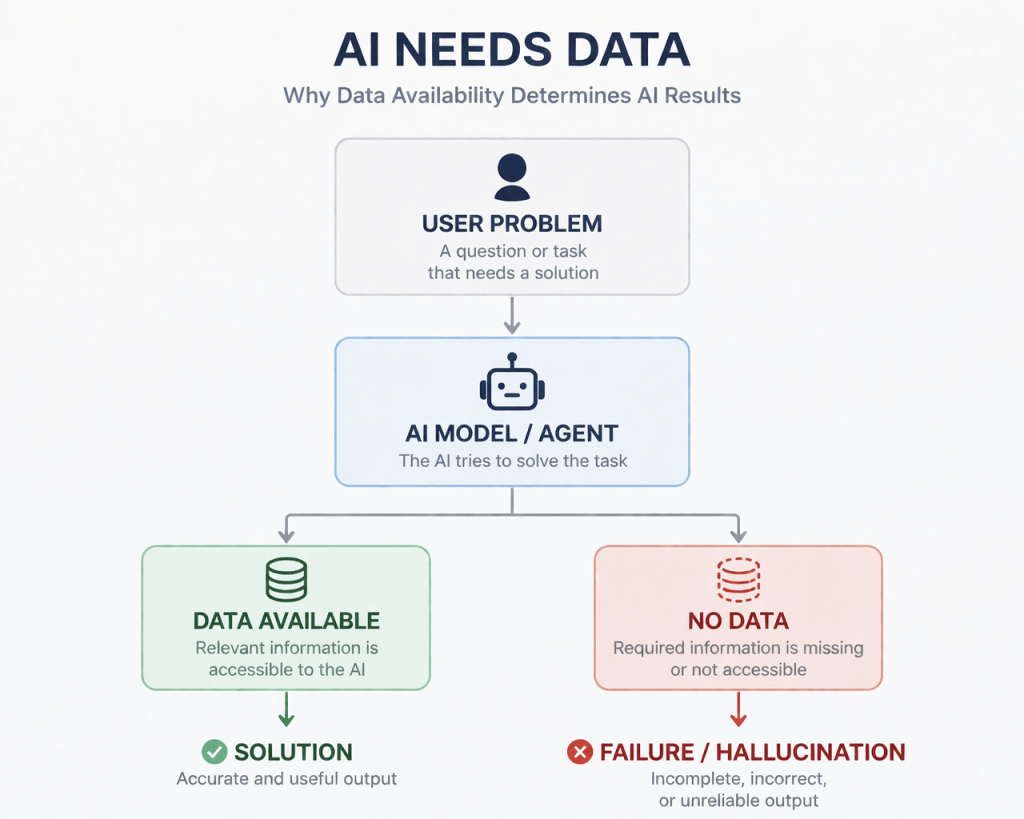
AI can be very powerful, but only when the required information is available.
Several times, I tried to generate implementations or integrations where the needed information was either not available on the internet, not accessible through APIs or other data sources, or simply outdated. In these situations, the tools struggled. They produced incomplete solutions or errors that were difficult to debug.
The reason was simple:
The required information was missing.
This experience reinforced something that had already become clear to me.
AI systems are not limited only by the quality of their models or by their non-deterministic nature. In many practical situations, they are limited by access to information — in other words, by access to data.
This is why I believe the following statement is becoming more important again:
- Data is the real currency of AI.
This diagram visualizes my initial observation while working with AI tools.
2. Why This Could Lead to Less Openness
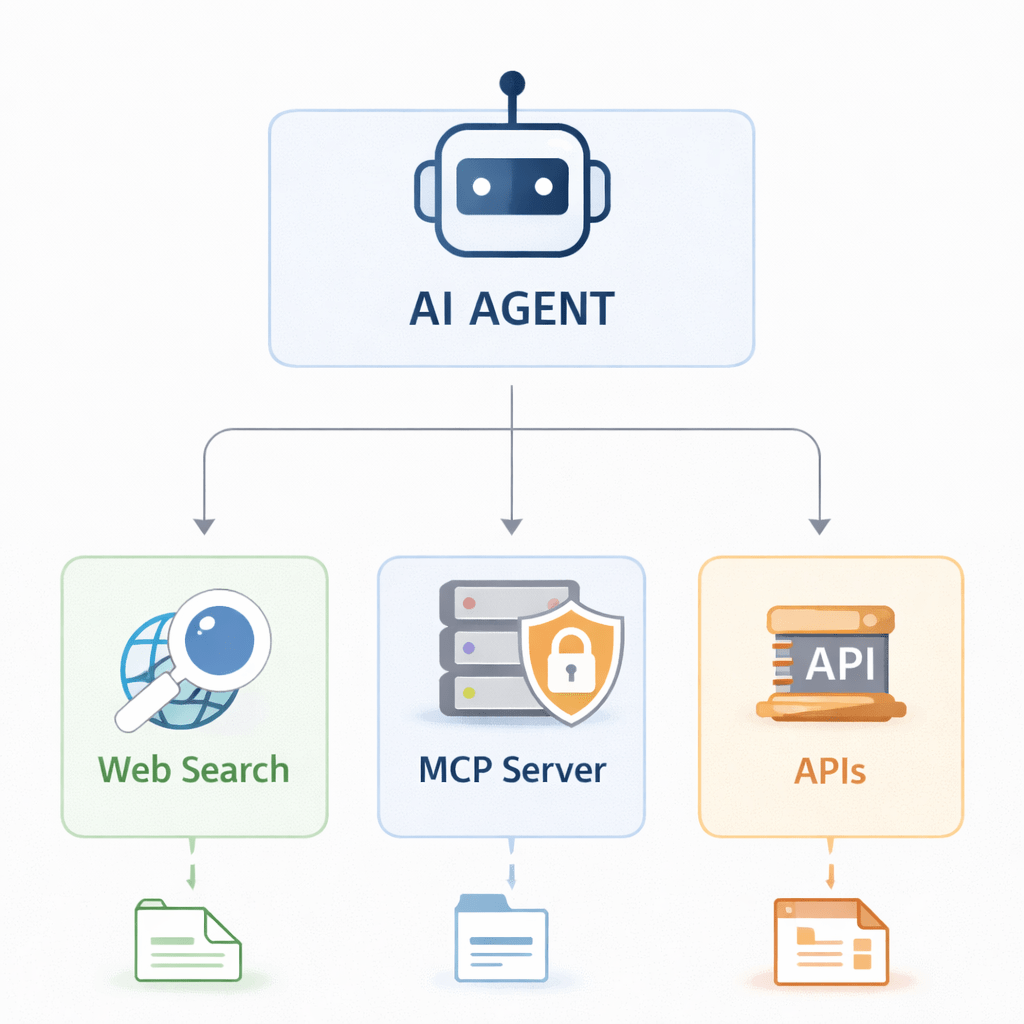
When working with modern AI systems, especially in the context of agentic AI architectures and MCP servers, the importance of accessible data becomes even clearer.
Agents can interact with systems, call tools, and perform complex tasks. However, they can only do this if the necessary data sources exist and are accessible.
Without access to relevant data:
- even strong large language models struggle to reason correctly
- agents cannot perform meaningful actions
- automation becomes limited
In other words, AI systems depend heavily on the availability of information.
This leads to an important economic implication.
If AI systems generate value mainly through the data they can access and process, then the competitive advantage may increasingly shift toward those who control valuable data sources.
This creates a potential tension.
For many years, large parts of the software ecosystem benefited from openness:
- public documentation
- open APIs
- open-source projects
- shared datasets
However, if data becomes the key factor that enables AI systems to generate value, organizations may start asking a different question:
Why should we make valuable data freely available?
From a business perspective, the incentives could slowly change.
Instead of sharing information openly, companies may prefer to protect, restrict, or monetize access to their data.
We can already observe early signals of such developments:
- more closed AI models
- restricted access to training data
- paid APIs replacing previously open interfaces
- increased control over proprietary datasets
These developments do not necessarily mean that openness will disappear.
But they may indicate that data access is becoming a strategic asset, and that access to information could become more restricted in some areas.
This diagram visualizes my initial observation while working with AI tools.
3. A Possible Future: AI Driving Digital Protectionism
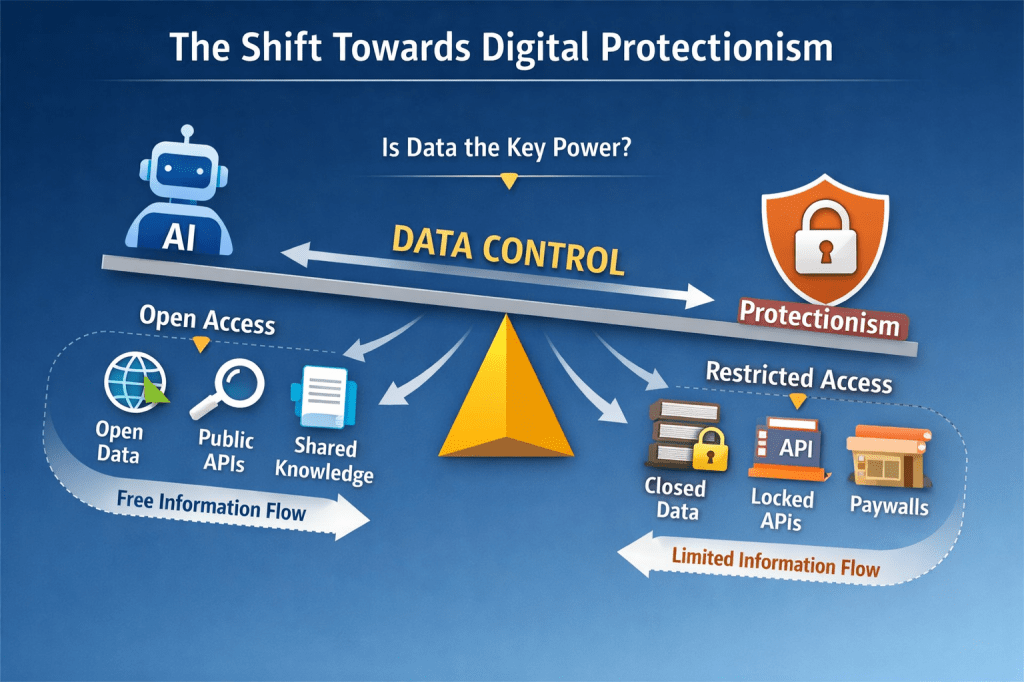
If this trend continues, AI could unintentionally push the digital world toward a new kind of protectionism.
Organizations may increasingly:
- stop sharing datasets
- restrict public documentation
- limit open APIs
- hide knowledge behind paywalls
From a business perspective this makes sense.
The enormous investments in AI infrastructure must eventually generate revenue.
But there is a risk.
If too much knowledge becomes closed, the collective knowledge growth of the ecosystem may slow down.
4. The Paradox of the AI Era
Modern AI systems became powerful largely because of open knowledge and shared data.
Large language models learned from vast amounts of publicly available information:
- documentation
- research papers
- open-source projects
- blogs and tutorials
- public datasets
This openness accelerated innovation across the entire ecosystem.
However, the success of AI is now changing the incentives around data.
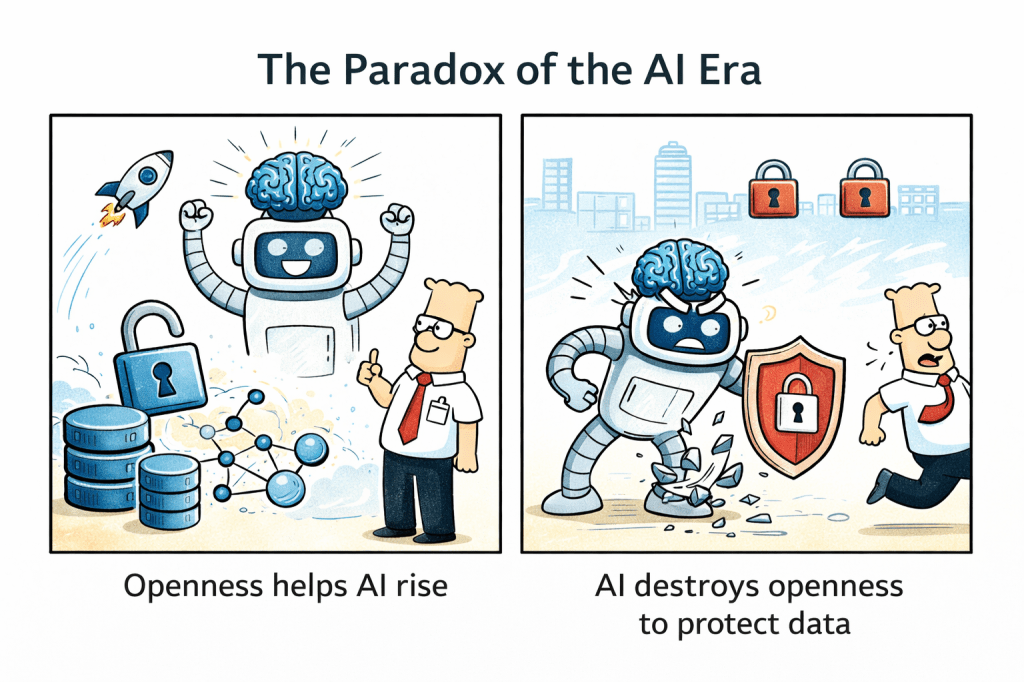
AI became powerful because knowledge and data were shared openly.
But as AI becomes more valuable, data also becomes more valuable.
This may encourage organizations to protect their data instead of sharing it.
That is the paradox:
AI grew because of openness, but its success may reduce that openness.
If access to data becomes more restricted, AI systems may eventually become less effective, because the flow of new information becomes smaller.
In other words:
AI grew because of openness, but its success may reduce that openness.
5. Summary with Open Questions
The observations in this post are not meant as definitive conclusions. They are simply reflections based on practical work with modern AI systems.
One important point should be emphasized:
the idea that data has value is not new. For many years people have said that data is the new currency.
However, the role of data may become even more important in the AI era.
Modern AI systems can process information, generate code, and automate complex tasks at a speed that was previously impossible. When knowledge can be transformed into usable results so quickly, the value of exclusive access to information increases.
In such an environment, competitive advantage may increasingly come from something very simple:
knowing something that others do not know yet.
The easiest way to maintain such an advantage may not always be patents or innovation. It may simply be not sharing knowledge.
For decades, the digital ecosystem benefited from a culture of openness:
- shared documentation
- open-source software
- public APIs
- blogs and tutorials
- freely available datasets
This openness enabled enormous innovation and collaboration.
But if data truly becomes the central economic asset of AI, the incentives around knowledge sharing may slowly change. Organizations – and even individuals – may decide to protect knowledge instead of sharing it.
This could lead to a surprising paradox.
AI systems became powerful largely because knowledge was shared openly.
But the success of AI may encourage behavior that reduces that openness.
If that happens, the ecosystem that enabled rapid innovation could gradually become more closed.
This raises an important question:
- Will AI accelerate innovation through better access to knowledge?
- Or will it contribute to a new form of digital protectionism, where valuable information becomes increasingly restricted?
The answer to this question may shape the future of the AI ecosystem — not only technologically, but also economically and culturally.
6. References
These observations are based on practical experimentation with AI coding and agent tools and on publicly known developments in the AI ecosystem:
- OpenAI platform and API ecosystem
- Anthropic Claude models and API access policies
- IBM watsonx.ai and watsonx Code Assistant and IBM Bob tooling
- Model Context Protocol (MCP) ecosystem and agent-tool interaction patterns
General background concepts:
- Agentic AI architectures
- Retrieval-Augmented Generation (RAG)
- Tool-calling LLM systems
- Data-centric AI development approaches
I hope this was useful to you and let’s see what’s next?
Greetings,
Thomas
#ai, #artificialintelligence, #openknowledge, #opendata, #datasharing, #dataprotection, #datacurrency, #agenticai, #llm, #generativeai, #mcp, #softwaredevelopment, #aiecosystem, #digitalinnovation, #digitalprotectionism
Note: This post reflects my own ideas and experience; AI was used only as a writing and thinking aid to help structure and clarify the arguments, not to define them.
 Thomas Suedbroecker's Blog
Leave a comment