
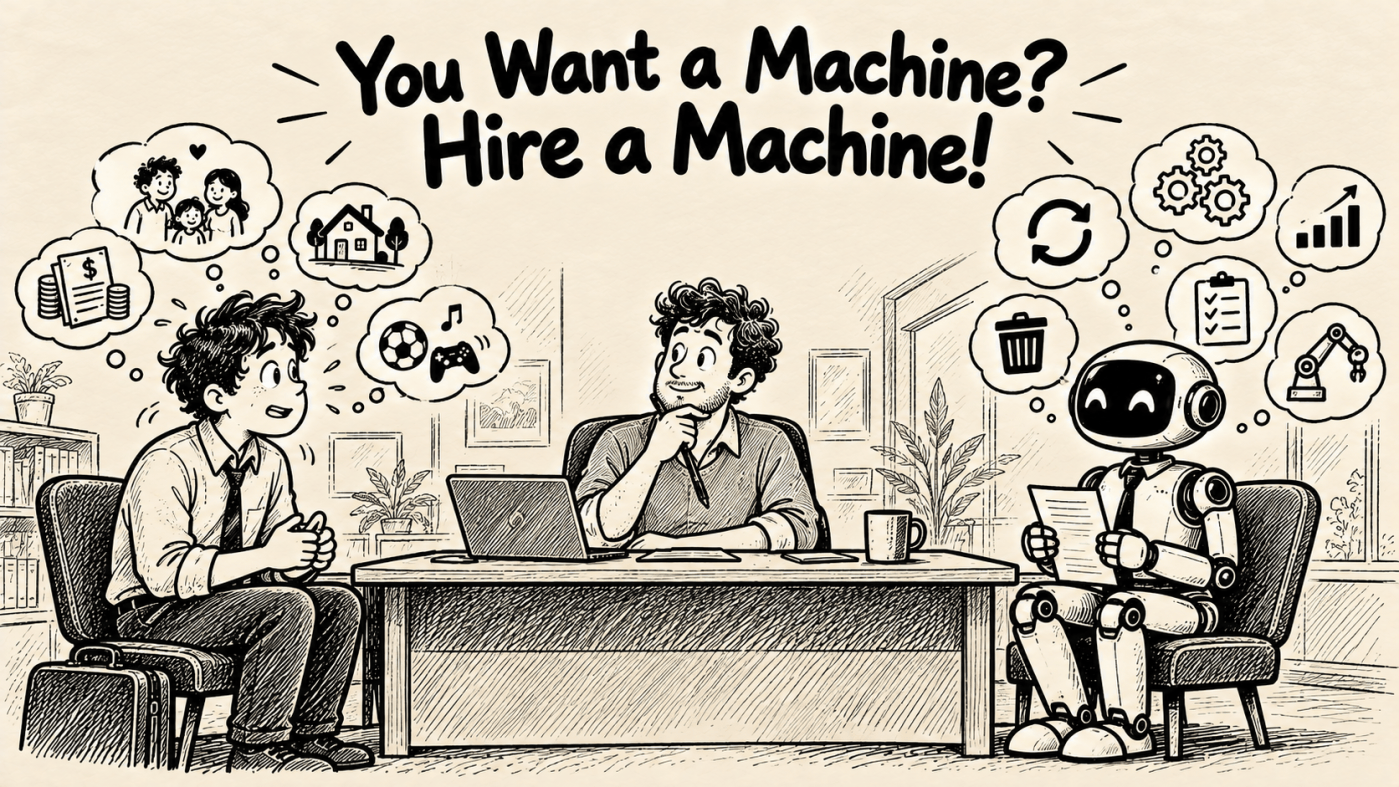
Why a company without human employees might actually be good for people.
Table of content
- What If Replacing Humans Is Sometimes a Good Thing?
- Were We Already Treating People Like Machines?
- Technology Is Not the Problem
- Will Everyone Become a One-Person Company?
- What Responsibility Do Companies Have Towards Society?
- References
Don’t want to read? Just listen to the podcast on YouTube.
1. What If Replacing Humans Is Sometimes a Good Thing?
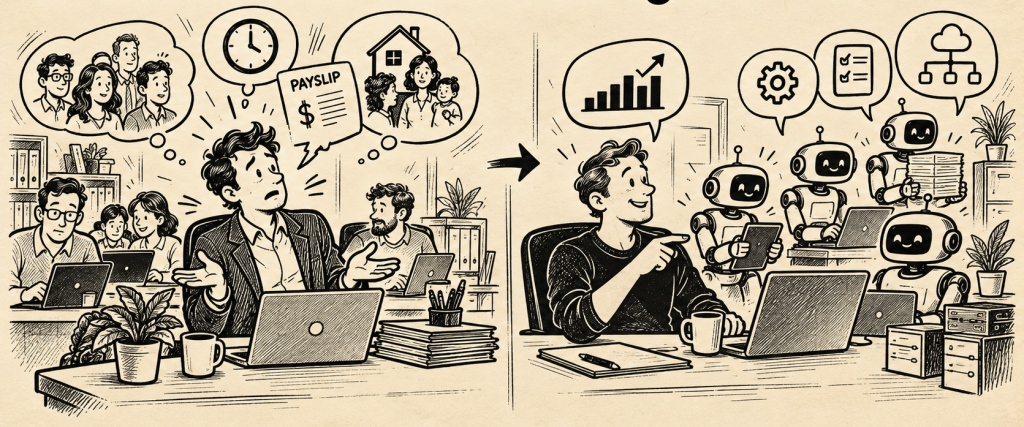
We often discuss how AI agents could replace human employees. We talk about automation, efficiency, productivity, and return on investment. But recently, I had a different thought: what if a company without human employees could actually be good for people?
Imagine an entrepreneur who wants to maximize profits, reduce costs, and optimize every business process. Everything needs to be measurable and efficient. Human employees become resources within these processes.
Here is my provocative hypothesis:
If you want to manage everything like a machine, perhaps you should only manage machines.
AI agents can be created, replaced, restarted, or deleted. They do not have families to support, mortgages to pay, or personal lives that depend on their jobs. When an AI agent is removed, no human employee inside that company loses their livelihood directly. Business decisions can still affect customers, partners, and society. But some entrepreneurs may simply be better suited to managing AI agents than to managing human employees.
Not because business success is wrong.
Not because capitalism is wrong.
But because managing people also means taking responsibility for people.
But isn’t any job better than no job?
This is the strongest objection to my hypothesis. If such an entrepreneur never hires anyone, people do not automatically find a better employer. They may simply have one job opportunity less. I take this objection seriously. My point is not that fewer jobs are good. My point is that a job where a person is treated only as a replaceable resource also has a cost. When we only count jobs, we often ignore this cost.
This is my personal hypothesis, not a scientifically proven conclusion.
2. Were We Already Treating People Like Machines?
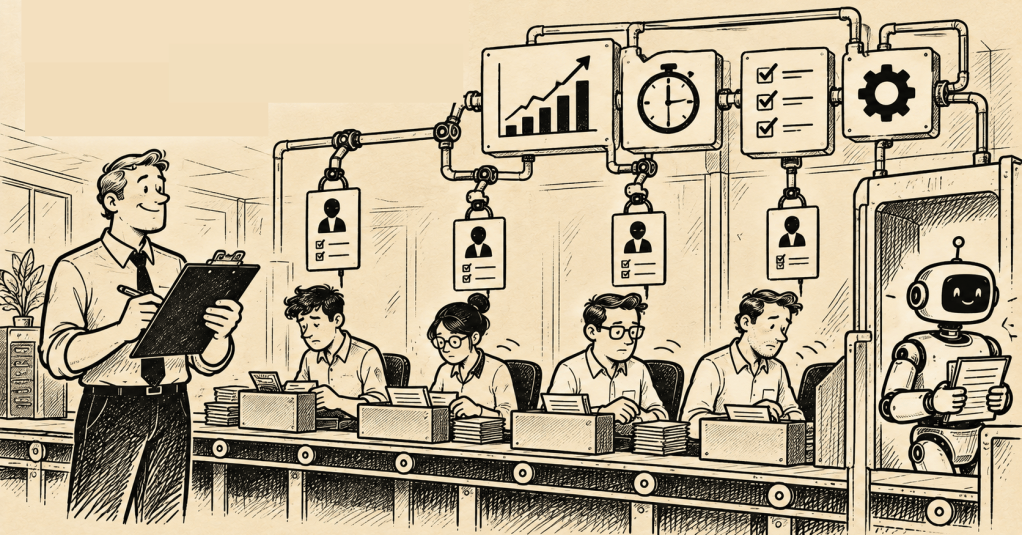
One inspiration for this thought experiment was Gunter Dueck, the former CTO of IBM Germany. In a 2026 podcast interview about his new book on humanoid robots, he discusses the concept of the Funktionsmensch [1]. My rough translation: a person who is valued mainly for functioning reliably, like a part of a machine. In another interview, Dueck describes the humanoid robot as a perfect Funktionsmensch and calls this the real warning of his book [1]. This made me think.
For years, companies have optimized processes, standardized tasks, and measured employee performance. There are good reasons for this. But what happens when people are mainly treated as interchangeable resources? Are we still managing people, or are we managing processes that happen to be executed by people?
If people have already been treated like machines, perhaps replacing some of these processes with AI agents is simply the next step. And perhaps it is better for people not to work in environments where they are primarily treated as machines.
This is my own interpretation and extension of the discussion, not a direct conclusion attributed to Dueck.
3. Technology Is Not the Problem
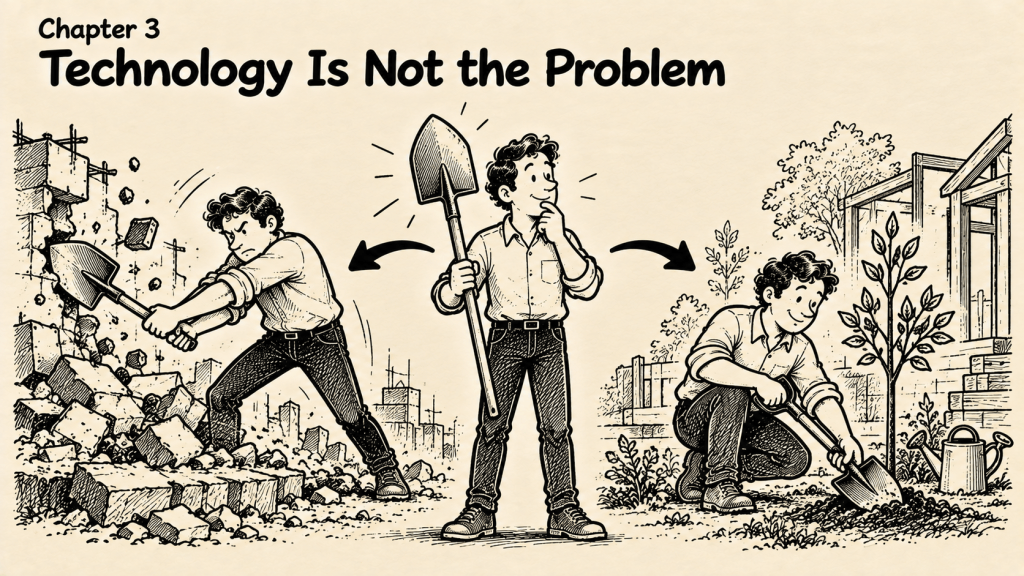
I often use a simple example. A shovel is a tool. What matters is how someone uses it.
I see AI in a similar way. AI agents can help us develop software, automate processes, and create business value. But the technology itself does not determine how we treat other people. Our decisions do.
Maybe AI agents do not create this problem. Maybe they reveal how some people have already been thinking about their employees.
4. Will Everyone Become a One-Person Company?

Let’s take this thought experiment one step further. Imagine a world where companies operate with one person managing multiple AI agents.
- Does everyone become the founder of a one-person company?
- Does everyone create digital products using AI agents?
- And who will buy all these products?
These questions are not new. Already in 1930, John Maynard Keynes discussed technological unemployment [2]. More recently, the International Monetary Fund examined how AI could transform employment and economic inequality [3]. I am certainly not the first person asking these questions. But I want to add another perspective.
What happens to human responsibility when companies increasingly operate without human employees?
5. What Responsibility Do Companies Have Towards Society?
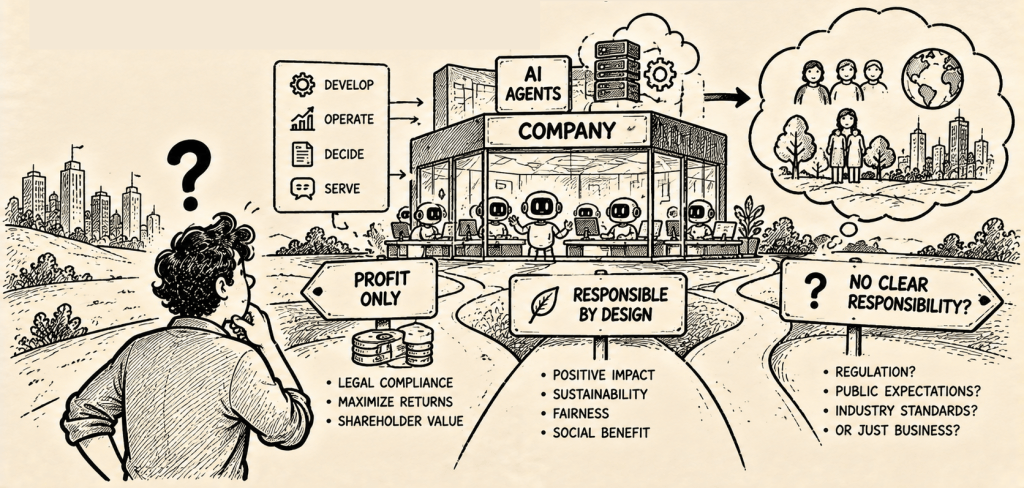
The remaining responsibility may be interpreted in very different ways: as mere legal compliance, as market responsibility towards customers, or as a broader ethical responsibility towards society. In the European Union, corporate social responsibility is defined as the responsibility of companies for their impact on society [4]. Of course, how this responsibility is interpreted depends on the economic and legal system. An entrepreneur may decide to run a business almost entirely with AI agents. That is a business decision.
But this brings me back to the question from the previous section: who will buy all these products? Even a company without employees needs customers, and customers are people. Society is not only the environment around a company. It is also its market.
So my final question is:
If companies no longer need people to operate, what responsibility do they still have towards the society they are part of?
Or, taking this thought experiment even further:
What happens to society if everyone runs a company with AI agents, but nobody needs human employees anymore?
I do not have an answer. This is not an argument against AI, automation, capitalism, or business success. It is a thought experiment about leadership, responsibility, and how we treat other people.
Perhaps some entrepreneurs really should only manage machines.
6. References
The following sources provide background for this thought experiment. They do not establish the central hypothesis about entrepreneurs’ leadership abilities.
[1] Gunter Dueck – Humanoid Robots and the Funktionsmensch (2026)
Everlast AI, KI REVOLUTION: „Die neue Krone der Schöpfung!” Humanoide Roboter, KI & Zukunft (Prof. Gunter Dueck). Published: September 24, 2026. The published episode chapters list Funktionsmensch at 14:58.
Watch the episode (YouTube)
Daniel Fürg, Gin And Talk: Gunter Dueck über humanoide Roboter, Abwehrreflexe und Funktionsmenschen, 48forward. Published: October 3, 2026. In this interview, Dueck describes the humanoid robot as a perfect Funktionsmensch.
Read the interview (48forward)
Related book: Gunter Dueck, Die neue Krone der Schöpfung: Wie humanoide Roboter unsere Arbeitswelt, Gesellschaft und Identität neu definieren, Redline, September 22, 2026, ISBN 978-3-690-46025-5.
Publisher’s website (Redline)
[2] John Maynard Keynes – Economic Possibilities for our Grandchildren (1930)
Keynes discussed technological unemployment and the consequences of improvements in productivity.
Read the essay (PDF)
[3] Kristalina Georgieva, IMF Blog – AI Will Transform the Global Economy. Let’s Make Sure It Benefits Humanity (January 14, 2024)
The IMF estimates that almost 40% of global employment is exposed to AI. Exposure does not necessarily mean job replacement; AI can also complement human work. The IMF also warns that in most scenarios AI will likely worsen overall inequality.
Read the IMF analysis (IMF Blog)
[4] European Commission – A renewed EU strategy 2011–14 for Corporate Social Responsibility, COM(2011) 681 final (October 25, 2011)
The European Commission defines corporate social responsibility as “the responsibility of enterprises for their impacts on society.”
European Commission – Sustainability, due diligence, responsible business
Note: This post reflects my own ideas and experience. AI was used as a writing and thinking aid to structure and check the arguments, not to define them.
#AI #AIAgents #AgenticAI #FutureOfWork #Leadership #Entrepreneurship #Responsibility #CorporateSocialResponsibility #CSR #HumanoidRobots #Automation #ThoughtExperiment #GunterDueck #Funktionsmensch


Leave a Reply