
Original Post From AI Coding Assistants to Autonomous Engineering Systems made in 06/2026
Pip: Welcome to a blog where the question “what happens to my code when I hit send?” turns out to have a genuinely complicated answer — and thomassuedbroecker has spent close to a year working through it.
Mara: This episode covers one deep investigation into AI coding assistants, agentic IDEs, and what privacy actually means when your development environment starts acting like an autonomous agent. Let’s start with what that shift means in practice.
AI Coding Assistants, Agentic IDEs, and Privacy
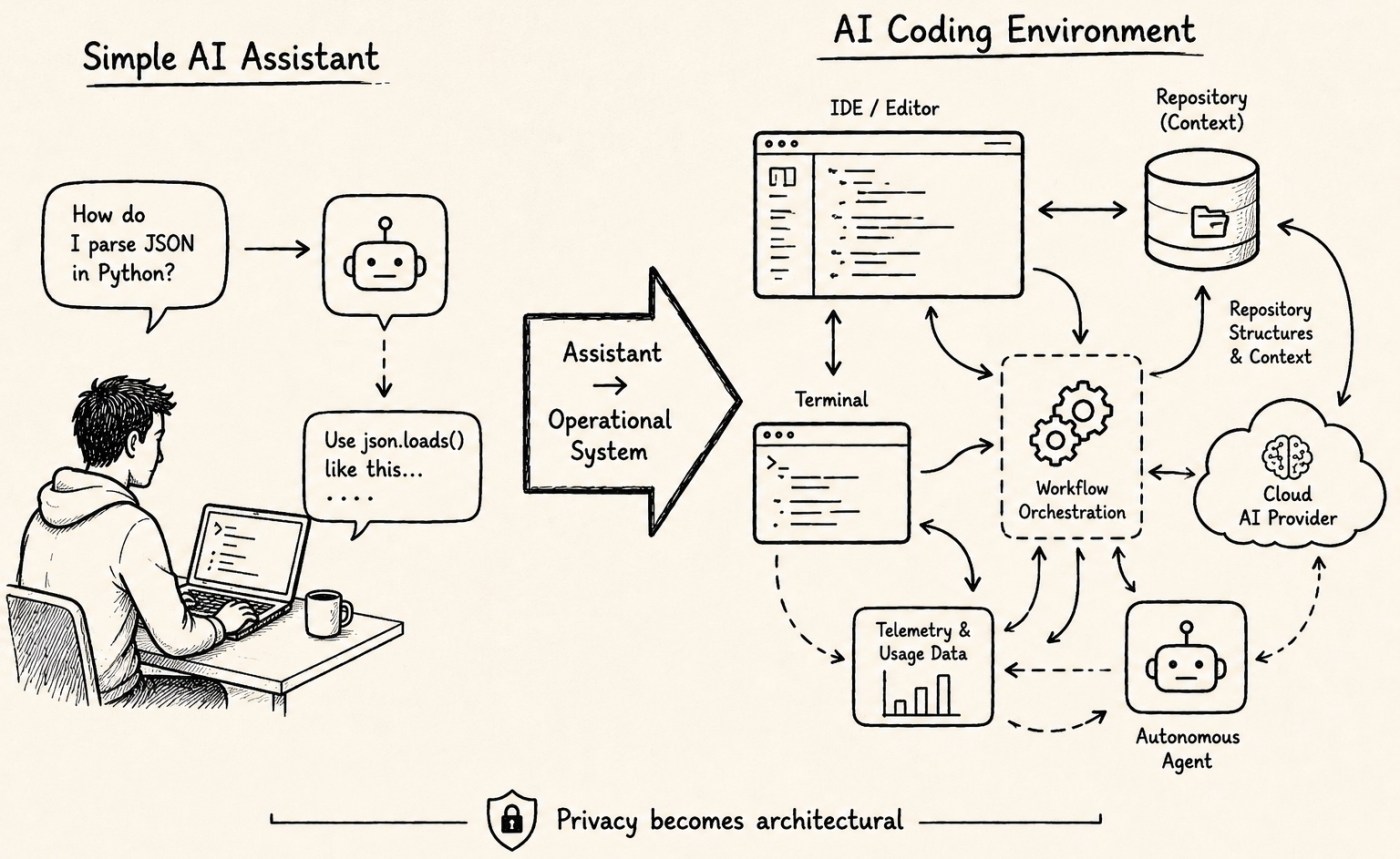
Pip: The framing here is not “does this tool train on my data” — that’s the old question. The new question is what happens when your AI assistant can see your repository, your terminal, your workflow metadata, and your unfinished ideas all at once.
Mara: The post sets this up directly: “Privacy is no longer just a checkbox. It is increasingly becoming an architectural design decision of your development environment for the entire SDLC.”
Pip: That reframe matters. It moves privacy from a policy you accept at signup to a structural choice you make when you decide how your tooling is wired together.
Mara: Right, and the post breaks that down into distinct layers — training, retention, logging, telemetry, human review, repository context access, and tool integration. Most users only think about the training layer.
Pip: Which is a bit like worrying about whether your landlord reads your mail while ignoring the security camera in the hallway.
Mara: The post compares six platforms on exactly these dimensions: local Granite models, IBM Bob, Claude, ChatGPT and OpenAI, Gemini, and GitHub Copilot. Local Granite running via Ollama ranks highest for technical isolation because prompts and code stay inside your environment by default.
Pip: IBM Bob earns the second spot largely on the strength of one unusually direct statement.
Mara: IBM states: “Your prompts are not used as training data.” The post notes this is an important and unusually direct claim, but it does not automatically mean zero telemetry, zero retention, or zero logging.
Pip: So “not trained on” and “not seen” are two different things — and the post is careful to keep those separate throughout.
Mara: Claude gets credit for more privacy-focused wording and configurable routing, including documented support for local model workflows through Claude Code. ChatGPT’s structure is described as one of the most complicated in the comparison, partly because OpenAI separates consumer, API, enterprise, and open-model deployments with different data policies for each.
Pip: GitHub Copilot lands at the bottom of the privacy ranking, which is notable given it’s also the cheapest option at around ten dollars a month.
Mara: The post makes that tradeoff explicit. GitHub Copilot has the deepest IDE and repository integration of any tool in the comparison, and the post states that its privacy profile now depends strongly on the selected workflow, the model provider, and the routing architecture.
Mara: There’s also a pricing section that converts IBM Bob’s Bobcoin system into USD equivalents — one Bobcoin equals fifty cents — to make the plans comparable across all six platforms.
Pip: And the post closes with a point that lands harder than a pricing table: the real cost of AI tooling isn’t only money. You may also be paying with repository context, telemetry, workflow visibility, and the operational exposure of ideas that aren’t finished yet.
Mara: That connects to a broader argument in the post’s final section — that developer context itself may contain economically valuable knowledge, which makes the privacy question about more than just data hygiene.
Pip: The shift from chatbot to workflow participant changes what privacy even means for a developer.
Mara: And the honest answer to “which tool is most private” turns out to be: it depends entirely on your threat model and how you wire the system together.
Pip: More architecture, less checkbox. That’s the territory next time too.
Important Note:
The podcast narration was generated using experimental WordPress functionality. It summarizes and interprets the original article, but it may simplify individual details.
For the complete comparison, references, qualifications, and source links, please read the original blog post.
AI products, prices, privacy policies, and technical capabilities can change quickly. The investigation reflects the publicly documented information available when the article was written.


Leave a Reply