For several years, developers compared AI coding models based on benchmarks, personal experiments, context-window size, coding quality, speed, and price. The central question was simple: which model is best for coding?
In 2026, that question is becoming less useful. Not because one model has won, but because model selection is moving away from the developer and into the platform. I see this across product announcements, documentation, technical blogs, open-source projects, videos, and hands-on developer workflows.
This post compares what their public documentation actually supports. Where I go beyond the documentation, I say so. Product capabilities and factual statements were checked against publicly available primary sources on 30 July 2026.
Short Executive Summary
AI coding platforms are moving beyond the question of which individual model is best.
The important shift in 2026 is that model selection and agent coordination are increasingly becoming platform responsibilities.
The main findings of this article are:
IBM Bob is one of the clearest documented examples of built-in cross-provider model orchestration. IBM describes Bob as selecting from Granite, Claude, Mistral, and specialized models according to criteria such as accuracy, performance, latency, and cost.
GitHub Copilot combines automatic model selection with repository-native access to coding agents such as Copilot, Claude, and Codex. GitHub currently provides more visible information about the model selected by its router.
Gemini CLI demonstrates task-based, fallback, and experimental local routing primarily within Google’s own model ecosystem.
Claude Code emphasizes configurable models, subagents, and external gateway-based routing rather than one native cross-provider router.
OpenAI Codex emphasizes a flexible coding-agent harness, parallel agents, and configurable inference endpoints.
My conclusion is that IBM Bob appears architecturally advanced in treating managed cross-provider orchestration as a core product capability. However, this does not prove that Bob always selects the best model, provides the lowest customer cost, or offers the strongest transparency.
The broader market shift is from:
Which coding model should I use?
to:
Which orchestration platform should select, coordinate, and govern the models and agents for me?
This reduces model-level dependency, but it can create a new dependency on the orchestration platform itself.
The Podcast on YouTube, if you don’t want to read.
Something Changed in AI-Assisted Development
I did not start this article as a theoretical market comparison. The idea came from my own work with IBM Bob, Claude Code, Codex, GitHub Copilot, Gemini, and local models. I increasingly noticed that I was no longer choosing one permanent coding assistant. I was combining different tools for planning, implementation, and review. That practical observation led me to the central question of this post: will the orchestration platform become more important than the individual model?
AI development platforms and developers are increasingly combining several models and agents for different parts of the software development lifecycle.
I also see this shift in my own practical work with tools such as:
IBM Bob
Claude Code
OpenAI Codex
GitHub Copilot
Gemini CLI
These tools are no longer always treated as direct alternatives.
Developers use them together.
One agent may analyze a repository and create a plan. Another may implement the change. A third may review the result. In other workflows, the platform selects the underlying model automatically without asking the developer to make that decision.
This changes the central question.
It is no longer only:
Which coding model should I use?
The more important question is becoming:
Which platform should select, coordinate, and govern the models and agents used for my software-engineering task?
My current conclusion is that the market is moving in this direction.
However, several different concepts are often mixed together:
Manual model selection
Automatic model routing
Multi-agent execution
Cross-provider orchestration
They are related, but they are not the same.
Table of contents
Model Pickers, Model Routers, and Agent Orchestration
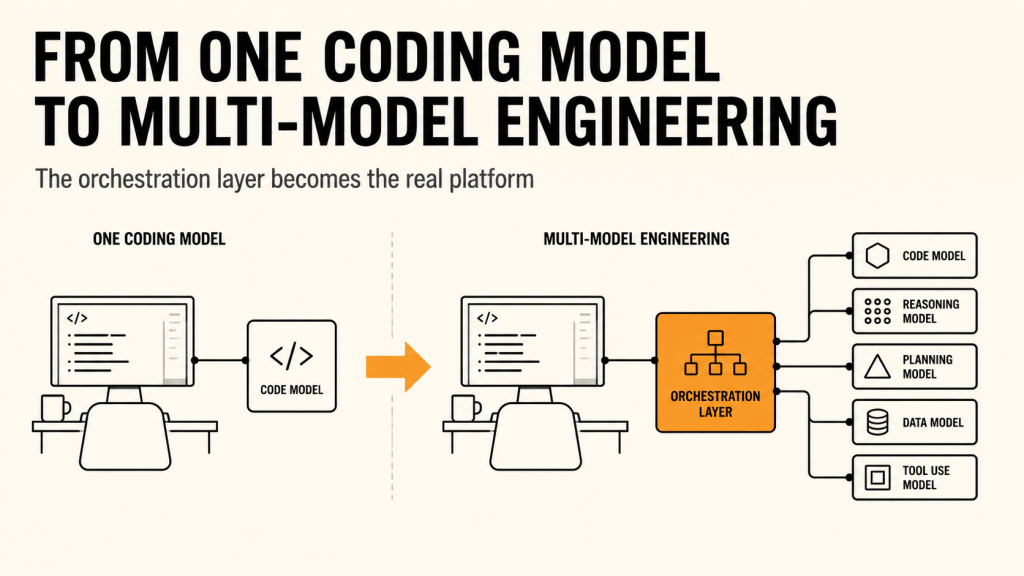
From One Main Model to an Orchestration Layer
IBM Bob: Multi-Model Orchestration by Design
GitHub Copilot: Model Routing and Agent Choice on the Repository Platform
Google Gemini CLI: Routing Within the Gemini Ecosystem
OpenAI Codex: Multi-Agent Execution Around an OpenAI-Centered Stack
Claude Code: Model Selection, Subagents, and Gateway-Based Routing
The Community Is Already Building Multi-Vendor Workflows
The Economic Trade-Off: Cost, Control, and a New Form of Lock-In
What Changes for Developers?
Is IBM Bob Architecturally Ahead?
Where I Think This Goes Next
My View
Current Capability Comparison
Sources and Evidence
1. Model Pickers, Model Routers, and Agent Orchestration
Before comparing the platforms, it is useful to separate several concepts that are often mixed together. The visual below shows the three main approaches.
Figure 1: Manual model selection, automatic model routing, and multi-agent orchestration solve different problems. The diagram is a conceptual overview, not a representation of one specific product.
1.1 Manual Model Selection
With manual model selection, the developer chooses the model directly.
For example, the developer may select:
A fast model for a simple change,
A reasoning model for architecture or debugging,
A coding-focused model for implementation.
The platform provides the available models, but the developer makes the routing decision.
This requires the developer to understand:
Which model is suitable for which task,
The expected quality,
The latency,
The usage limits,
The cost.
In this approach, the developer effectively acts as the model router.
1.2 Automatic Model Routing
With automatic model routing, the platform selects the model.
The routing decision may consider factors such as:
Task complexity
Model availability
Latency
Expected quality
Reliability
Cost
Policy restrictions
The developer describes the task, while the platform decides which model should process it.
This can reduce decision fatigue and unnecessary use of expensive reasoning models.
However, it also creates a transparency question:
Can the developer see which model was selected and why?
The answer differs between platforms.
1.3 Fallback Routing
Fallback routing is a more limited form of model routing. It does not necessarily select the best model for the task. Instead, it selects another model when the preferred model is unavailable because of:
Quota limits
Service errors
Capacity constraints
Regional availability
Policy restrictions
This distinction matters: Task-based routing attempts to match a model to the work. Fallback routing mainly keeps the service operational.
1.4 Multi-Agent Orchestration
Multi-agent orchestration goes beyond selecting a model.
Different agents perform different roles in a workflow.
For example:
A planning agent analyzes the repository and creates a plan
An implementation agent changes the code
A testing agent executes validation
A review agent evaluates the result
An agent normally combines:
One or more models
Instructions
Tools
Permissions
Context management
An execution loop
Workflow logic
A model produces an inference.
An agent uses a model as one component of a larger software-engineering process.
1.5 Multi-Model Is Not the Same as Multi-Agent
A platform can support several models without supporting several cooperating agents.
It can also run several agents while using the same underlying model for all of them.
These are separate architectural dimensions:
Architecture
Main question
Multi-model
Which model should perform the inference?
Multi-agent
Which agent should perform the task or role?
Cross-provider
Are models or agents from different vendors involved?
Automatic routing
Does the platform make the selection automatically?
The most advanced platforms increasingly combine all four.
2. From One Main Model to an Orchestration Layer
To understand the current shift, it helps to look at the simplified development path of AI coding assistants.
This is historical context, not a precise timeline for every product.
2.1 One Assistant and One Primary Model
Earlier AI coding assistants were commonly experienced as a connection between one development tool and one primary model.
The interaction was relatively simple:
Developer → Coding Assistant → Primary Model
Typical capabilities included:
Code completion
Code explanation
Generation of small functions
Simple refactoring
Repository chat
The product was often evaluated mainly through the perceived quality of its underlying model.
The central questions were:
Which model writes better code?
Which model understands more context?
Which model produces fewer errors?
Which model is faster?
Which model is cheaper?
This encouraged developers to think in terms of one winner.
2.2 The Model Picker Phase
The next step was not yet automatic orchestration.
Platforms began offering access to several models inside the same interface.
The developer could choose between models optimized for different priorities, such as:
Speed
Reasoning
Coding
Larger context
Lower cost
This increased flexibility, but it also moved a new responsibility to the developer.
The developer now had to decide:
Which model should I select for this task?
The platform offered the portfolio, but the user still managed the selection.
2.3 The Automatic Routing Phase
The next architectural step is to move that decision into the platform.
Instead of asking the developer to choose a model for every task, the platform can evaluate the work and select a suitable model automatically.
The question changes from:
Which model do I want to use?
to:
Which platform do I trust to select the model for me?
This is not only a user-interface change.
It moves responsibility for model selection, cost optimization, reliability, and governance into the orchestration layer.
2.4 From Models to Complete Agents
The transition does not stop at model selection.
Platforms coordinate complete agents that can:
Analyze repositories
Create plans
Edit files
Run terminal commands
Execute tests
Review changes
Apply security or governance checks
At this point, the underlying model becomes only one component of the system.
The product becomes the layer that manages:
Models
Agents
Tools
Context
Policies
Execution
Cost
This is the transition examined in the rest of this post: model and agent selection are increasingly becoming part of the platform.
The developer no longer needs to manage every model directly. Instead, the developer chooses the platform that manages the model portfolio.
3. IBM Bob: Multi-Model Orchestration by Design
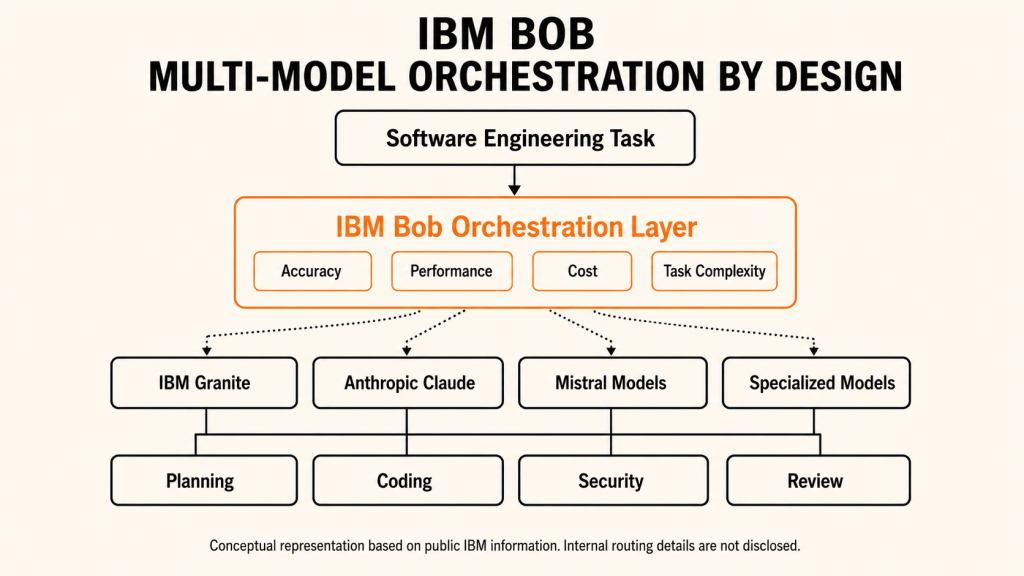
IBM Bob is one of the clearest current examples of an AI development platform that treats multi-model orchestration as a built-in product capability.
Instead of asking the developer to select an underlying model for every task, IBM describes Bob as dynamically matching tasks to models according to criteria such as:
Accuracy
Performance
Latency
Cost
IBM publicly identifies a model portfolio that includes:
IBM Granite models
Anthropic Claude
Mistral models
Specialized fine-tuned models for code reasoning
Security-focused models
Next-edit prediction models
IBM also explains that simpler tasks can be routed to lighter models, while more complex work can be assigned to more capable models.
The stated objective is to improve results while avoiding unnecessary model cost.
Based on IBM’s public description, the following statements are supportable:
Bob uses more than one model family.
Bob includes models from more than one provider.
Model selection is managed inside the platform.
Routing can consider accuracy, performance, latency, and cost.
Smaller models can be used for simpler work.
More capable models can be used for more complex work.
Specialized models can support specific software-engineering functions.
This means Bob is more than a user-facing model picker.
The developer interacts with Bob, while the platform manages the underlying model portfolio.
Figure 2: Conceptual representation of IBM Bob based on IBM’s public product descriptions. The diagram illustrates the documented model portfolio and orchestration concept. It does not represent IBM’s undisclosed internal routing implementation.
3.2 Model Routing and Agent Orchestration Are Two Different Layers
IBM expanded Bob’s architecture further in July 2026 with capabilities including:
This introduces two related but separate orchestration layers.
Model routing
Model routing determines which inference capability should process a task.
Examples include:
A smaller model for a straightforward edit,
A stronger reasoning model for complex analysis,
A specialized model for security-related work.
Agent orchestration
Agent orchestration determines which agent or subagent should perform a specific role.
Examples include:
Repository analysis
Planning
Implementation
Modernization
Security review
Validation
A subagent can work in an isolated context and return only the relevant result to the main workflow.
This can reduce context growth because exploratory searches, file reads, and intermediate tool traces do not all need to remain in the main agent context.
It may also reduce cost, although the exact effect depends on the workflow, model usage, and implementation.
3.3 What IBM Does Not Publicly Disclose
IBM documents the overall orchestration concept, but not the complete internal routing implementation.
The publicly available sources do not clearly explain:
The exact classifier used to determine task complexity
Which exact model handles every individual operation
Whether a model can change during one task
How quality and cost are weighted against each other
Whether multiple models validate the same result
The frequency and logic of fallback routing
The full list of models active at a given time
Which models IBM operates directly
Which models are accessed through external provider infrastructure
The internal cost of each model call
Whether users receive a complete model-level audit trail
Therefore, I cannot state:
IBM Bob always selects the best available model for every task.
That conclusion would not be independently verifiable from the public documentation.
The supportable statement is:
IBM Bob is designed to select a suitable model based on criteria such as accuracy, performance, latency, and cost.
There is an important difference between a documented optimization objective and independently demonstrated optimal routing.
3.4 Convenience, Control, and Transparency
Automatic orchestration can remove significant complexity from the developer workflow.
The developer does not need to continuously compare:
Model benchmarks
Provider-specific limits
Latency
Pricing
Task-specific model strengths
However, this abstraction creates new questions:
Which model generated this code?
Which provider processed the repository context?
Was a smaller model selected mainly because of cost?
Was the result validated by another model or agent?
Where did the model execute?
What did the individual operation cost?
Why did the router make this decision?
IBM provides usage, productivity, quality, governance, consumption, and cost information through Bobalytics.
However, based on the public documentation I reviewed, it is not clear whether users receive a complete per-operation routing trace that identifies every model, provider, decision criterion, and validation step.
IBM does make two related claims that deserve to be stated fairly.
First, IBM describes BobShell as creating self-documenting agentic processes, so that actions remain traceable from start to finish.
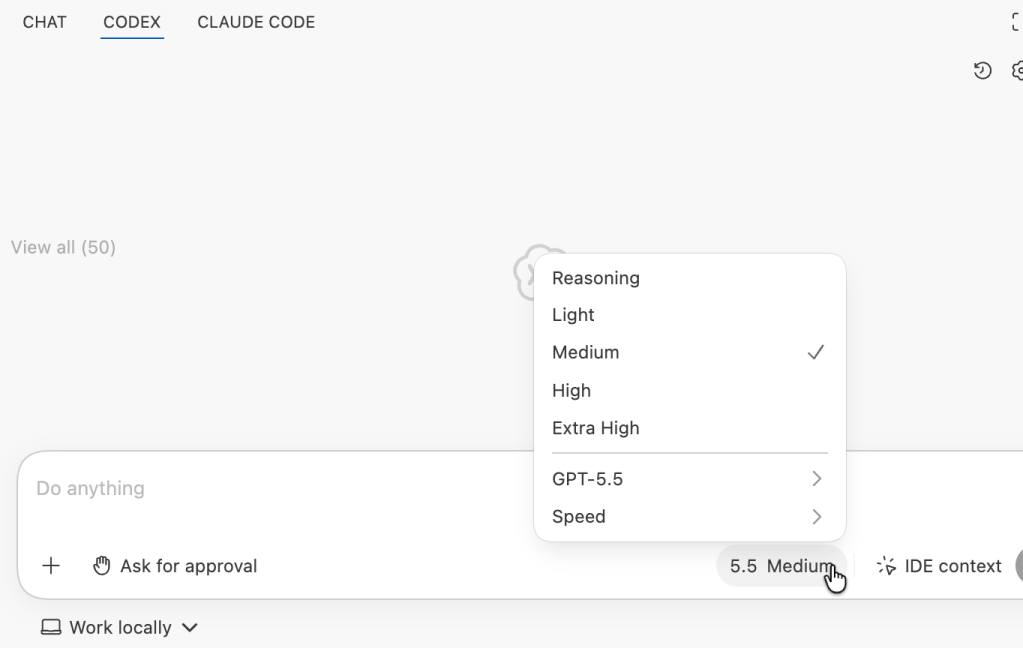
Second, IBM describes pass-through pricing alongside usage visibility, so that organizations can connect AI spend to outcomes.
Both claims matter. Neither of them answers the narrower question I am asking here. Action-level traceability is not the same as a model-level routing record, and pass-through pricing describes how a cost is billed, not which model the router chose or why. Those are the details I could not establish from the public sources.
The orchestration platform reduces operational complexity, but the developer may receive less direct control and less visibility into the underlying execution path.
3.5 My Interpretation
The following is my interpretation, not an official statement from IBM.
In my view, Bob’s architectural advantage is not that IBM owns one model that must be the best for every software-engineering task.
Its advantage is that IBM can combine:
Its own Granite models
External frontier models
Open and open-weight models
Specialized models
Task-specific agents
Enterprise governance
This gives IBM the ability to change the model portfolio behind a relatively stable developer interface.
A newer or stronger model can potentially be introduced without requiring developers to redesign their complete workflow.
This is why I see Bob less as a single-model coding assistant and more as an orchestration platform for software engineering.
4. GitHub Copilot: Model Routing and Agent Choice on the Repository Platform
GitHub Copilot is moving in the same general direction as IBM Bob, but through a different product architecture.
GitHub now combines at least three distinct capabilities:
Access to several models
Automatic model selection
Execution of complete coding agents through Agent HQ
These capabilities should not be treated as identical.
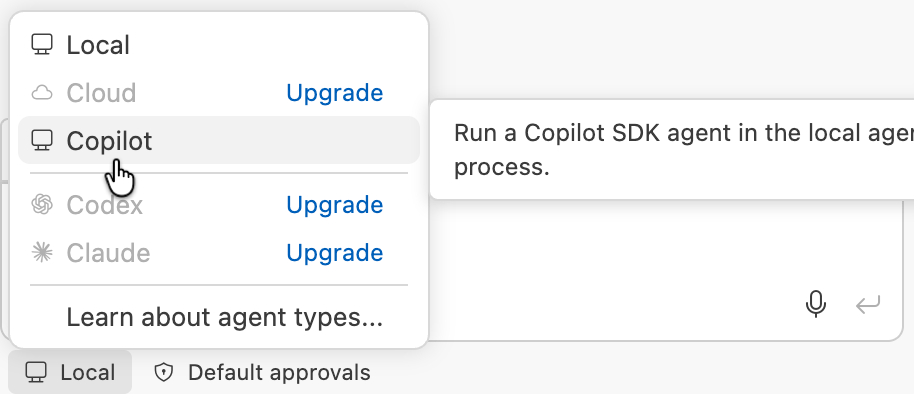
Figure 3: Example of GitHub Copilot in Visual Studio Code. The available model and agent controls depend on the plan, extension version, and organizational configuration.
4.1 Automatic Model Selection
GitHub documents an Auto model-selection system that evaluates both model conditions and task requirements.
According to GitHub, the routing process considers factors such as:
Task complexity
Model availability
Model health
Reliability
Latency
Cost or premium-request efficiency
Higher-capability reasoning models can be reserved for difficult work, while simpler requests can be assigned to faster or less expensive models.
GitHub also documents that model switching is handled at natural cache boundaries rather than continuously during every conversation step.
This matters because switching models can invalidate cached context and increase cost.
GitHub Agent HQ moves beyond selecting foundation models.
GitHub introduced coding agents from competing providers, including:
GitHub Copilot
Anthropic Claude
OpenAI Codex
Custom agents
One qualification is important here. When GitHub introduced Claude and Codex on Agent HQ in February 2026, both were released as a public preview and required a Copilot Pro+ or Copilot Enterprise subscription.
Agent choice is therefore a plan-dependent capability rather than a universal Copilot feature. That matters for the comparison in this post: availability and architecture are not the same thing.
These agents can operate within GitHub and supported development environments while keeping work connected to:
Issues
Branches
Commits
Pull requests
Reviews
Repository history
GitHub can also let users assign the same issue to more than one agent and compare the resulting approaches.
Which coding agent should perform this software-engineering task?
A coding agent includes more than a model. It may include:
Its own system instructions,
Execution loop,
Tool access,
Repository interaction,
Permissions,
Planning behavior,
Review workflow.
The same platform can therefore support both:
Automatic model selection
Explicit agent selection
4.4 GitHub’s Strategic Advantage
GitHub approaches orchestration from the repository and collaboration layer.
It already manages:
Source code
Issues
Pull requests
Code review
Permissions
Development history
Continuous integration workflows
This gives GitHub an important advantage.
Different agents can work inside the same repository context without requiring the developer to manually copy specifications and results between separate products.
The orchestration layer is therefore closely connected to the software-delivery system of record.
4.5 IBM Bob and GitHub Copilot Are Converging
IBM Bob and GitHub Copilot now overlap in several important areas.
Capability
IBM Bob
GitHub Copilot
Multiple model families
Yes
Yes
Models from multiple providers
Yes
Yes
Automatic model selection
Yes
Yes
Task requirements considered
Yes
Yes
Cost or efficiency considered
Explicitly documented
Documented as part of routing and premium-request efficiency
Multi-agent capabilities
Yes
Yes
Competing external coding agents
Not the main public product framing
Claude and Codex through Agent HQ
Selected model visible per response
Not clearly documented
Yes
Integrated usage and cost analytics
Bobalytics
Usage, request, and model-related reporting
Repository system of record
Development environment and enterprise workflows
Native GitHub repository and collaboration platform
This table compares public product capabilities. It is not a quality ranking.
The important conclusion is not that both platforms are identical.
They are converging from different starting points.
IBM Bob starts from:
Enterprise orchestration,
Model portfolio management,
Governance,
Modernization,
Specialized workflows.
GitHub starts from:
Repositories,
Collaboration,
Pull requests,
Developer workflow,
Agent choice.
A precise conclusion is:
IBM positioned cross-provider multi-model orchestration as a central part of Bob’s product architecture. GitHub is rapidly converging through automatic model selection and repository-native access to competing coding agents.
4.6 What GitHub Does Not Fully Disclose
GitHub exposes more than the selected model. In a June 2026 engineering post, GitHub describes its routing component by name: HyDRA, a routing model that weighs factors such as reasoning depth, code complexity, debugging difficulty, and tool orchestration needs. HyDRA first identifies the models that can meet the quality bar for the task, and then selects among them.
That is more disclosure than most managed routing platforms offer. It is still not a complete account of the decision process.
The available documentation does not fully reveal:
The exact complexity classifier
All weighting factors
The complete ranking logic
The evaluation of competing models
The detailed cost function
Whether model quality is continuously measured per repository
Whether routing policies differ by language or project
The full fallback sequence
Whether another model validates the result
Therefore, the fact that GitHub displays the selected model should not be confused with complete router transparency.
GitHub provides useful operational visibility, but not a full explanation of the internal decision process.
5. Google Gemini CLI: Routing Within the Gemini Ecosystem
Google Gemini CLI also shows how model selection is moving from a manual decision toward a platform capability.
Gemini CLI example:
However, its documented architecture differs from IBM Bob.
IBM describes a portfolio that includes models from several providers.
Gemini CLI primarily routes between models inside Google’s Gemini ecosystem.
That distinction is important.
5.1 Product Status Update
Before describing the architecture, one important change needs to be stated.
Google announced on 19 May 2026 that Gemini CLI and the Gemini Code Assist IDE extensions would stop serving requests on 18 June 2026 for Google AI Pro, Google AI Ultra, and free individual users. These tiers are now served by Antigravity CLI instead. Organizations using Gemini CLI through a Gemini Code Assist Standard or Enterprise license, or through paid Gemini API access, keep unchanged access.
Antigravity CLI example:
Antigravity IDE example:
This section therefore describes a documented routing architecture that remains useful as an engineering example. It no longer describes the default Google CLI experience for the affected individual-user tiers after 18 June 2026.
I have kept the section because the routing concepts are still relevant, and because the transition itself is a useful example of the dependency I describe in section 9.
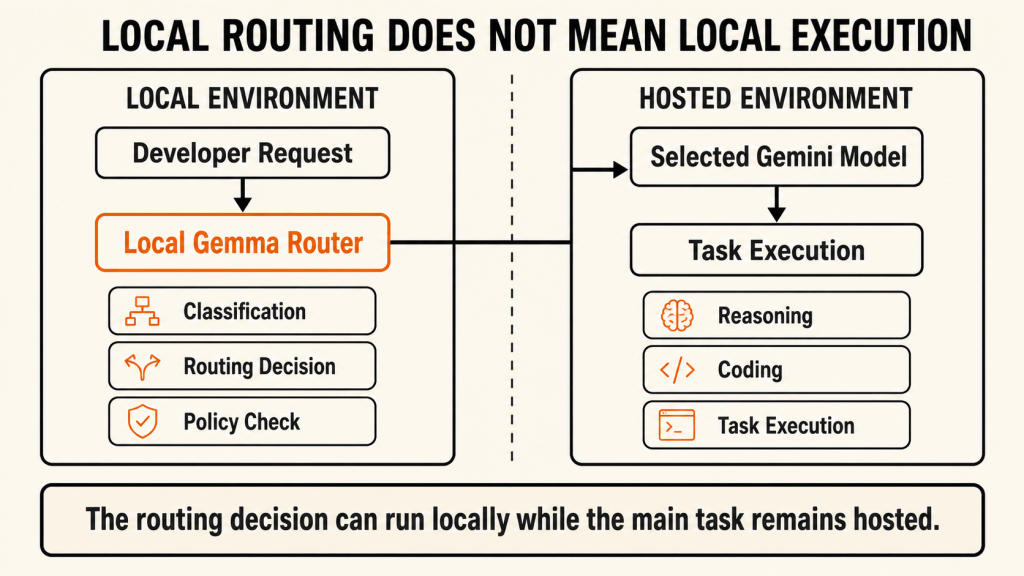
One particularly interesting feature is experimental local model routing. Gemini CLI can use a locally running Gemma model to make the routing decision.
This means the local model can evaluate a request and help determine which hosted Gemini model should receive it.
The important distinction is:
The routing decision can run locally, while the actual coding or reasoning task may still run on a hosted model.
Local routing does not automatically make the complete workflow local.
It can, however, influence:
Routing cost
Latency
Privacy exposure
Resilience
Control over classification logic
Google presents local routing partly as a way to reduce hosted-model usage for the routing decision itself.
This is architecturally significant.
It separates the router from the models that execute the main task.
When platforms begin optimizing the cost, latency, and privacy exposure of the routing decision itself, model routing has become infrastructure.
Figure 4: A local model can make the routing decision while the selected model and the main task remain hosted. Local routing therefore does not make the complete workflow local.
5.6 What Gemini CLI Does Not Currently Demonstrate
Based on the current public documentation, I did not find evidence that Gemini CLI automatically routes normal coding tasks across commercial model families from:
Google
Anthropic
OpenAI
IBM
Mistral
The documented architecture primarily uses Gemini models, with Gemma optionally supporting the routing decision.
Therefore, Gemini CLI should not be described as equivalent to IBM Bob’s documented cross-provider model portfolio.
A precise description is:
Gemini CLI provides automatic, task-related, fallback, and experimental local routing primarily within Google’s own model ecosystem.
5.7 Why the Local Router Matters
The local Gemma router may appear to be a small implementation detail. In my view, it signals a broader architectural direction. The software-engineering task and the routing decision do not need to run in the same place or use the same model.
A future platform could use:
A local model for classification
A local model for data filtering
A hosted model for complex reasoning
Another model for implementation
A policy engine for provider restrictions
Once the routing decision becomes a separate component that can be optimized for privacy, latency, and cost, model routing has become infrastructure.
6. OpenAI Codex: Multi-Agent Execution Around an OpenAI-Centered Stack
OpenAI’s development of Codex in 2026 focuses strongly on agent execution, parallel work, and supervision.
The current architecture is best understood through two layers:
the Codex app as a control surface for agent work,
the Codex harness as the execution loop around models and tools.
These capabilities are significant, but they are not the same as automatic cross-provider model routing.
Figure 5: Example of the Codex interface in Visual Studio Code. The screenshot illustrates the user interface, not automatic cross-provider routing.
6.1 The Codex App as a Multi-Agent Control Surface
OpenAI introduced the Codex app as a command center for managing several coding agents and long-running software-engineering tasks.
Developers can use it to:
Run work in parallel
Maintain separate agent threads
Review changes
Supervise long-running tasks
Coordinate work across projects
Keep different tasks isolated
This is a clear example of multi-agent software development.
The primary orchestration question is:
Which agent should work on which task?
That is different from asking:
Which underlying model should process one inference?
OpenAI documents that Codex CLI uses the Responses API for model inference.
The endpoint can be configured for compatible environments, including examples such as:
OpenAI-hosted models
Azure-hosted Responses API endpoints
Local gpt-oss models through Ollama
Local models through LM Studio
This makes the Codex harness technically flexible.
It means developers can potentially choose where the inference endpoint runs and which compatible model endpoint is used.
However, endpoint flexibility does not automatically create an intelligent model router.
A configured endpoint normally defines where Codex sends the request. A model router dynamically decides which model or provider should receive each task. These are different capabilities.
6.4 Configurable Models Are Not Automatic Routing
The distinction can be summarized as follows:
Capability
Meaning
Model selection
The developer or configuration chooses a model
Endpoint configuration
The developer defines where inference requests are sent
Multi-agent execution
Several Codex agents work on separate tasks
Automatic model routing
The platform dynamically chooses a model according to task, cost, latency, or policy
Cross-provider routing
The router can select models from different vendors
The public Codex documentation supports the first three capabilities.
I did not find official evidence that the standard Codex product automatically routes individual coding tasks between commercial models from providers such as:
OpenAI
Anthropic
Google
IBM
Mistral
Therefore, Codex should not currently be described as equivalent to IBM Bob’s documented cross-provider model portfolio.
6.5 What Codex Does Not Publicly Document
The available public sources do not describe:
A built-in router that selects among competing model providers
Task-complexity-based switching between commercial vendors
Automatic cost optimization across provider models
Provider-level fallback routing
Per-task evaluation of Claude, Gemini, Granite, and OpenAI models
A complete routing audit trail
This does not mean that such mechanisms cannot exist internally or appear later.
It means they are not part of the publicly documented standard architecture I could verify.
6.6 Codex’s Architectural Strength
Codex’s current strength is different.
It combines:
A strong coding-agent execution loop
Repository and file operations
Terminal access
Parallel agents
Long-running tasks
Model and endpoint flexibility
This makes Codex a capable execution platform.
Its architectural focus is currently closer to:
A flexible harness for running coding agents around an OpenAI-centered model stack.
IBM Bob’s documented focus is closer to:
A managed orchestration layer that selects from a cross-provider model portfolio.
Both approaches move beyond simple code completion, but they solve different orchestration problems.
6.7 My Interpretation
In my view, Codex is especially strong when the developer wants direct control over the coding-agent execution environment.
The developer can choose:
The task
The agent thread
The project
The model configuration
The endpoint
The local or hosted execution setup
Bob abstracts more of the underlying model selection.
Codex currently exposes more of the execution harness, while Bob emphasizes managed model orchestration.
This creates a useful contrast:
Codex gives the developer a flexible agent runtime. Bob gives the developer a managed model and agent portfolio.
7. Claude Code: Model Selection, Subagents, and Gateway-Based Routing
Claude Code provides several building blocks for advanced model and agent orchestration.
These include:
Manual model selection
Specialized subagents
Separate model configuration for delegated work
Parallel agent execution
Enterprise deployment through supported cloud platforms
LLM gateway integration
These capabilities make Claude Code flexible.
However, they should not be confused with one native, fully automatic cross-provider router.
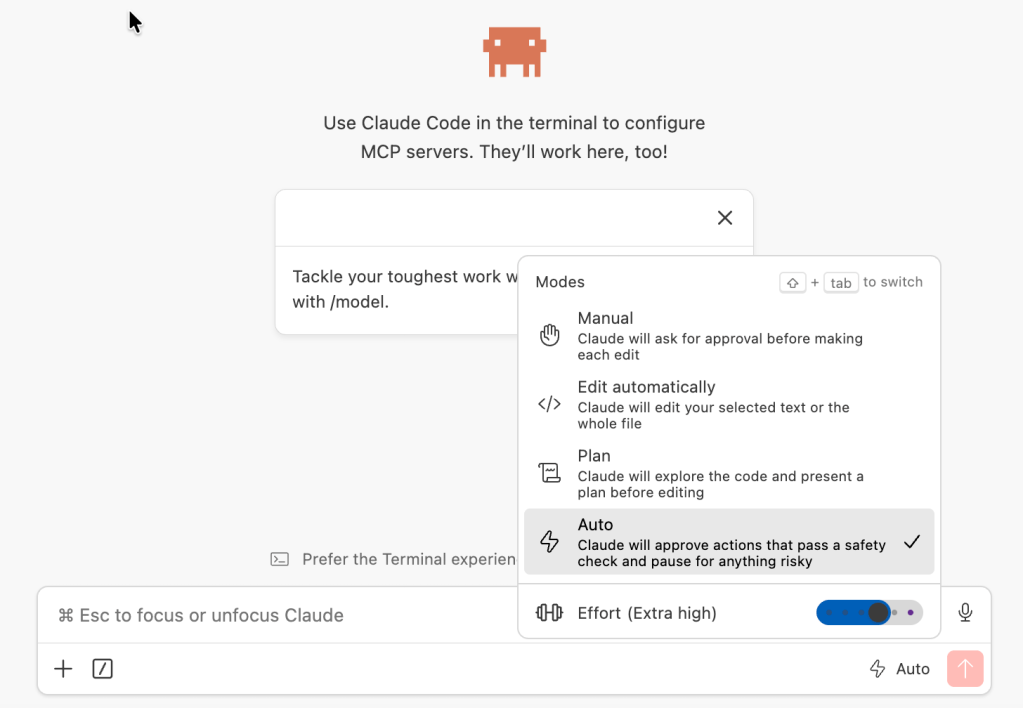
Figure 6: Example of Claude Code in Visual Studio Code. Model and subagent behavior depend on the local and organizational configuration.
7.1 Manual Model Selection
Claude Code allows the developer to select the model used for a session.
The model can be configured through the command line or through Claude Code settings.
For example, the developer can choose between Claude model variants according to priorities such as:
Reasoning capability
Speed
Cost
Task complexity
This is primarily manual or configuration-based model selection.
The developer or administrator defines the model rather than Claude Code necessarily routing every task automatically.
The gateway sits between Claude Code and the inference endpoint:
Claude Code
     │
     ▼
Enterprise LLM gateway
     │
     ├── Authentication
     ├── Usage tracking
     ├── Cost controls
     ├── Audit logging
     ├── Fallbacks
     └── Model or provider routing
     │
     ▼
Configured model endpoint
This makes cross-provider routing technically possible in a custom architecture.
However, the routing is then primarily implemented by the gateway configuration.
It is not necessarily a native Claude Code decision.
This distinction matters:
Claude Code can participate in a cross-provider routed environment, but the external gateway may be the component performing the routing.
Anthropic also notes that third-party gateway software is not necessarily maintained, endorsed, or audited by Anthropic. The security and correctness of that layer therefore need separate evaluation.
7.6 Native Capability Versus External Orchestration
The difference can be summarized as follows:
Capability
Where the decision is made
Claude session model selection
Developer or Claude Code configuration
Subagent model selection
Subagent configuration
Claude hosting through Bedrock or Vertex AI
Deployment configuration
Gateway fallback
Enterprise gateway
Cross-provider gateway routing
Enterprise gateway
Bob-style managed portfolio routing
Built into the orchestration platform
Claude Code provides several components needed for a multi-model workflow.
But the platform does not need to own every orchestration decision itself.
Organizations can add their own gateway and routing policies.
This gives them more control, but it also creates more implementation and governance work.
7.7 What Is Not Publicly Demonstrated
Based on the public documentation I reviewed, I did not find evidence that standard Claude Code automatically performs all of the following itself:
Classify every coding task by complexity
Compare Claude, Codex, Gemini, Granite, and Mistral models
Select the best commercial provider dynamically
Optimize provider cost for each operation
Provide a native cross-provider routing audit trail
That does not mean such a workflow cannot be built.
It means the routing would normally require:
Explicit model configuration
Subagent configuration
An external gateway
A custom orchestration layer
7.8 Claude Code’s Architectural Strength
Claude Code’s strength is its composability.
It provides:
A capable coding-agent loop
Direct terminal and file interaction
Configurable models
Specialized subagents
Tool permissions
Enterprise deployment options
Gateway compatibility
This makes Claude Code suitable as both:
A complete coding agent
One component inside a larger orchestration system
A precise description is:
Claude Code is a flexible Claude-centered agent environment that supports specialized subagents and can participate in externally routed multi-model architectures through configurable gateways.
7.9 Comparison with IBM Bob
IBM Bob and Claude Code place responsibility in different locations.
IBM Bob
IBM manages:
The model portfolio
Cross-provider selection
Internal routing
Integrated agent workflows
Claude Code
The developer or organization can manage:
The selected Claude model
Subagent roles
Model assignment
Hosting route
Gateway configuration
External routing policy
The practical trade-off is:
Bob provides more managed abstraction. Claude Code provides more composability and infrastructure-level control.
Neither approach is automatically better for every team.
The appropriate choice depends on whether the organization prefers:
A managed orchestration platform
Or a configurable agent and gateway architecture
8. The Community Is Already Building Multi-Vendor Workflows
Official platforms are not the only place where multi-model and multi-agent orchestration is emerging.
Developers are also assembling their own workflows from separate coding agents and tools.
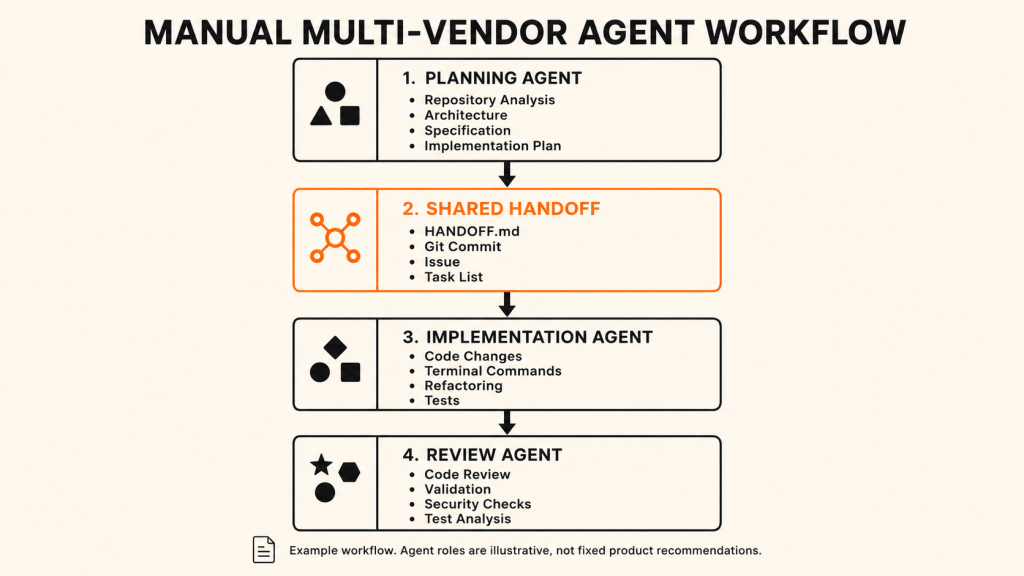
A common pattern looks like this:
Figure 7: Example of a manually coordinated multi-vendor workflow. The agent roles are illustrative and are not fixed recommendations for specific products.
A developer may, for example, use:
One agent for planning
Another agent for implementation
Another tool inside the IDE
A separate agent for review
The tools can come from different providers.
Examples may include combinations of:
Claude Code,
OpenAI Codex,
GitHub Copilot,
Gemini CLI,
IBM Bob,
local models.
8.1 This Is an Observed Pattern, Not a Proven Best Practice
I want to be precise here.
There is no universal evidence that one named product should always perform one fixed role.
For example, I cannot state that:
Claude Code is always the best planner
Codex is always the best implementation agent
Copilot is always the best reviewer
Gemini is always the best repository analyst
IBM Bob is always the best architect
These role assignments are usually based on:
Personal experience
Model behavior at a specific point in time
Project type
Language
Tool integration
Cost
Usage limits
Individual preference
The important pattern is not the permanent assignment of one product to one role.
The important pattern is the division of software-engineering work between specialized agents.
8.2 The Handoff Problem
When separate tools are used, context does not automatically move between them.
One agent may know:
The repository structure
The architecture discussion
The rejected alternatives
The implementation constraints
The current task state
The next agent may know none of this.
Developers therefore need an explicit handoff mechanism.
Typical handoff artifacts include:
Markdown files
Specifications
Git commits
Issue descriptions
Pull requests
Architecture decision records
Task lists
Test reports
A handoff file can act as a shared, tool-independent contract between agents.
8.3 My Shared HANDOFF.md Pattern
In my own work, I explored a simple shared handoff file for coordinating several agentic IDEs and coding agents.
The basic idea is:
The repository contains the current task state in a format that every tool can read.
A useful handoff file can include:
Objective
Current status
Completed work
Open decisions
Constraints
Changed files
Test status
Unresolved risks
Recommended next steps
A simplified example:
# Current Objective
Implement the repository search feature.
# Completed
- Added API endpoint
- Added basic unit tests
- Updated configuration
# Open Work
- Add error handling
- Validate access control
- Add integration test
# Constraints
- Do not change the public API
- Keep the workflow local-first
# Recommended Next Step
Review the implementation and add the missing integration test.
This approach has several advantages:
It is independent of one vendor
It remains inside the repository
It can be versioned with Git
It is readable by humans
It is readable by different agents
It creates a lightweight audit trail
8.4 The Handoff File Is Not Full Orchestration
A shared handoff file helps transfer state, but it does not solve every orchestration problem.
It does not automatically provide:
Agent scheduling
Conflict detection
Permission management
Cost optimization
Model routing
Parallel task coordination
Rollback
Execution monitoring
It is a coordination artifact, not a complete orchestration platform.
This distinction matters
HANDOFF.md
=
shared state and coordination

Orchestration platform
=
routing, execution, policies, monitoring, and coordination
Combining several tools can provide flexibility, but it also introduces friction.
The developer may need to manage:
Several subscriptions
Several command-line tools
Different authentication methods
Different context formats
Duplicated repository analysis
Inconsistent instructions
Repeated setup
Conflicting changes
Manual review of overlapping results
This means the developer becomes the orchestration layer.
The work is not only software engineering.
It also includes:
Deciding which agent should act
Transferring context
Checking consistency
Resolving conflicts
Monitoring cost
Verifying completion
8.6 Why Integrated Platforms Are Attractive
Platforms such as IBM Bob or GitHub Agent HQ can reduce some of this coordination work.
They can provide:
Shared repository context
Common execution history
Integrated permissions
Centralized policies
Agent coordination
Model selection
Usage reporting
Cost visibility
The platform manages more of the handoff internally.
That is the key difference between:
Manually combining several independent tools,
Using one integrated orchestration layer.
8.7 Why Custom Workflows Will Still Remain Relevant
Integrated platforms will not replace every custom workflow.
Developers may still prefer their own orchestration when they need:
Local models
Strict data sovereignty
Provider independence
Reproducible evaluation
Custom routing rules
Direct cost control
Specialized internal tools
Transparent execution paths
A custom workflow provides more control.
An integrated platform provides more convenience.
The architectural decision is therefore not simply:
Which agent is best?
It is:
Which coordination model provides the right balance between control, transparency, cost, and operational effort?
9. The Economic Trade-Off: Cost, Control, and a New Form of Lock-In
Multi-model and multi-agent engineering can reduce dependency on one model provider.
However, it does not remove cost, complexity, or lock-in.
It changes where they appear.
9.1 Reducing Dependency on One Model
Using several models or agents can reduce dependency on:
One provider’s release cycle
One pricing strategy
One context limit
One availability level
One model’s strengths and weaknesses
One product roadmap
If one model becomes unavailable, more expensive, or less suitable for a task, another model may be used instead.
This creates resilience at the model layer.
It can also allow developers to use different capabilities for different tasks, such as:
A reasoning model for architecture
A faster model for simple edits
A local model for sensitive classification
A specialized agent for review or security
However, this flexibility introduces additional operational work.
9.2 The Cost of Using Several Independent Tools
A manually assembled multi-vendor workflow may require several commercial relationships.
A developer or team may pay for combinations of:
IBM Bob
Claude Code
OpenAI Codex or ChatGPT
GitHub Copilot
Gemini
Direct model APIs
Local hardware
Cloud infrastructure
The real cost is not only the subscription price.
It can also include:
API consumption
Premium requests
Rate-limit upgrades
Local compute
Storage
Networking
Duplicated repository analysis
Context transfer
Orchestration scripts
Maintenance
Evaluation
Governance
Developer time
This means a workflow that uses several tools may be technically flexible but economically fragmented.
9.3 The Developer Becomes the Router
When several independent coding agents are used, the developer often manages the orchestration manually.
The developer decides:
Which tool receives the task
Which model should be used
How context is transferred
When another agent should review the result
Whether outputs conflict
Which subscription or API budget should be consumed
This can provide direct control.
It also creates coordination overhead.
A lower model price does not necessarily produce a lower total workflow cost if the developer spends additional time managing the process.
9.4 Integrated Orchestration as a Commercial Model
An integrated platform attempts to hide much of this complexity behind one interface.
A simplified structure is:
Developer → Orchestration Platform → Managed Portfolio of Models and Agents
The platform may provide:
One user experience
One authentication model
One governance layer
Shared context
Standardized workflows
Central usage reporting
Integrated cost management
Automatic model selection
The customer pays for access to the orchestration capability rather than managing every model relationship separately.
This can reduce operational effort.
However, it also means the platform controls more of the execution path.
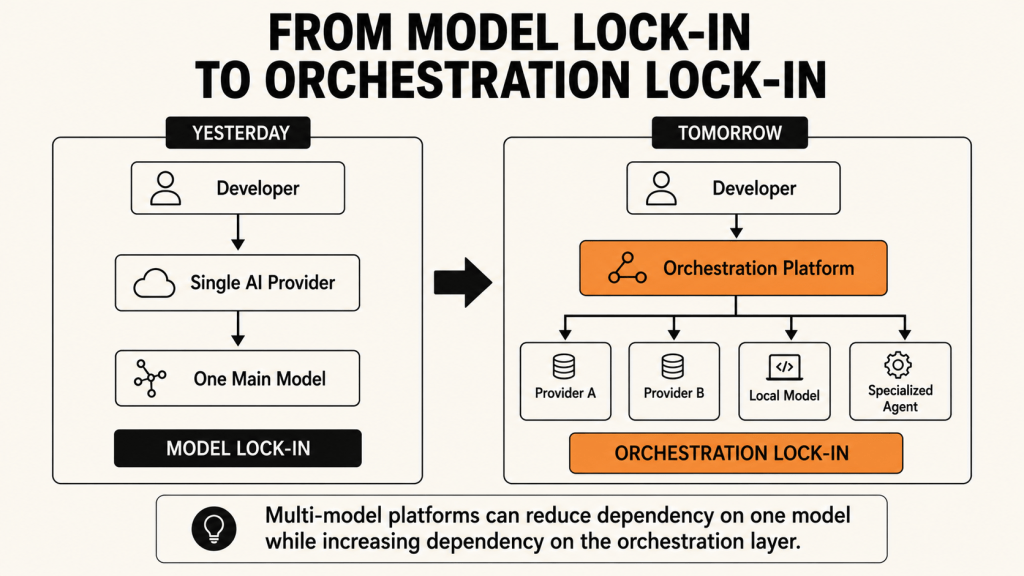
9.5 From Model Lock-In to Orchestration Lock-In
Figure 8: Multi-model platforms may reduce dependency on one underlying model while increasing dependency on the orchestration platform that manages models, agents, context, policies, and billing.
Traditional model lock-in means that a workflow depends heavily on one provider or model family.
A multi-model platform can reduce that dependency because the underlying models may be replaceable.
However, the stable dependency may move upward into the orchestration layer.
The customer can become dependent on:
Routing logic
Agent workflows
Proprietary skills
Repository integrations
Governance policies
Stored context
Audit functions
Billing rules
Evaluation systems
Platform-specific metadata
The underlying model may change without affecting the developer workflow.
That is useful.
But it also means that replacing the orchestration platform may become more difficult than replacing a single model.
9.6 Three Forms of Lock-In
It is useful to distinguish three different dependencies.
Lock-in type
Main dependency
Model lock-in
One model family or model provider
Agent lock-in
One agent environment, tool protocol, or workflow
Orchestration lock-in
One platform for routing, context, governance, and execution
A platform can reduce one type of lock-in while increasing another.
For example:
Cross-provider routing can reduce model lock-in
Proprietary agent workflows can increase agent lock-in
Centralized context and governance can increase orchestration lock-in
A Practical Example
The Gemini CLI transition shows how this works in practice.
Gemini CLI supported task-related model selection, availability-based fallback routing, and experimental local routing. The underlying Gemini model family did not disappear when access changed for the affected Gemini CLI user tiers on 18 June 2026. What changed was the orchestration layer around them.
For affected developers, the models remained available through other paths. The tool that selected, routed, and executed around those models did not. Access depended on the license type rather than on the model.
This is orchestration dependency rather than model dependency. It also shows that the orchestration layer is not automatically more stable than the models it manages. It can be replaced, rebranded, or restricted to a different customer segment.
This does not mean the developer becomes less important.
It means the required skills change.
10.4 Model Knowledge Still Matters
Automatic routing does not make model knowledge irrelevant.
Developers may still need manual control for:
Sensitive code
Regulated environments
Reproducible evaluations
Local execution
Difficult architectural decisions
Performance-sensitive workloads
Cost-controlled pipelines
Incidents and debugging
Provider-specific limitations
A routing system can make a reasonable default decision.
It cannot remove the need for technical judgment.
10.5 The New Core Skills
As more orchestration becomes automated, developers need to focus more on:
Defining the objective
Stating constraints
Supplying relevant context
Setting permissions
Describing acceptance criteria
Validating tests
Reviewing changes
Checking security
Understanding risk
Evaluating cost
Inspecting the execution trace
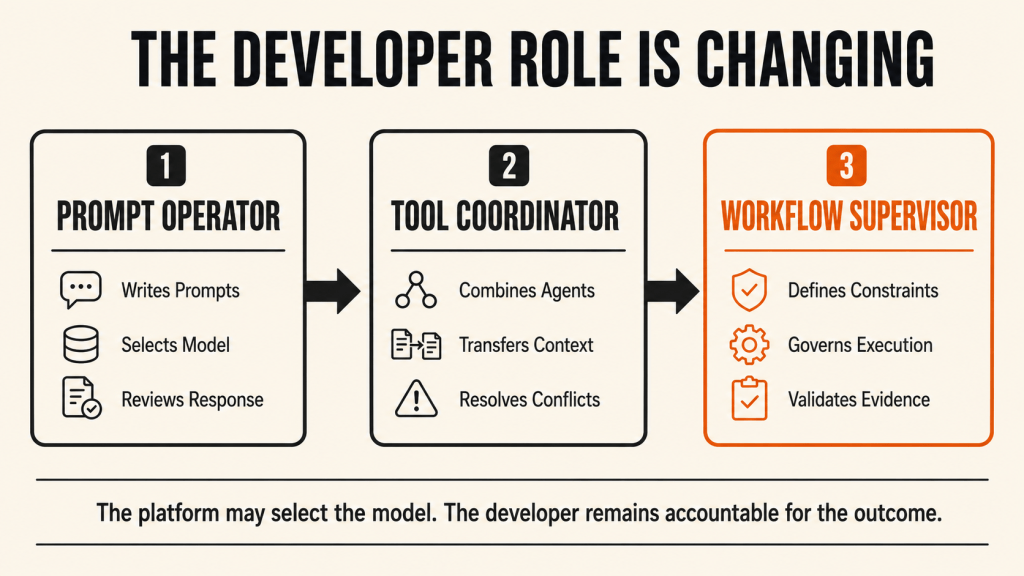
These skills are less about asking a model for code and more about governing a software-engineering workflow.
10.6 Review Becomes More Important, Not Less
More automation increases the amount of work a system can perform.
It also increases the potential impact of a wrong decision.
An agent may:
Modify several files
Execute terminal commands
Introduce dependencies
Change infrastructure
Update tests
Create pull requests
The developer must therefore review not only the final code, but also:
The plan
The assumptions
The tools used
The files changed
The test evidence
The unresolved risks
The more autonomous the workflow becomes, the more important evidence-based review becomes.
10.7 Developers Need Visibility Into the Orchestration Layer
When the platform selects models and agents, developers need answers to new questions:
Which model was used?
Which agent performed the change?
Which tools were executed?
Which files were read or modified?
Which external provider received context?
What did the operation cost?
Which policies were applied?
Why was this route selected?
Was the result reviewed by another agent?
Without this visibility, the developer is asked to accept the result without understanding the execution path.
That may be acceptable for low-risk tasks.
It is much more difficult for production, enterprise, or regulated work.
10.8 The Developer Becomes the Governor of the Workflow
The long-term role is not simply “prompt engineer.”
It is closer to:
A developer who defines the task, governs the execution, and validates the evidence.
The platform may select the model.
The platform may coordinate the agents.
The developer remains accountable for the software outcome.
11. Is IBM Bob Architecturally Ahead?
The answer depends on the capability being evaluated.
IBM Bob is not the only platform with:
Multiple models
Automatic model selection
Subagents
Parallel execution
Usage reporting
GitHub Copilot has documented task-aware model routing and repository-native access to coding agents from several providers.
Gemini CLI provides routing within Google’s model ecosystem and supports experimental local routing decisions. See the product status update in Section 5.
Claude Code provides configurable models, specialized subagents, and gateway integration.
OpenAI Codex provides a flexible coding-agent harness and parallel agent execution.
Therefore, a general statement such as:
IBM Bob is ahead of every other AI coding platform would be too broad and not supportable.
A better assessment is to compare the platforms against explicit architectural criteria.
11.1 Cross-Provider Model Orchestration
IBM publicly describes Bob as using a managed portfolio that includes:
IBM Granite
Anthropic Claude
Mistral models
Specialized models
The routing is presented as an internal platform capability rather than a workflow the developer must assemble.
Against this specific criterion, Bob has a strong and clearly documented architectural position.
IBM Bob is one of the clearest examples of built-in cross-provider model orchestration in an AI software-development platform.
This does not prove that Bob always selects the objectively best model.
It means that cross-provider selection is part of the documented product design.
11.2 Automatic Abstraction of Model Choice
Bob reduces the need for developers to manage the underlying model portfolio directly. The user interacts with Bob, while IBM can change or optimize the models behind the interface.
This can provide:
Lower decision overhead
A stable user experience
Easier adoption of new models
Centralized governance
Integrated usage management
Against this criterion, Bob may be ahead of tools that still require the developer or administrator to configure most model decisions manually.
However, abstraction also reduces direct visibility into the execution path.
11.3 Transparency
Public IBM information does not clearly show that Bob users receive a complete per-operation record of:
The selected model
The provider
The routing reason
The cost of the individual call
Validation by another model
Fallback behavior
GitHub documents clearer post-routing model visibility in supported interfaces.
Against this criterion, Bob cannot currently be described as ahead. GitHub documents both the selected model per response and the name and general inputs of its routing component. IBM documents action-level traceability through BobShell and cost visibility through Bobalytics, but I did not find an equivalent public description of the routing component itself.
A platform can have sophisticated routing while still exposing limited routing evidence to the user.
11.4 Repository and Collaboration Integration
GitHub has a structural advantage because its orchestration capabilities are connected directly to:
Repositories
Issues
Branches
Pull requests
Reviews
Permissions
Software-delivery history
Agent HQ can place different agents inside the repository workflow.
Against this criterion, GitHub has a particularly strong position.
IBM Bob approaches the problem more from:
Enterprise software engineering
Modernization
Governance
Managed model orchestration
Specialized development workflows
The platforms start from different system boundaries.
11.5 User Control and Extensibility
Claude Code and Codex provide substantial control over areas such as:
Agent configuration
Model selection
Subagent roles
Endpoints
Gateways
Local or hosted execution
A managed platform such as Bob may expose less of this infrastructure-level control because more decisions are handled internally.
Against this criterion, Bob is not automatically ahead.
The result depends on whether the user values:
Managed abstraction
Or direct configuration
11.6 Governance and Enterprise Operation
IBM’s enterprise position may provide an advantage in areas such as:
Centralized governance
Usage visibility
Modernization workflows
Policy control
Model portfolio management
Enterprise support
However, governance quality cannot be inferred only from a product announcement.
It needs to be evaluated through:
Available controls
Audit detail
Deployment options
Data-processing terms
Administrative visibility
Operational evidence
The current documentation shows a strong direction, but not every implementation detail.
11.7 Cost Optimization
IBM explicitly identifies cost as one routing factor and provides consumption visibility through Bobalytics.
This suggests that cost optimization is part of Bob’s architecture.
However, the public sources do not expose enough detail to determine:
The exact savings
The cost per routed task
Whether savings are passed to the user
How quality is balanced against operating cost
Therefore, cost-aware routing is a documented capability, but superior customer economics are not independently proven.
11.8 Evaluation Summary
Evaluation criterion
Current assessment
Built-in cross-provider model portfolio
Strong position for IBM Bob
Automatic abstraction of model choice
Strong position for IBM Bob
Model-level routing transparency
GitHub appears more explicit in public documentation
Repository-native collaboration
Strong GitHub advantage
Configurability and infrastructure control
Strong Claude Code and Codex position
Local routing and local model integration
Stronger explicit examples outside Bob
Enterprise governance and modernization
Strong IBM positioning
Proven best model for every task
Not demonstrated by any platform
Proven lowest total customer cost
Not demonstrated
This table is an architectural interpretation of public documentation.
It is not a benchmark of coding quality.
11.9 My Answer
My answer is therefore more specific than simply saying that Bob is ahead.
IBM Bob appears architecturally ahead in treating managed cross-provider model orchestration as a central product capability.
At the same time:
GitHub has a stronger repository-native position
GitHub documents more selected-model visibility
Claude Code offers strong composability
Codex offers a flexible agent execution environment
Gemini demonstrates interesting local and within-family routing patterns
The competition is not settled because the platforms are optimizing for different control points.
IBM Bob’s main advantage is not ownership of one dominant model.
Its potential advantage is ownership of the orchestration layer that can continuously change the model portfolio behind the developer experience.
12. Where I Think This Goes Next
This section is my forecast.
It is based on the product direction described in the previous sections, but it does not describe confirmed future functionality.
12.1 The Model Picker Becomes a Secondary Control
Manual model selection will probably remain available for advanced users.
However, automatic selection is likely to become the default for many normal software-engineering tasks.
The model picker may become an expert control for situations such as:
Reproducible evaluation
Regulated development
Local execution
Model-specific testing
Cost-sensitive workflows
Debugging routing behavior
For many routine tasks, the platform will choose the model automatically.
The user will select the platform, policy, or workflow rather than the individual model.
12.2 Routing Becomes Risk-Aware
Current routing documentation often emphasizes:
Task complexity
Availability
Latency
Reliability
Cost
Future routing systems will likely also consider risk.
Possible inputs include:
Repository sensitivity
Production impact
Security classification
Regulatory requirements
Change size
Data access
Test coverage
Rollback complexity
A CSS adjustment and a production database migration should not necessarily use the same model, agent, permissions, or review process.
The routing decision may therefore include both:
Capability selection
Risk governance
12.3 Local Models Handle Sensitive Preprocessing
Local models may perform early-stage tasks such as:
Request classification
Repository summarization
Secret detection
Data filtering
Policy checks
Routing decisions
Only the necessary context may then be sent to a hosted model.
This could reduce:
External data exposure
Hosted inference cost
Unnecessary context transfer
Google’s experimental local Gemma routing is one early example of separating the routing component from the hosted task model.
However, local preprocessing does not automatically make the complete workflow private.
The final privacy outcome still depends on:
What data leaves the environment
Which provider receives it
Retention
Logging
Tool execution
Telemetry
12.4 Agent Roles Become Standard Platform Capabilities
Software-engineering agent roles are becoming recognizable.
Examples include:
Planner
Repository analyst
Implementer
Tester
Reviewer
Security analyst
Modernization specialist
Today, many developers define these roles manually through:
Prompts
Subagent files
Skills
Custom instructions
Workflow scripts
In the future, these roles may become standardized capabilities inside development platforms.
The important competition may then shift from:
Which model is best?
to:
Which platform provides the most reliable software-engineering roles and coordination?
12.5 Auditability Becomes a Competitive Feature
When the developer no longer selects every model or agent directly, the orchestration platform needs to explain the execution path.
Developers and organizations will increasingly ask:
Which model was used?
Which provider processed the context?
Which agent performed the change?
Which tools were executed?
Which files were accessed?
Why was this route selected?
What did the operation cost?
Which policy allowed it?
Was the result reviewed by another model or agent?
GitHub already exposes the selected model in supported Auto workflows.
IBM provides broader usage and cost visibility through Bobalytics.
The next step is likely to be a more complete model- and agent-level audit trail.
12.6 Evaluation Becomes Part of Routing
Future routers may not rely only on fixed rules.
They may continuously evaluate results based on evidence such as:
Test success
Failed builds
Review findings
Security issues
Rollback frequency
Code quality
Task completion
Cost per successful outcome
A platform could learn that:
One model performs better for a specific repository
Another model is more reliable for a language
One agent produces smaller changes
Another agent performs better in debugging
One combination provides better results per cost unit
The router could then update its decisions over time.
At that point, routing becomes a continuous evaluation system.
12.7 The Orchestration Layer Becomes the Stable Product
Models will continue to change quickly.
A platform may replace:
One model version
One provider
One specialized capability
One agent implementation
The developer workflow may remain stable.
This suggests a broader product shift:
The model becomes replaceable infrastructure, while the orchestration layer becomes the long-term developer relationship.
That does not mean the model becomes unimportant.
It means that the model may no longer be the main product boundary visible to the developer.
13. My View
In my view, the most important development in AI-assisted software engineering is not that one coding model has won.
It is that the individual model is becoming less visible to the developer.
The platform increasingly decides:
Which model should process the task
Which agent should perform the work
Which tools should be used
How context should be managed
How cost and policy should influence execution
How the result should be reviewed
This changes the product boundary.
The model remains technically important, but the orchestration layer becomes the stable interface between the developer and a changing portfolio of models and agents.
13.1 Why IBM Bob Is Interesting to Me
IBM Bob is interesting because IBM does not need to position one Granite model as the best model for every software-engineering task.
Instead, IBM can combine:
Granite models
External frontier models
Open or open-weight models
Specialized models
Agents and subagents
Enterprise governance
The model portfolio can evolve while the developer continues to work through the same platform.
That is a meaningful architectural advantage.
However, it is not automatically a complete competitive advantage.
A managed orchestration platform must also demonstrate:
Routing quality
Model-level transparency
Provider visibility
Cost transparency
Governance
Auditability
Reliable engineering outcomes
13.2 The Trade-Off
The central trade-off is:
Convenience and optimization versus control and transparency.
A platform such as Bob can reduce the need to build and maintain a custom workflow across Claude Code, Codex, local models, and other tools.
At the same time, the developer delegates more decisions to an internal routing and orchestration layer.
That requires trust.
The more decisions the platform makes, the more evidence it should provide about:
What was selected
Why it was selected
Where it executed
What data was processed
What the operation cost
How the result was validated
13.3 My Conclusion
For me, the question is no longer only:
Which coding model should I use?
The more important question is:
Which orchestration layer do I want to work inside, and how much control, evidence, and transparency does it provide?
The competition in AI developer tooling is therefore no longer only about who builds the strongest model.
It is about who builds the most effective, adaptable, transparent, and trustworthy orchestration platform.
14. Current Capability Comparison
The following table compares orchestration capabilities, not coding quality.
The categories describe different technical dimensions:
Cross-provider portfolio: the platform can use models or agents from more than one model provider.
Automatic model routing: the platform selects a model without requiring a manual choice for every task.
Selected-model visibility: the user can see which model produced a response.
Multi-agent execution: several agents or subagents can perform separate roles or tasks.
External routing support: the platform can participate in routing controlled by a gateway, endpoint, or custom infrastructure.
Local routing or inference: documented support exists for local routing decisions or local model execution.
Capability
IBM Bob
GitHub Copilot
Gemini CLI
Claude Code
OpenAI Codex
Multiple model options
Yes
Yes
Yes
Yes
Yes
Built-in cross-provider model portfolio
Yes
Yes
Not publicly documented
Not as the native default architecture
Not as the native default architecture
Automatic model routing
Yes
Yes
Yes, primarily within Gemini
Limited or configuration-based
Not publicly documented in Bob-style form
Availability or fallback routing
Not fully disclosed
Yes
Yes
Gateway-dependent
Endpoint or infrastructure-dependent
Multi-agent or subagent execution
Yes
Yes
Yes
Yes
Yes
Competing external coding agents in one platform
Not the main documented model
Yes, through Agent HQ
Not publicly documented
Not natively documented
Not natively documented
Selected model visible to the user
Not clearly documented per operation
Yes
Interface- and mode-dependent
Configurable or session-visible
Configurable
External gateway or endpoint routing
Not the main public architecture
BYOK and platform integrations
Limited to documented Gemini architecture
Yes
Yes
Local routing decision
Not publicly documented
Not the main documented approach
Yes, experimental Gemma routing
Gateway-dependent
Possible through compatible local endpoints
Local model inference
Not publicly documented as Bob’s standard backend
Possible in selected workflows
Gemma models exist separately; workflow-dependent
Possible through external routing setups
Yes, through compatible local endpoints
Integrated repository workflow
Yes
Very strong, GitHub-native
Yes
Yes
Yes
Integrated usage or cost visibility
Bobalytics
Yes
Usage-dependent
Gateway- or provider-dependent
Usage- and endpoint-dependent
This comparison shows that the platforms are converging, but they are not converging on exactly the same architecture.
IBM Bob emphasizes managed cross-provider orchestration, enterprise workflows, and abstraction of model choice.
GitHub Copilot combines automatic model selection with repository-native access to competing coding agents.
Gemini CLI demonstrates task-based, fallback, and experimental local routing primarily within Google’s model ecosystem.
Claude Code emphasizes configurable models, subagents, and gateway-based extensibility.
OpenAI Codex emphasizes a flexible coding-agent harness, parallel execution, and configurable inference endpoints.
The table is a technical interpretation of publicly available documentation.
It is not:
An independent benchmark
A model-quality ranking
A pricing comparison
A claim that one platform is best for every developer
15. Sources and Evidence
This article separates three types of evidence:
Current product evidence from 2026 Used to describe the present capabilities of IBM Bob, GitHub Copilot, Gemini CLI, Claude Code, and OpenAI Codex.
Historical sources published before 2026 Used only to explain how AI coding assistants developed over time. They are not used as primary evidence for the current 2026 product state.
Personal observations and implementation experience Used for my interpretation of community workflows, shared handoff patterns, and the practical use of several coding agents.
Product capabilities can change quickly. The links below reflect the public documentation reviewed on 30 July 2026.
15.1 IBM Bob — Current 2026 Product Evidence
IBM Newsroom, 28 April 2026 — Introducing IBM Bob Used for IBM’s description of multi-model orchestration, model families, routing criteria, BobShell action-level traceability, pass-through pricing, and the use of smaller or more capable models for different tasks.
15.2 GitHub Copilot — Current 2026 Product Evidence
GitHub Docs — Auto model selection Used for task-aware routing, model availability, model health, cost efficiency, cache boundaries, and selected-model visibility.
Sources published before 2026 are used only where the article describes the historical development from:
One primary coding model
To manual model selection
To model and agent orchestration
They are not used as primary evidence for the current 2026 product capabilities.
15.8 Evidence Limitations
The public documentation does not expose every internal implementation detail.
In particular, the sources do not provide a complete and independently verifiable account of:
Every routing rule
Every active model
Every provider endpoint
Model-level internal cost
All fallback behavior
All validation steps
The exact reason for every routing decision.
Where the article goes beyond documented product facts, the text is explicitly framed as:
My observation
My interpretation
Or my forecast
Note: This post reflects my own ideas, implementation work, and experience. AI was used as a writing, discussion, research, and structured-thinking aid to help organize and clarify the arguments, but not to define the conclusions.